
Powder Packaging Solutions: How to Match a Line to Your Powder Behaviour classes, pack formats, failure modes, and what must be measured on your own powder before anyone quotes a tolerance.
Skip ahead — send your powder and pack spec →
Authored by
Hellena Ji, International Sales Manager
Lead Time
15–30 working days ex-works
Countries Served
80+ countries served
Powder Metering
Auger-metered machines across four architectures
Powder Packaging in 60 Seconds
A powder packaging solution is a line, not a machine: a metering head, the hopper and feed that keep it supplied, a pack format, a low-dust transfer into that pack, and a way to prove the delivered weight. Which architecture you need is decided by what your powder does — not by what it is called.
Almost every enquiry opens with an ingredient name, and that name is not a sufficient acceptance criterion: the same product behaves differently after a change in particle size distribution, moisture, residence time, compaction or aeration.
So this guide gives you a behaviour-first routing table, the failure modes a powder line meets and how each is told apart, and what must be measured on your sample before a tolerance is quoted. Those follow the order a powder machine is specified in: what your powder does, what the pack is, what meters it, what gets measured. The Four-Gate Powder Spec Tree is our own framework, not an industry standard; the logic above it is our machine selection guide.
Most powder enquiries land in one of four places. Find yours before reading the rest.
| If you are… | Start here |
|---|---|
| not sure your product is even a powder problem — beans, a pumpable liquid, tablets, or bulk sacks | Is This Actually a Powder Packaging Problem? |
| sure it is powder, unsure which machine class | Start With What Your Powder Does and Which Architecture Your Pack Points To |
| already running a line that drifts, dusts or leaks | Where Powder Lines Actually Fail |
| ready to brief a supplier | What Has to Be Measured and What Actually Drives Your Quote |
Is This Actually a Powder Packaging Problem?
Much of what arrives labelled a powder enquiry is a different problem:
- Discrete granules are not powder — a free-flowing granule and a fine cohesive powder are not the same problem (per VTOPS' published guide).
- Liquids and pastes are fluid metering, out of scope here; tablets and capsules are counted doses where a powder filler dispenses a bulk quantity. Hard-capsule filling and blistering are pharmaceutical processes we do not build.
- Coffee needs one question first: ground or whole bean. Whole beans are discrete granules and do not go through a screw filler; capsules, pods and drip bags are separate architectures; whole bean brings degassing-valve and nitrogen-flush needs.
- A feeder is not a filler. Conveying gets material to the machine; the filler decides how much ends up in the pack. A line needs both.
- Retail packs and bulk sacks are two different lines. Open-mouth and valve sacks behind a palletiser are a class we do not build; case packing and palletising sit after primary filling.
- Premade pouch or rollstock is a genuine fork, compared in premade pouch versus rollstock; stick packs and retail pouches differ by lane count, which changes the whole machine.
- Food or chemical powder brings the safety data sheet, combustible dust and ATEX into the room — a gate that sits before the machine discussion.
Terminology, since suppliers word it differently: a filling machine meters the dose; a packaging machine forms, handles and seals the pack; a packaging line is both plus the automation around them. Our horizontal flow-wrap machines are built for discrete items, not for powder.
If your product is whole beans, a pumpable liquid, or a counted tablet, this page is the wrong page — and if it is a 25 kg open-mouth sack with a palletiser behind it, that is a different class of line from the retail packs we build.
Start With What Your Powder Does, Not What It Is Called
Flowability is a system property, not a permanent label: it emerges from the powder together with hopper geometry, stress state, environment and feed method. The classes below overlap rather than exclude each other, which is why free-flowing and non-free-flowing are not a sufficient acceptance criterion.
Different suppliers classify powder metering differently; we describe behaviour, and then the configurations we actually build.
Nothing in this table is a machine capability — it is a list of what each behaviour makes harder, and where it shows up on your floor.
| Behaviour | What you see on the floor | What it changes upstream of the filler | What it changes at the seal | What it means for your line |
|---|---|---|---|---|
| Free-flowing | Discharges under gravity as soon as the outlet opens. | Very free-flowing fines can drain from the outlet unless the tooling provides a cut-off. | — | The metering hardware is not the hard part; the cut-off tooling is. |
| Cohesive | Arches over the outlet; the centre empties while the sides stay put. | Gravity stops refilling the metering device, and a screw starved by a bridge or a rathole cannot meter. | — | What has to be solved is the hopper and the feed, not a more expensive metering head. |
| Aerated | Keeps running after the drive stops; loses control after a refill. | Whether entrained gas can leave the bed fast enough is the governing property; continued discharge after the screw halts is flushing. | — | De-aeration, cut-off tooling, controlled head level and agitation are part of the metering system, not accessories to it. |
| Hygroscopic | Fills well when fresh, then degrades after storage or exposure; wall build-up and rising torque after a stop. | Caking runs moisture uptake → liquid bridging → higher cohesion, which shifts the whole feed behaviour. | Caked lumps arrive at the sealing zone. | The answer is environmental and storage control, not a bigger motor. |
| Dusty | Dust plume at the fill point; powder on the seal area. | “Dusty” means a tendency to entrain air and is independent of cohesion; long free-fall entrains more. | Free-fall entrainment plus displaced air carrying fines back up out of the pack. | Bottom-up or low-drop filling plus balanced extraction — extraction must not pull away metered product. |
| Abrasive | Wear shows up on screws, tubes, bearings, transitions and outlets. | Worn screw-and-tube geometry becomes a metering problem in its own right. | — | Assess conveying and filling as one wear circuit, not as two purchases. |
| Mixed / multi-component | Total weight passes while the composition drifts. | Segregation happens after conveying and vibration, before the pack. | — | Correct gross weight is not correct blend — a multi-component product needs a composition assay, not a weight check. |
These are engineering starting points, not guarantees.
Why does bulk density matter in powder packaging?
Because an open-loop volumetric method delivers a volume: the mass arriving in the pack is that volume multiplied by the bulk density at that instant. Density moves with settling, aeration, moisture uptake, refilling and compaction, so the weight moves with it while nothing on the machine changes.
Second consequence: bag dimensions are sized against a settled density, but the density at the moment of filling is rarely settled — so a pack can be right on weight and still overfill its bag. Screw against weigher metering is taken apart in how the two compare.
Which filling machine is best for fine or non-free-flowing powder?
Fine and non-free-flowing powders generally need positive conveying rather than gravity discharge — the material has to be moved, not allowed to fall. Cup metering struggles on cohesive powder: the chamber fills incompletely, material clings, release varies.
Positive-displacement metering does not fix a hopper that bridges — a starved screw cannot meter, however good the servo is. Which metering principle wins on your product is a comparison in its own right — we compare weigher and auger metering side by side in a separate guide. If your material is a free-flowing granule rather than a powder, start instead from granule packing machines.
Which Architecture Your Pack Points To
The general format-first logic applies to every product class and is set out in the choosing guide; this section adds what powder changes. The pack decides the architecture; the powder decides how hard it runs. Once the architecture is settled, the full packing machine index lists every model by family.
We are not ranking these four. Each one makes a different pack, and each one makes something about powder harder.
| If your pack is | The architecture that makes it | What powder makes harder here | Where we would not put it | ShengWei machines |
|---|---|---|---|---|
| Finished premade pouches — stand-up, zipper, flat — at medium to large fill weights, across several bag styles | Premade-bag rotary filler | Opening the bag, dust at the fill point, and powder carried onto the bag mouth that then goes into the seal — the fill happens above an open pouch. | A single bag style at very high continuous output, where bag cost and the pick-and-place beat set the limit. | Premade-bag powder filler (SW-L200 / L250 / L320), for stand-up pouches among other formats |
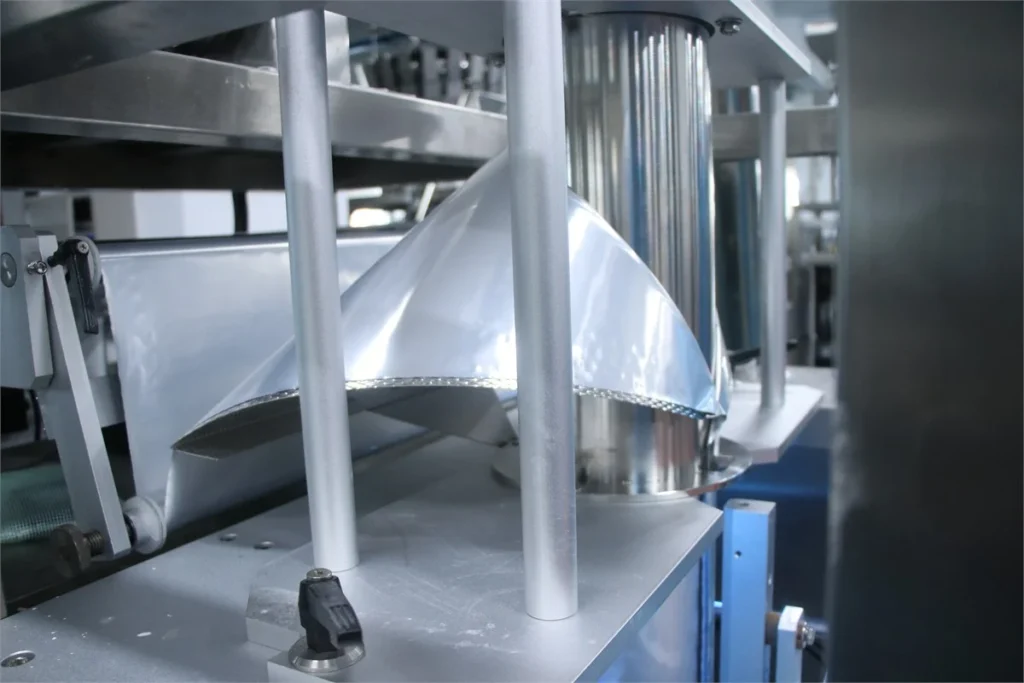
| Retail bags formed from rollstock, medium to large fill weights | Collar-type vertical form-fill-seal with screw metering | Drop height and transfer inside the forming tube; the downspout design is what links the metering domain to the sealing domain. | Very small single doses, where the forming tube and minimum film width run out. | Collar-type auger powder machine (SW-420E–820E), within the collar-type range |
| Small sachets and single servings from rollstock, back seal or three-side seal | Small-bag vertical form-fill-seal with screw metering | The dose is small, so refill disturbance and head-level change weigh proportionally more on each pack. | Large retail fill weights; coarse-and-fine mixtures carrying granules. | Back-seal auger sachet machine (SW-2030B) for back-seal sachets, and the three-side-seal vertical machine (SW-1328) |
| Multi-lane stick packs and high lane-count sachets | Multi-lane vertical form-fill-seal | Feed consistency lane by lane; lane count changes the design of the whole machine rather than a setting on it. | Multi-SKU work that changes bag style or lane count often. | Ten-lane back-seal stick machine (SW-B10) as the powder stick-pack choice, plus the six-lane three-side-seal machine and six-lane four-side-seal machine, all in the vertical packing machine range |
Our six-lane machines meter by volume (5–30 ml) and suit free-flowing powders; the ten-lane back-seal machine meters by weight and its metering range changes with the change parts fitted. Which feed a given lane count gets is confirmed against your powder, not assumed from the model number. Fill weights, output and bag dimensions live on the machine pages above.
Is it difficult to switch between different bag sizes?
The difficulty is rarely the bag — it is the powder. Changeover downtime is set by screw removal, hopper access, seals, agitator, ductwork and forming tube, all of which have to be cleaned before a different product runs.
Cost it as the saleable output lost, plus labour and utilities — not a stopwatch figure from a brochure. Ask any supplier to time a full changeover in front of you, and to show what they check for residue afterwards; our factory acceptance test guide covers writing that into acceptance.
Where Powder Lines Actually Fail
What are the problems when operating dry powder fillers?
Automated powder packaging is a coupled problem — material flow, metering, gas management, sealing, legal metrology, hygiene and explosion protection all interacting — not a bagging machine with a hopper.
Weight drift after a refill
Arching, a falling head level, unstable agitation and refill disturbance all propagate into dose variation, even where servo repeatability is faultless. On the floor: checkweigher trend drifting off the commissioning centre, light packs when the screw starves, overshoot after someone compensates.
Stabilise the product before touching software, and commission bagger, filler and feed as one control loop. Checkweigher feedback cannot mechanically fix a hopper that swings between bridging and flooding. Head-level control is part of dose control. The diagnostic is to record the delivered weight in four phases — start, refill, pause, restart — instead of one batch average. The Four-Phase Weight Check is our own name for a published diagnostic practice, not an industry standard.
Flushing — when the powder behaves like a liquid
Flushing is not ordinary overshoot: in an aerated fine powder the resistance to flow collapses and the material behaves like a liquid, worsened by a funnel-flow silo delivering the aerated material first. The signature: accuracy at low head level, loss of control after a refill, discharge continuing after the drive stops, tailing.
Tightening servo accuracy does not cure flushing — it is a solids-gas flow problem, not a position-control problem. Restart has to be qualified separately, and a drip cut-off proven by trial on your product, not asserted from the design.
Bridging and ratholing — and why the feeder can cause them
The counter-intuitive part is that the feeder can create the bridge: drawing from part of an elongated outlet turns the hopper into funnel flow, which produces the stable arch. Operators see a level sensor reporting product while the screw runs empty, flow pulsing after a tap, a slug dropping when it collapses.
Chronic bridging is a design problem: characterise the flow behaviour first, then design hopper and feeder around it so the feeder activates the full outlet. Vibrators, air pads and agitators are application-specific aids, not a universal fix — vibration can compact, aeration can trigger flooding, and agitation changes density.
How do I control dust in a powder packing line?
Dust extraction handles powder suspended in air; de-aeration handles gas held inside the bulk material. Extraction sized to fix de-aeration removes product instead.
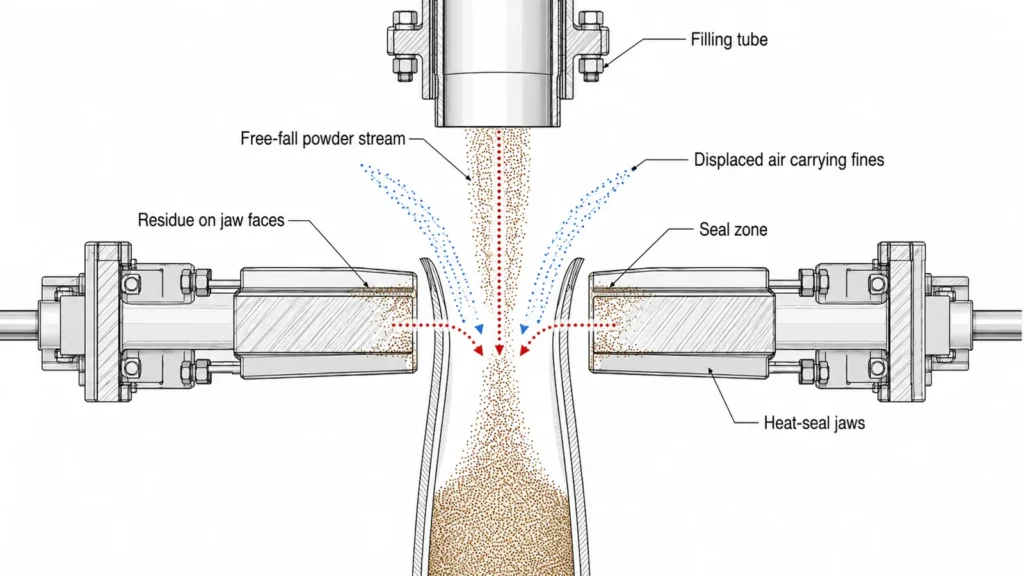
Dust reaches the seal by more than one route: long free-fall entraining air, air displaced out of the pack carrying fines back upwards, and residue on the jaws. The countermeasures have an order — reduce the drop, bring the nozzle close to or inside the pack, allow settling time, restrain the feed, balance the extraction, keep the jaws clean, then verify sealing through contamination on your film where residue is unavoidable.
More extraction is not better — the airflow must not pull away product you have just metered. Film problems must be diagnosed separately from powder problems: both present as leaking packs. Raising the jaw temperature is not a general cure — a contaminated seal behaves as sealant chemistry × contamination × pressure × temperature × dwell. Sealing method choice is covered in sealing methods and seal integrity.
Total weight right, blend wrong
A multi-component powder can pass every weight check and still be out of specification, because correct gross weight is not correct blend. Segregation happens after mixing — in conveying, vibration and storage. If you pack a blend, ask what your supplier verifies: gross weight, or the blend itself.
Hygiene, Legal Weight, and the Combustible-Dust Gate
There is no single international powder packaging standard. A real installation sits under several regimes at once — machinery safety, hygiene and food contact, explosive atmospheres, electrical area classification, legal metrology — written by different bodies for different duty holders. A law, a consensus standard and a model procedure for legal metrology are not interchangeable.
None of these four is a certificate a machine can carry — each one is a duty that sits with a different party.
| Layer | What it governs | Whose duty it is | Cited |
|---|---|---|---|
| Legal net content | The delivered distribution, not the setpoint, is what carries economic meaning. There is no universal permitted shortfall. | The filler, as the packer of a prepackaged good | NIST Handbook 133 (2026 ed.), a legal-metrology handbook that takes effect through adoption rather than as one federal law covering all goods · 21 CFR §101.7 · 16 CFR Part 500 · OIML R 87:2016 as an international reference, with local law taking precedence · the EU average-quantity regime, explained on the European Commission's Your Europe e-mark page |
| Weighing instruments | An in-line QC checkweigher is not automatically legal for trade. | The buyer, with the local legal-metrology authority | NIST Handbook 44 (2026 ed.) |
| Hygiene & food contact | Equipment must be adequately cleanable and maintainable; food-contact surfaces corrosion-resistant and non-toxic; seams minimised so material does not lodge in them. | The equipment maker and the food business operator | 21 CFR §117.40 — a regulatory requirement on the operation, not a certificate a machine carries · the FDA's Food Contact Substances authorisation framework · 3-A SSI 00-02, a voluntary standard that becomes relevant when a buyer specifies it |
| Combustible dust | Once a dust is confirmed combustible, area classification, Ex equipment, bonding and earthing, collection and inspection become project-level work. | The buyer, for site zoning and ignition control, with specialist vendors | OSHA's Combustible Dust overview · NFPA 660:2025 · 29 CFR §1910.307 (Class II locations) · IEC 60079-10-2:2026 · Directive 2014/34/EU (ATEX), summarised on the European Commission's own topic pages |
This is the layer buyers discover late. OSHA's Combustible Dust overview names sugar, spice, starch and flour among combustible dusts — what a buyer calls “just flour” is on the list. A filler cannot be area-classified in isolation: hopper, screw, dust collector, ducting, fill point, enclosure, vacuum receiver and extraction form one connected explosion system, so a combustible powder needs a project-level safety review, not a specification written from fill weight and bag size.
Once a dust is confirmed combustible, the protective measures are not a value-engineering line item. Before you talk to any supplier, get your powder's Kst, Pmax, MIE and MEC from a testing house — the parameters OSHA's overview and NFPA 660 work from, and what turns a guess into a specification. Explosion venting, suppression and isolation are a separate discipline handled by dedicated vendors, and NFPA 68 and NFPA 69 point at where that discipline starts. The zone classification for your site is determined by your own hazard assessment, not by a supplier's marketing line.
What Has to Be Measured Before Anyone Quotes a Tolerance
A demo on conditioned sample material is not shift-long evidence. Evidence means real production powder in its real condition, real refill behaviour, your actual film, the extraction you will run, a representative environment, and your intended cleaning procedure.
These are the questions that separate a demo from evidence.
| Check | What a weak answer looks like | Limitation (not a guarantee) |
|---|---|---|
| Was it real production powder? | “A similar free-flowing product.” | A shared product name is not a sufficient acceptance criterion. |
| Did the run include refills? | “The whole hopper went through in one go.” | Production failures cluster at the refill transition. |
| Was it your target film? | “Our standard film.” | Film faults must be diagnosed separately from dust faults. |
| Was extraction the real configuration? | “Extraction was off for the demo.” | Extraction balance changes the quantity delivered. |
| Was cleaning the intended procedure? | “We wiped it down.” | Without a residue acceptance criterion, a cleaning time means little. |
Per All-Fill's published guidance, the variables that have to be measured are product condition, bulk density, particle size, flow behaviour, aeration, container geometry, equipment configuration and operating technique — a datasheet supplies none. We also ask whether the sample is the material you will actually run, or a substitute.
For the run itself, use The Four-Phase Weight Check: record the delivered weight across start, refill, pause and restart rather than as a batch average, and characterise the powder loose and settled. It is our own name for a published diagnostic practice, not an industry standard.
Worth writing into acceptance: fill-weight distribution including the refill transition, give-away, powder-attributed seal rejects, film consumed outside good production, cleaning and changeover labour and lost availability, product lost to extraction, wear-part consumption, utility demand at representative operating conditions, and unplanned downtime by root cause. Define film consumption as a KPI — film reaching a good pack, separated from film lost to setup, rejects, jams and changeover — and ask for utility figures at the design point and the operating point, with their installation assumptions, not a motor nameplate. Give-away is where dosing choice turns into money, worked through in the dosing comparison. Our acceptance run is a test run across two working days, detailed in our factory acceptance test guide and run at our Shantou plant.
What we see in our own enquiry queue
Powder enquiries open with an ingredient name, and what we ask back is about its state: when it was milled, how long it has been stored, how far the moisture moves between a sealed bag and an opened one, how it reaches the hopper. The most expensive mismatch we see is not a machine that runs too slowly. It is a configuration specified from the ingredient name.
— Hellena Ji, International Sales Manager
Machine or Line? Where the Handoffs Are
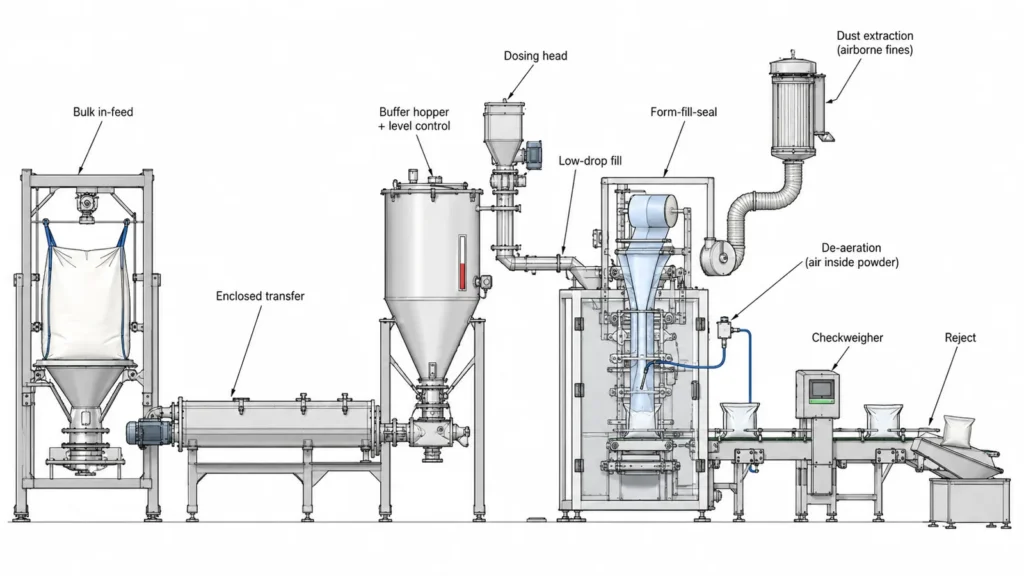
A powder line is a chain of handoffs: bulk source, conveying, conditioning or sieving, a controlled buffer hopper, metering, low-dust transfer into the pack, form / fill / seal, checkweighing and inspection, reject and segregation, downstream handling — and each arrow is where responsibility falls between suppliers.
The counter-intuitive one is upstream: pneumatic conveying can create the very density instability the metering device must then fight. For a difficult powder, the real “metering device” is the combination — hopper, agitation, feeder, tooling, gas management and control. The downspout joins the metering domain to the sealing domain; a poor transition manufactures drop height, dust plume and rebound even where metering is sound.
Seven integration points are worth naming in an enquiry, because that is where lines fail as systems: metering-to-bagger timing, hopper refill against dose consistency, extraction against metering flow, machine vibration against load cells, powder aeration against pack geometry, cleaning against mechanical complexity, and explosion isolation against whole-line connectivity. Reject logic belongs there too — it must track the pack from measuring point to reject point, and fail safe. Ask who owns each handoff, and where that boundary is written. Case packing and palletising happen after primary filling and sealing — they are a different scope, and often a different supplier.
What Actually Drives Your Quote
Powder equipment is priced by machine architecture, not by an average for “a powder machine”. We publish our own price bands by machine type in the pricing guide, with the component drivers that move a quote within a band — see price bands by machine type.
What decides which band you land in is a shorter list: how your powder behaves, the fill accuracy you need, pack format and size, automation level, integration scope, target output, and how much is customised.
Equipment MOQ and packaging or co-packing MOQ are two different objects: a machine order can be a single unit, while a printed-film minimum is a different negotiation with a different supplier. We build machines — film and pouch supply is not something we sell.
On timing: standard builds ship in 15–30 working days ex-works; deep-custom configurations run 15–45.
An enquiry that gets a serious answer contains: powder identity and behaviour; target fill quantity and tolerance; pack type and dimensions; target output; automation scope; upstream feeding; downstream sealing, inspection and end-of-line; hygiene or combustible-dust constraints; destination electrical requirements; and product and packaging samples for testing. The strongest specification is a testable system requirement, tying powder state, refill behaviour, fill distribution, seal integrity, dust containment, legal metrology, cleaning and changeover, and combustible-dust classification into criteria you can hold a supplier to. The lowest-cost metering head is not always the lowest-cost powder line — and where the product is free-flowing, low-value and repeatable by volume, a precision gravimetric system does not add value.
Three facts. Replacement parts are sent free of charge inside the two-year warranty. Acceptance runs are recorded — report, video and photos — and the run is a test run across two working days. One named contact runs the project from enquiry to shipment — Hellena Ji, International Sales Manager.
When a Dedicated Powder Line Is the Wrong Buy
Six situations where the answer is to wait:
- Your volume is a forecast, not an order book. A machine configured for a moving target serves nobody; run current orders through a co-packer until demand settles.
- What you need is a middle tier, not a line. A modest output that fits a small workshop is a real requirement that full-line quotes scare off. Ask where the bottom of our range sits.
- Your film or co-packing minimum is unsolved. A machine arriving before you have an affordable film roll is capital standing still.
- Your SKU count is ahead of your cleaning plan. The true cost of many products on one line is changeover and residue, not machine price; without a residue acceptance plan, more equipment magnifies it.
- Your dust has not been tested. Specifying explosion protection before you hold Kst, Pmax, MIE and MEC is backwards — and protection is not where a budget gets trimmed.
- It is not a powder — whole beans, a pumpable liquid, a counted tablet, or a bulk sack behind a palletiser. See the scope section.
We build powder machines, and we still tell some buyers to wait. If your volume is a forecast, your film supply is unsolved, or your dust has never been tested, we will say so — that conversation is cheaper before a deposit than after one.
Key Takeaways
- Specify the powder's behaviour, not its name — the same ingredient behaves differently after storage, transport and a change in moisture.
- The metering head is part of the metering system — hopper, refill regime, feeder and tooling decide whether it can meter at all.
- Dust reaching the seal has more than one route, and film problems must be diagnosed separately from powder problems.
- No tolerance can be quoted from a datasheet — it comes from your own powder, across start, refill and restart.
Frequently Asked Questions
How accurate are powder filling machines?
Accuracy is not a constant you can copy from a datasheet — it is a distribution. The achievable distribution depends on your powder's measured behaviour, the refill regime, and the fill weight — which is why we ask for a sample before quoting a tolerance. Record the delivered weight across start, refill, pause and restart rather than as one batch average.
What is the difference between a powder packaging machine and a powder bagging machine?
Suppliers use both loosely, so settle the scope rather than the label. A filling machine meters the dose. A packaging machine forms, handles and seals the pack. A packaging line is both plus the automation upstream and downstream. One further distinction: a feeder conveys material to the machine, while the filler decides how much goes into the pack.
Can an auger filler handle chunky or variable-density ingredients?
Variable density is the weak point of any open-loop volumetric method: the delivered mass follows the instantaneous bulk density in the metering chamber, so a powder that settles, aerates or takes up moisture shifts the weight with nothing on the machine changing. Coarse particles add segregation — a composition failure, not a weight failure. Screw against weigher metering is covered in our dosing comparison guide.
What safety features should I look for in a powder filling machine?
Start one step earlier and ask whether your dust has been tested for combustibility. Until that result exists a features list is guesswork, because the area classification for your site comes from your own hazard assessment rather than a supplier's brochure. Explosion venting, suppression and isolation are specialist scopes handled by dedicated vendors, not an option we add to a filler.
What is the best machine for industrial powder packaging?
There is no single best powder machine, because “powder packaging machine” is not a clean product category — it spans several architectures that make different packs. The pack format you sell and the way your powder behaves decide the architecture; what gets measured on your sample decides the configuration. Work through the four gates, then look at premade-bag, collar-type and vertical machines.
Do powder packaging machines need stainless steel contact surfaces?
Food-grade stainless steel is a necessary condition, not sufficient evidence of compliance. Cleanability carries as much weight as the alloy: dead spaces, seams and welds, bearing-lubricant isolation, elastomers and plastic parts, and whether the construction suits your cleaning method. Ask for a written declaration on the food-contact materials used — the FDA operates an authorisation framework for them — not the phrase “food grade”.
What lead time should I expect on a powder packing machine from China?
Plan on 15–30 working days ex-works for a standard build, and 15–45 for a deep-custom configuration. What moves you inside that window is custom tooling, how much integration sits in the supplier's scope, and whether an acceptance run is part of the order — that run has to be booked into the build, not added at the end. Our factory acceptance test guide explains how it is scheduled.
Send Three Things, Get a Machine Class
Not sure which architecture your powder points to? Send us three things you already have: what the powder is and how it behaves, your target fill weight, and the pack format you want. You get back a machine-class recommendation, an FOB price range from our published bands, and a delivery window — standard builds in 15–30 working days ex-works, deep-custom configurations in 15–45. If you can send a sample of the actual material you will run, say so — that is what a tolerance conversation has to be based on. We usually reply within one business day.
info@shengweimachine.com · +86 181 2511 2025 · talk to sales

International Sales Manager · ShengWei Machine
More: our buyer guides.