Packaging Machine Factory Acceptance Test: A Buyer's Checklist for Ordering from China

A factory acceptance test in five steps: (1) write acceptance criteria as numbers and conditions in the contract; (2) send your own product and film; (3) run it on your bag formats and log speed, seal, weight and rejects; (4) verify before the crate closes, remotely or with a third-party inspector; (5) tie the balance to the signed-off test record.
Key Takeaways
- Acceptance criteria written as numbers plus conditions go into the contract before production starts — whatever you did not write down, nobody checks.
- The test run happens on your product and film, in every format you intend to run, not on the factory's well-behaved demo material.
- Ask for the raw test log, not a "FAT passed" conclusion — the numbers on your formats, with the failures visible.
- Verify before shipment: live or recorded viewing, an independent inspector where the order justifies it, and the crate photographed before it closes.
- Tie each payment to a documented event rather than a calendar date, so leverage still exists at the moment you need it.
Quick Facts
| Our test run | Two working days, on your bag sizes and formats |
| Sign-off pack | Eight documents, digital copies sent as standard |
| Payment terms | 30% deposit, 70% before shipment, FOB Shantou |
| Samples to send | Your real product and film, in every bag format you intend to run — quantity depends on the model |
What a Factory Acceptance Test Actually Is
A factory acceptance test (FAT) is a structured run of the finished machine at the builder's works, against acceptance criteria agreed in advance, carried out before the machine is packed and shipped. Its purpose is narrow and useful: to prove, on record, that this specific machine does the specific things your purchase order says it will do — at the speed, on the formats, and with the materials you bought it for.
Two things follow from that definition and they set the tone for everything below. First, a FAT is a contract event, not a statutory one. There is no free, publicly accessible international standard that dictates what a packaging-machine FAT must contain; the definitions circulating online come from equipment makers, inspection companies and trade associations, and the standards and association work products that do exist are not freely readable in full. What binds anyone is what your contract says. Second, that makes the FAT only as good as the criteria you wrote — a point three international inspection bodies make in identical language, which we come back to in the contract section.
This matters most to the reader we wrote it for. One buyer, pricing a wrapping machine on a public forum, put the whole problem in two sentences: "I'm thinking more along the lines of $5k - $10k, and there are a few things on alibaba that fit the price, but I have no idea about the quality." Another, in the same discussion, answered flatly: "I would not purchase directly from a listing on Alibaba from an unknown supplier... attention to QA tends to be sub-par." Both are real buyers, both are reasonable, and neither is going to be argued out of that position by a supplier saying "trust us". The only answer is a procedure that produces evidence. A third, introducing himself as "a small tortilla manufacturer, looking for an automated packing solution" who found that "Chinese flow packs caught my attention!", is the same person a little further along the same road.
If you have not yet decided which machine you want — or whether you need one at all — this is the wrong page to start on. Begin with our guide to choosing the right packaging machine and come back here when you are close to placing an order.
FAT, pre-shipment inspection and SAT are three different sign-offs
These three names get used interchangeably in sales conversations, and they are not the same thing.
The FAT proves the machine works in isolation, at the factory that built it, on your materials. The pre-shipment inspection is an independent third party looking at the finished goods before they leave — model, quantity, markings, documentation, packing and, if you order it specifically, witnessing of tests. The site acceptance test (SAT) happens after delivery and proves something the FAT structurally cannot: that the machine survived transport and connects to your power, air, floor and upstream and downstream equipment. Installation, line integration and electrical handshaking are a separate discipline and a separate page; treat them as work still ahead of you, not as something the FAT covered.
There is a trap in the middle term worth naming, because buyers fall into it while searching. "Pre-shipment inspection" has two completely different meanings. Bureau Veritas describes its service as one "carried out for governments" that combines "confirmation of the buyer's specifications and quantity and value controls of imports and exports … in compliance with WTO requirements" (Bureau Veritas, government services). Intertek's page under the same URL slug says it "provides commercial services to governments as a way of protecting import revenues" (Intertek, government services). That is customs valuation and duty protection work commissioned by an importing country — not quality control commissioned by you. Two independent providers describing it in near-identical terms tells you it is the industry's standard meaning, not one company's wording. If you want someone to look at your machine, ask for a vendor / manufacturing inspection or a witnessed FAT by name.
Why the FAT carries more weight when the factory is 10,000 km away
When the builder is a two-hour drive away, a weak FAT is recoverable: you go back, you bring your engineer, you withhold a visit fee. Across an ocean, three things change at once. The cost of a return visit is measured in flights rather than fuel. The machine becomes physically hard to send back — reverse logistics on a crated machine can cost more than the machine is worth, which in practice means "returning it" is not a real option. And once the container sails, the commercial leverage you had disappears, because on standard export terms the balance is normally paid before shipment. The FAT is therefore not one checkpoint among many; for a first-time importer it is close to the last moment where evidence and money are both still on the table.
What a FAT does not prove
An honest guide has to be as clear about the limits as the benefits. A FAT does not prove the machine will survive the voyage — that is what crating checks and the sign-off package are for. It does not prove the machine fits your line, your voltage, your air supply or your operators' habits; that is the SAT. It does not prove long-term reliability, spare-parts availability or after-sales response, all of which are judged over years, not days. And it emphatically does not transfer with your payment method:
- Incoterms do not do it. ICC's own academy writes that the rules "are not a substitute for a sales contract dealing with payment and quality terms" and that "Incoterms do not deal with the passing of title in the goods" (ICC Academy). The US Department of Commerce says the same from the other side: the rules neither "reference the method nor timing of payment" nor "address liability for the failure to provide the goods in conformity with the contract of sale" (trade.gov).
- Banks do not do it. Under UCP 600 Article 5, "Banks deal with documents and not with goods, services or performance." A letter of credit pays against paper that appears to conform, not against a machine that runs.
- Platform escrow does not do it either. Marketplace protection is anchored to receipt and confirmation of the goods and to the platform's own order and payment flow — it is a payment-and-dispute layer, not a process-capability test, and it does not tell you whether the machine holds its rate on your film.
Three independent official sources, pointing the same way: the tools people assume will protect them are settlement and delivery instruments. Verification is a separate job, and it is yours to commission.
The Five Links You Actually Control
The most useful reframing we can offer is this: acceptance is not one test, it is a chain. When a cross-border machine purchase goes wrong, it usually fails at a link the buyer never realised was theirs to hold. Five links carry the load, and a buyer sitting in another country can influence every one of them by email before anything is built.
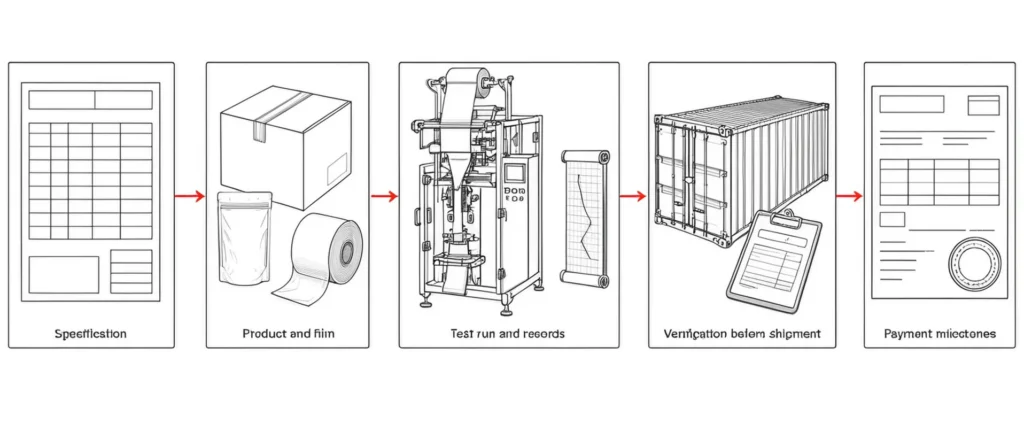
| Link | What you decide | What it produces | How it usually breaks |
|---|---|---|---|
| 1. The specification | Acceptance criteria written as numbers plus conditions, in the PI or contract, before production starts. | A document any inspector — yours or a third party's — can judge the machine against. | Criteria are adjectives. "Good seal quality" cannot be adjudicated by anyone. |
| 2. Your product and film | What you ship to the factory, how much, and which formats it must cover. | A test on your actual materials rather than a well-behaved substitute. | The run is done on the factory's free-flowing demo product, so your real behaviour never appears. |
| 3. The run and its records | How long, across which sizes, what is logged, and that you receive the raw log. | Speed, seal, weight and reject data on your formats, with the failures visible. | You are sent a conclusion — "FAT passed" — instead of the numbers behind it. |
| 4. Verification before shipment | Live or recorded viewing, whether to appoint a third party, and who checks the crate and the loading. | Independent evidence, plus a container closed under someone's observation. | The machine is verified but the packing and stuffing are not — and that is where the damage happens. |
| 5. Payment pacing | Which documented event releases which payment, agreed in writing at order stage. | Leverage that still exists at the moment you need it. | Milestones are tied to calendar dates or to shipment alone, so nothing has to be proven first. |
Notice that only link 3 is what most people mean by "the FAT". The public material on factory acceptance testing is overwhelmingly written from the supplier's side — how a builder should conduct a test — and the buyer-side execution layer, particularly for someone who cannot get on a plane, is thinly covered. That gap is the reason this page exists, and it is why the sections below are written as things you ask for, not things we promise.
Before the Machine Is Built: Acceptance Criteria in the Contract
This is the load-bearing section of the page, and the argument is not ours. Three international inspection bodies describe the source of acceptance criteria in almost identical language, and all three point at the buyer:
- SGS inspects for conformity with "technical and purchase specifications, codes, standards and other relevant contractual documents" (manufacturing inspection).
- Bureau Veritas works to "your expressed needs … and other specific requirements" (shop inspection).
- TÜV Rheinland conducts final inspection "according to the specifications you approved" (factory acceptance test).
- PMMI's OpX Leadership Network publishes its acceptance-test work products — One Voice for Acceptance Tests — on exactly this premise: that unclear criteria and mismatched expectations are what generate unbudgeted travel, rework and schedule damage.
Read together, those four say one thing: the inspector is an eye, not a brain. Whatever you did not write down, nobody checks. A project engineer on the buyer side put the consequence in blunter terms on an engineering forum in 2024 — his context was not China sourcing, which is why it carries weight here — "you'll be the fall guy for passing the equipment that clearly can't do what it was sold to do if you have no metrics to reference at FAT."
Write criteria as numbers plus conditions, never as adjectives
The test of a good acceptance clause is simple: could a stranger with a stopwatch and a scale decide whether it was met? "The seal must look good" fails that test — it is unarbitrable by any mechanism, whether that mechanism is a third-party inspector, a bank, a platform dispute team or a court. "Seal strength of at least X N/15 mm on film structure Y, at line speed Z, sampled from N consecutive bags" passes it. Every criterion you write should carry three parts:
- The number — output per minute, fill tolerance, reject rate, seal strength.
- The condition — on which product, which film structure, which bag size, at what speed, over what period. A rate achieved on one easy format is not the rate you bought.
- The signature — who on each side signs that it was met, and what happens to open items. Agree that unresolved points go on a written punch list with owners and dates, rather than being closed by the shipping deadline.
Two boundaries are worth stating explicitly. Speed and efficiency are two separate contract metrics, and a machine can hit a nominal rate while losing hours to stoppages — specify both, and specify them per format. And write the criteria in the RFQ, not after the machine exists: our machine selection guide covers the RFQ structure, and this page picks up where that leaves off. Whichever family of machine you are quoting — premade bag, collar type, vertical form-fill-seal or pillow packing — the criteria travel with the quotation, not after it.
Ship Your Product and Film First
A test run on the factory's demo material proves that the factory owns a working machine. It does not prove the machine handles your product. Powder that bridges, granules that vary in bulk density, a sauce with particulates, a film that seals in a narrower window than the one on the demo roll — these are exactly the variables a generic run hides. Industry acceptance-test guidance is consistent on this point: the test should use real production materials, or its validity is discounted.
How much to send depends on the machine, and the honest answer is that our own model pages give different quantities because the machines fill differently. They are reproduced here as written rather than averaged into a single number:
| Machine | What we ask you to ship | What comes back |
|---|---|---|
| SW-C6 six-column four-side-seal sachets |
A 500 ml liquid or 500 g powder/granule sample, plus both upper and lower rollstock film samples. | A packing test on a demo machine, video of six-lane running behaviour, recommended settings and estimated speed. |
| SW-Y200 premade-bag rotary liquid |
2–5 kg of your liquid product (or 1 L for thin liquids) plus a sample pouch. | A packing test on the actual machine, a recorded video, and recommended machine settings. |
| SW-420F collar-type liquid |
Approximately 5–10 litres of your liquid, plus your target bag size specifications. | A filling and sealing test on the actual machine, a video, and the results with recommended settings. |
Treat those as the shape of the request, not a universal rule — quantities differ by model, product viscosity and bag size, so confirm the figure for the machine you are actually quoting. The same applies to bag formats: if you are sending pre-made pouches, send the ones you intend to buy, in every size you intend to run. Our pouch types hub sets out the formats, and if you are still weighing pre-made pouches against forming your own bags inline, our premade bag versus VFFS comparison covers that decision.
The film matters as much as the product
Sealing behaviour is a property of your film, not of the machine — the sealing window a laminate tolerates is not the window a recyclable mono-material tolerates, and a machine tuned on one will not simply run the other. Send the film you will buy, from the roll you will buy it from, and ask for the sealing settings that were used. Our bag sealing methods guide covers how those seals form and how they fail; this page only asks that the trial happen on the real material.
ShengWei's standing offer is the one on our Factory & Quality Center page: schedule a factory tour, request a video call walkthrough, or send us your product samples for a free trial run on our machines. On the paperwork side, mark sample shipments clearly as non-commercial samples with a composition statement — it keeps the parcel moving and is separate from the machine's own import documentation.
The Test Run: Two Working Days on Your Bag Sizes
ShengWei's standard acceptance run is a test run across two working days on your bag sizes and formats, with speed, seal quality, weight accuracy and rejection rate all logged. That is our own practice, published so you can hold us to it — not an industry rule, and we are not going to dress it up as one.
Because the honest position on duration is that there is no standard. The publicly checkable figures come from trade publications framing them as recommendations, and the packaging OEMs who write about FAT on their own sites deliberately avoid quantifying at all, preferring phrases like "an extended period at production speed". So the question worth asking a supplier is not "how many hours do you run?" — any number is easy to say — but "what run duration and which formats are written into my contract, and what do I get if it isn't met?" Duration is a variable you specify, not a property of the machine.

Why a five-minute demo proves nothing
A short demonstration is a sales artefact. It shows a machine that has been set up, warmed up and fed by the person who built it, on the format that runs best. Almost everything that will actually cost you money appears later: film tracking drifting as a roll runs down, seal temperature climbing as the jaws heat-soak, the dosing head losing accuracy as the hopper empties, the changeover that takes forty minutes instead of ten. As one general manager at a US equipment maker wrote in a published white paper on acceptance testing, "Machinery that is powered up for the first time never works properly. Both mechanical and electrical failures are very common." That is not a slight on any builder — it is why the run exists. A test long enough to reach the second and third failure is worth more than a test long enough to reach the first success.
Two extensions are worth writing into the criteria. Ask that the run is split across the formats you bought, not concentrated on the easiest one — for us that is standard, since the test covers your bag sizes and formats, but it is not something to assume elsewhere and it costs nothing to specify. And ask what happens before the product run: running a machine unloaded first is a recognised way to flush out early-life mechanical and electrical faults, so whether a dry cycle precedes your test, and for how long, is a fair question at quotation stage.
The four numbers to log — and the fault behaviour nobody logs
Our four logged values are speed, seal quality, weight accuracy and rejection rate. Those are the right four to start from, and each is covered in the next section. But an acceptance run that only records good-state numbers tells you nothing about the machine's behaviour when something goes wrong, which is most of what an operator experiences on a night shift. Ask the builder to demonstrate — and to note in the record — how the machine handles:
- Film break or film run-out mid-cycle: does it stop cleanly, and how much material is lost?
- No-product or low-level alarm: does it stop filling, or does it keep making empty bags?
- A feed jam at the dosing head: how is it cleared, and by whom, and how long does it take?
- Emergency stop and restart: after an e-stop, are part-formed bags or part-filled doses lost, and does the machine resume in a known state?
- Registration mark loss on printed film: does it flag the fault or keep sealing through the print?
- Guard and interlock behaviour: doors opened during operation, guard interlocks, and what the record says about each.
Ask for the raw record, not the conclusion
"FAT passed" is not evidence; it is somebody's opinion about evidence. What you want is the log — the counted output over the recorded period, the individual weight readings rather than a stated average, the number of rejects with the time they occurred, and the settings the machine was running when each was taken. A raw record lets you see the pattern that a summary hides: whether the rejects were three at start-up or scattered evenly through the run, whether weight drifted in one direction, whether the rate was held or averaged. Agree at order stage that you receive the record itself, and agree who signs it.
Watching Remotely: What to Ask to See
Start with the failure mode rather than the technique, because the most useful thing said publicly about video acceptance was said by someone cleaning up after it. Describing equipment problems that reached his plant, a maintenance professional wrote in 2025: "These things could have been caught, but the team dropped the ball on FAT and just allowed video sign-off." He then gave the constructive half, which matters more: "vet vet vet. You can get quality from china, but throwing a dart is not the way. Find a reference, ask to see one running in the US, etc."
Read the whole comment and the lesson is precise. The problem was not that video was used. The problem was that video was allowed to replace the acceptance work rather than to document it. So the real question for a buyer who cannot travel is not "is video good enough?" but "at what point does signing off on video become the same as not verifying at all?"
The industry does not agree with itself — and that is useful to know
Three honest data points, pulled in different directions:
- Several premium international OEMs now publicise live remote factory acceptance tests as a formal service, with multiple camera angles, high-resolution close-ups and HMI screen sharing, and treat the recording as part of the acceptance documentation. The capability is real and it is not exotic.
- PMMI's 2024 study of remote services (144 end users and 36 OEMs) found that end users still consider FAT, commissioning and initial training better done in person, and that virtual FATs skew toward repeat purchases or simpler equipment such as conveyors. A packaging machine is not a conveyor — that finding does not flatter our position, and we would rather you had it.
- A remote FAT tends to push some performance checks downstream into the SAT, at your own plant, where problems are more expensive to fix. If you accept a remote test, accept that shift knowingly and write the retained checks into the contract.
The most balanced framing we have seen comes from a buyer-side engineering executive. Lisa Rathburn, Vice President of Engineering at T. Marzetti Company, speaking on a PMMI podcast in 2022, said "the way we did FATs in the past wasn't working" — and immediately made clear she meant the method needed updating, not that attendance had been abolished: "I'm happy to see this tool get revised this year to kind of get refreshed and updated and incorporate a lot of what was in an amendment during COVID on how to do virtual FATs." (PMMI unPACKed, Episode 83.)
What to ask to see
These are requests you can make of any supplier, ours included. None of them require special equipment; they require willingness.
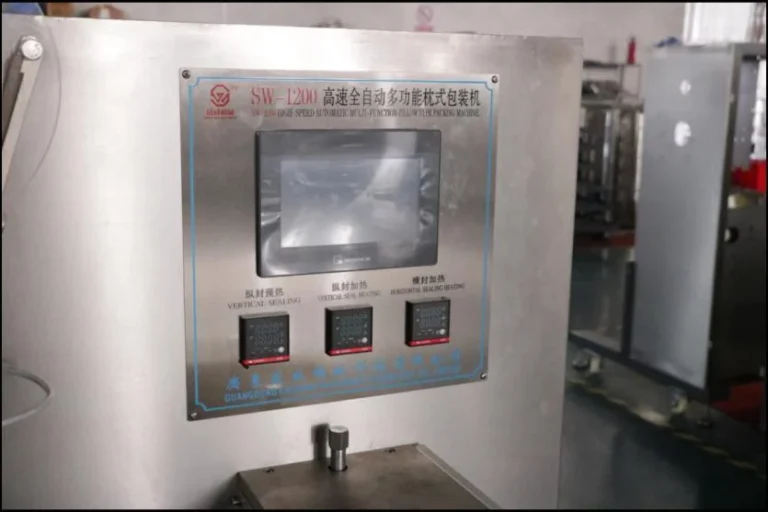
- The machine's identity, in the same view as the machine running. Ask the camera to move from the rating plate — model, serial number, voltage, phases — to the machine in motion without cutting. That single continuous move is what ties the footage to the unit you are buying.
- The operating screen and its numbers. Ask for the parameter page and the output counter to be readable, and ask what each setpoint is. If the supplier can share the screen live, better.
- The scale. Ask for filled bags to be weighed on camera, and for the reading to be legible, not narrated.
- Continuous rather than edited footage for at least one full sequence — including a changeover, a roll change, and the fault behaviour listed above. An edited highlight reel proves the machine can do a thing once; a continuous segment proves it keeps doing it.
- A live call in which you direct the camera. Recorded video answers questions the factory chose; a live call answers yours. Ask for something specific to be changed — a different bag size, a different speed — while you watch.
- Program identity recorded at sign-off. A systems integrator, describing a job he had been hired to do, wrote that after a customer witnessed and signed a test with "code checksums were recorded, the whole works", the controls engineer began editing the HMI and PLC code once the customer left — which, in his words, "invalidated my entire FAT." The defensible answer is procedural: ask for the program version or checksum to be recorded in the acceptance document, and verify it again after delivery. That is a reasonable request to any builder, including us.
Live viewing and recorded footage prove different things, and it is worth being deliberate about which you are buying. A recording is durable evidence you can re-watch and attach to a dispute. A live call is unrehearsed and lets you steer. If you can only have one, take the live call for the acceptance decision and the recording for the file — and if you can have both, that is what a well-run remote acceptance looks like.
Reading the Numbers: What "Passed" Should Mean
Four values get logged. Each of them means nothing until you know how it was measured.
Weight accuracy — borrow the rule your own market will judge you by
There is no public standard defining how a packaging machine's fill accuracy should be judged at a factory acceptance test. There is, however, a mature international framework for judging the packages themselves once you sell them: OIML R 87, the recommendation on the quantity of product in prepackages, used as the basis of legal metrology systems in many markets.
This next part is our own derivation and we want that stated plainly. R 87 is about prepackages, not machines; it does not mention factory acceptance testing, and nothing here means any machine "complies with R 87" — that would be a category error, since compliance attaches to the packs you sell, not to the equipment. What R 87 gives a buyer is a ready-made shape for a fill-accuracy criterion, on the logic that a machine has to be capable of producing packs that are lawful in your destination market. Its structure has three conditions that must hold together:
- The average. "The average actual quantity … shall be at least equal to the nominal quantity." An average below declared weight fails, regardless of how tight the spread is.
- The tolerated shortfalls. No more than a small proportion of packs — "no more than 2.5 % of packages having T1 errors" — may fall short by more than the tolerable deficiency for that nominal quantity, which is read from a table.
- The absolute floor. "No prepackage shall have a T2 error." One pack short by twice the tolerable deficiency fails the lot outright.
Two further details make it operational: the sampling size comes from a table rather than from intuition, and the inspection lot is defined so that "the size of the inspection lot shall be equal to the maximum hourly output of the production line". Translate that into acceptance questions and you get something an inspector can actually execute: how many bags were sampled, were they taken at random or selected, and what were the average, the number of packs outside tolerance, and the single worst bag? Check what your own destination market's legal metrology system requires before fixing the numbers — national implementations differ, and we are not going to tell you what your regulator says.
Reject rate — always ask what the denominator is
A reject rate is a fraction, and almost all the argument is in the bottom half. Is the denominator total bags produced, or output during the elapsed test time? Does it include start-up waste, the bags lost during adjustment, and the material consumed at changeover — or does the count start once the machine has settled? Both conventions are defensible and they produce very different-looking numbers, which is why the figure alone is meaningless. Agree the definition in the contract, and agree that changeovers and start-ups are included if your real production scenario includes them.
Speed and seal
Speed should be verified as a sustained rate on each format, not a peak observed briefly on the easiest one, and it should be recorded alongside the efficiency figure — a machine that hits the rate but stops frequently has met one criterion and failed the other. On seals, resist the urge to invent a number: there is no publicly established quantitative seal criterion for packaging-machine acceptance testing, so specify a test method and a threshold appropriate to your own film and product, and require sample bags from the run to be retained and sent to you. Our guide to seal strength versus seal integrity explains which test finds which defect. If your accuracy concern is really about the dosing system rather than the machine frame, our weigher versus auger comparison covers what each method can and cannot hold.
The Sign-Off Package: What You Should Receive
When buyers who have already imported equipment talk about what went wrong, the recurring theme is not the machine failing to run. It is the documents and the parts. "Documentation is usually non-existent", wrote one; "buy one that you can maintain and modify, and that has documentation in appropriate languages", wrote another. The sign-off package is where that risk is either closed or left open, and it closes before the crate does.
ShengWei supplies all eight of the following with every machine. Digital copies are sent whether or not you ask for them, and an engineer and a salesperson walk you through them.
| Document / item | Why it matters after delivery | What to check on receipt |
|---|---|---|
| Electrical drawings | Your local electrician works from these; without them, any fault becomes an investigation. | Do the drawings match the panel as built, and are the component labels legible and consistent? |
| PLC parameter backup | Lets settings be restored, and lets a future integrator see what was configured. | Which software and version reads the file? Ask that the acceptance record notes the program version in use. |
| Operation manual | Operator training and daily reference. | English is standard; other languages are available — confirm your language at order stage, not after. |
| Spare parts package | The first wear parts you need should already be in the country. | Check the packed items against the written list, item by item, and keep the list. |
| CE declaration | Part of the machine's document set for import and for your own records. | Does the document identify the machine model actually shipped? |
| QC report | The logged evidence from the test run. | Are the raw numbers there, on your formats, or only a conclusion? |
| Test video | Durable record of the machine running your product before shipment. | Does it show your bag sizes, and the rating plate on the same machine? |
| Packing photos | Proof of condition and of how the machine was secured for transport. | Machine in the crate, bracing visible, markings readable. |
Can your own people take the machine over?
This is the question experienced buyers ask that first-time buyers forget. One maintenance engineer's assessment of Chinese-built packaging equipment is worth quoting in full because it is neither hostile nor promotional: "The HMI and controllers they come with are largely combinations of Siemens, so the controllers themselves rarely need to be replaced, just rewritten" — adding that builders tend to "make them exceedingly generic", and advising buyers to "budget the extra money for the controls in your purchase and you'll have an easily maintainable machine." He also flagged the practical North American detail that motors may need 60 Hz variants and transformers may need changing.
That is a fair description of the real work. Our machines use a Siemens HMI and a brand-name PLC, which is why that assessment is relevant rather than flattering — the platform is one your local integrator can work with. What you should ask any supplier is concrete: what is in the parameter backup, what documentation comes with the program, and what voltage and frequency the machine is configured for. Ask it at quotation stage, and get the answer in writing.
Crating and marking — an insurance question, not an aesthetic one
Buyers underrate this step because it feels like packing. It is not. Standard cargo insurance wording excludes "loss damage or expense caused by insufficiency or unsuitability of packing or preparation of the subject-matter insured" — the exclusion in the Institute Cargo Clauses (A), 1/1/82, clause 4.3, whose wording extends to stowage in a container or liftvan. In plain terms: if the machine is damaged because it was badly packed or badly stowed, that can be exactly the loss your policy does not pay.
What that looks like when it goes wrong is not hypothetical. A buyer described receiving a machine ordered online: "I ordered a dough sheeter for my business… open trailer bed with no packaging whatsoever… completely broken machine and I'm out almost 3k." That was a small, low-value machine on a different trade lane — but the mechanism generalises perfectly.
So the crate belongs in the pre-shipment sign-off, not the post-delivery complaint. Ours are fumigation-free wooden crates: each machine is wrapped in protective film, bolted to a wooden pallet, and sealed in a fumigation-free plywood crate. Ask for photographs of the machine inside the crate before it closes, and of the markings. Ask, separately, about the container: international inspection bodies treat loading as its own service — checking "the stowing, fastening and wedging on the means of transport", and in Intertek's case sealing the container with its own seals as proof of compliance (container loading inspection). That is also your protection against the machine that passed the test not being the machine in the box.
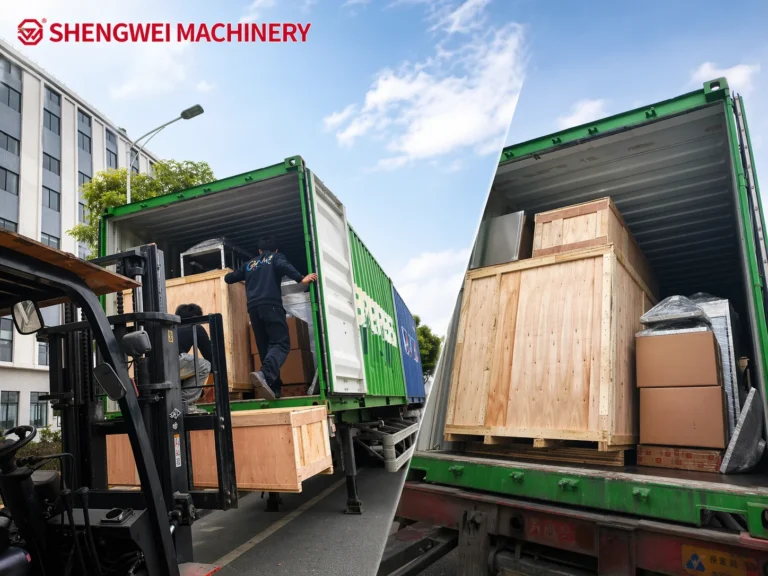
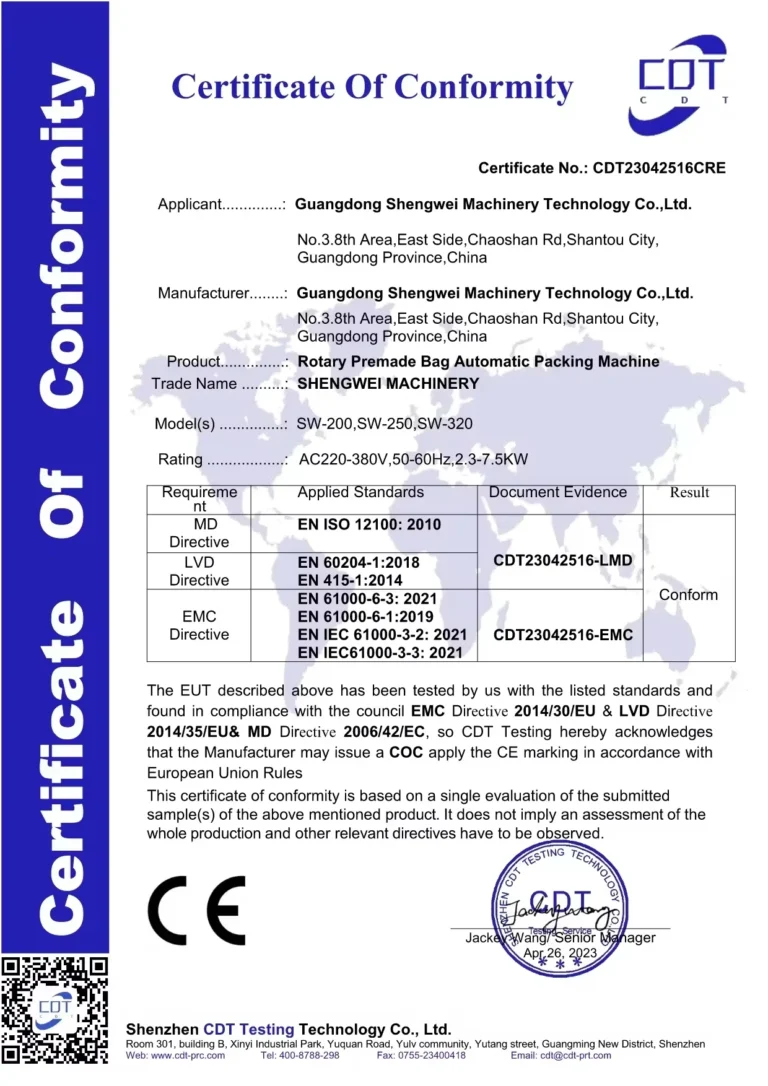
Two final items belong to this stage. Get the warranty terms in writing before the balance is paid — ours are a 2-year warranty on electrical and mechanical components, excluding wear parts like sealing jaws and heating elements. And keep the document set together: our core machine lines hold valid CE certificates, and the certificate is part of the file you will want when your own inspector, insurer or customs broker asks.
Third-Party Inspection: When It's Worth It
ShengWei's position on this is simple: you are welcome to arrange an SGS, Bureau Veritas or TÜV pre-shipment inspection. We coordinate scheduling and provide full access to the machine and test records. We also send FAT videos and photos for remote inspection if you prefer. A supplier who resists an independent inspector is telling you something; a supplier who arranges one is not doing you a favour, they are doing the normal thing.
What an inspection actually buys you, though, is narrower than most buyers assume, and worth understanding before you spend the money.
Witnessing is the default; performing is a separate order
SGS states the option pair explicitly on its factory acceptance test page: "we have the trusted skills and resources to perform reliable testing. Alternatively, we can witness appropriate testing on your behalf" (SGS FAT). Most standard inspection products are the second one — an inspector attends and records what happened against your checklist. Of the nine service items on a typical pre-shipment inspection scope, only two touch whether the machine actually runs; the rest are appearance, quantity, dimensions, documents, packing and loading. If you want the machine put through its paces rather than observed, say so, and order it by name.
Their criteria, again, come from you. An inspector without your acceptance criteria has nothing to compare against and will default to a generic checklist — which is how buyers end up with a clean report on a machine that cannot do the job.
How to actually commission one
Read across the four firms' own service pages and a workable buyer-side sequence emerges: get your acceptance criteria written down first; pick the right service name (vendor inspection, manufacturing inspection or witnessed FAT — not government pre-shipment inspection); request a quotation; agree a date with the factory; tell the factory what the inspector needs made available; have the inspection performed with a channel open to you during it; receive the report; tie the report to a payment or release milestone; and treat container loading as a second, separate attendance. Note also that inspection results can be attached to commercial instruments — Intertek describes ensuring quantity and quality specifications "as per Purchase Orders and Letters of Credit", which is the mechanism by which a report becomes leverage rather than just a PDF.
When it is worth the money — and its limits
An independent inspection earns its cost when the order is large relative to your business, when the machine is heavily customised, when you have no prior relationship with the supplier, or when your own criteria are detailed enough for a stranger to execute. It adds less when you have bought from the supplier before, when the build is a standard model, and when you are already receiving raw test records plus live viewing on your own product.
On cost, we deliberately give no figures. All four major firms publish no prices at all — every one of them runs on a quote-then-schedule basis, so any "$X per man-day" number you find online is somebody else's pricing model, not theirs. Ask for a quotation. And keep the boundary clear: an inspection report is evidence that specified checks were performed on a date. It is not a guarantee of the machine's performance, and we would not want you to read it as one.
Payment Milestones Tied to Acceptance
ShengWei's standard terms are published and unremarkable for this trade: 30% deposit, 70% balance before shipment (T/T), FOB Shantou, with a factory acceptance test included. Lead time on standard configurations is 15–30 working days, with custom configurations adding 5–10 days.
Now the part most supplier pages leave out. Under a structure where the balance falls due before the goods move, the US Department of Commerce's own assessment of advance payment is that "the exporter is exposed to virtually no risk as the burden of risk is placed almost completely on the importer", and that "requiring payment in advance is the least attractive option for the buyer" (trade.gov). We are not going to pretend otherwise. The practical consequence is the reason this whole page exists: in a deposit-and-balance structure, the acceptance test is very nearly the only leverage a buyer has left, and it exists for a short window. Everything you did not write into the criteria, and every record you did not ask for, is leverage you spent without noticing.
What the payment instruments do and do not cover
It is worth repeating the three official positions from the top of this page in the payment context, because this is where they bite:
- Incoterms allocate delivery, risk and cost — not payment timing, not title, not conformity. Which means the payment schedule is a blank space in your contract that you and the supplier fill in freely. Nothing in the trade term stops you agreeing that a particular payment follows a particular documented event.
- A letter of credit pays against documents. UCP 600 Article 5 is explicit that banks deal with documents, not performance. An L/C can, however, require an inspection certificate among those documents — which is how a third-party report acquires financial force.
- Marketplace protection follows the marketplace's own rails. Escrow-style protection is released after the product is received and confirmed, and is enforced on the basis of the platform's online order and online payment. A direct bank transfer to a supplier's company account — the normal arrangement for machinery, and ours — sits structurally outside that scheme. That is a difference between two transaction structures, not an accusation against either, and it is precisely why documented acceptance and, where you want it, third-party inspection matter more in our lane than in a consumer-goods lane.
One practical warning if you are relying on platform protection: the platforms' own pages state different claim windows — one says 30 days after delivery, another says 15 days — so check the current terms on your own order rather than on a guide page, including this one.
What to negotiate, honestly
Buyers do structure payments differently. One described his own arrangement plainly: "It was a little scary wiring money to a bank in china.. but a deposit was made then a payment when it ships and another on delivery." Note that he gave no percentages — he was describing trigger points, not a split. That is the right instinct, and it is what we would encourage you to negotiate on: which documented event releases which payment.
We will not pretend his terms are ours. Our published terms settle the balance before shipment, and that is a real difference between what one buyer negotiated somewhere and what we publish here — you should judge that difference with your eyes open rather than have it smoothed over. What we will say is that there is no published, verifiable "industry standard" split for cross-border machinery payments; any page quoting one is quoting itself. Ask for the trigger events to be written down, ask for the evidence attached to each, and treat the percentages as a commercial negotiation rather than a rule. For where the money actually goes in a machine quotation — and which costs tend to surface late — see our packaging machine price guide. Ocean freight, insurance and customs clearance are a separate subject from acceptance and we deliberately do not cover them here.
Factory or Trading Company: Five Things a Real Factory Can Do on Camera
This deserves a section, not a page. In the buyer discussions we studied, "are you a factory?" was a much less common anxiety than "will I get a machine that works, with the documents and parts to keep it running". Still, it is a fair question, and it has a practical answer that does not require anyone to be accused of anything. A trading company is not a fraud; it is a different business with different capabilities. The distinction only matters because of what you will need after delivery.
The framing we prefer comes from a buyer, not from us. Someone who described roughly fifteen years of overseas contract-manufacturing and factory-audit experience wrote that "there are good and bad factories on every continent, and China unfairly gets a bad rap", adding that his own experience dealing with Chinese suppliers had been overwhelmingly positive. That is the right level of generalisation: judge the specific supplier, on evidence, using tests they either can or cannot pass.
Five requests, all answerable on a video call:
- Start the exact model you are buying, and run it. Not a similar model, not a photo — this model, in this building, now. If your samples are already there, run those.
- Walk from the machine to where its parts are made. Ask the camera to travel, without cutting, from the assembly area to the cutting and machining shop. A builder makes structural parts; a reseller shows you a warehouse.
- Open the electrical cabinet, then hand over the drawings. Ask to see inside the panel on camera and ask, in the same conversation, for the electrical drawings and the PLC parameter backup as deliverables. A factory can commit to both because it built both.
- Accept a third party into the building on a date you choose. Not "we can arrange an inspection" in general — a specific willingness to have an inspector attend on a date you name.
- Match the paperwork to the place. The invoicing entity, the factory address, and the machine's rating plate should be consistent with each other and with the proforma invoice. Ask for the machine's nameplate to be checked against the PI, item by item, and photographed.
Add to that the advice quoted in the remote-viewing section above: find a reference, and if you can, see one running in your own country. It remains the single highest-value check a buyer can make, and it costs nothing but time. ShengWei is a manufacturer rather than a trading house, with our own laser cutting and CNC machining — the workshops, the production lines and the component brands are documented on our Factory & Quality Center page and the company itself on About Us, and we would rather you tested those claims than took them.
The Buyer-Side FAT Checklist
The advice a buyer-side project engineer gave for running an acceptance test is the most practical sentence in this whole subject: "bring a copy, and go line by line verifying the equipment meets what was specified." That is what this table is for. Take it into the call.
| Stage | What you do | The test of "done" |
|---|---|---|
| Before the order | Write acceptance criteria as numbers plus conditions; specify run duration and which formats it covers; name who signs; agree the punch-list mechanism. | A stranger with a stopwatch and a scale could decide whether each criterion was met. |
| Before the build | Ship your product and film in the quantity the supplier specifies for that model, plus every bag format you intend to run. | The factory has your real materials, not a substitute, for every format on the order. |
| Setting the run | Confirm the run is split across formats; ask whether a dry cycle precedes it; agree the fault scenarios to be demonstrated and recorded. | The test plan is in writing and includes behaviour under fault, not only under normal running. |
| During the test | Live call with the camera directed by you: rating plate to running machine in one continuous move, operating screen readable, bags weighed on camera, one uninterrupted sequence including a changeover. | You have seen the machine's identity, its settings and its output in the same session, unedited. |
| Reading the result | Request the raw log, not a summary: sampled weights, sample count and selection method, rejects with timestamps, sustained rate per format, and the settings in use. | You can see the pattern of failures, not just a pass statement. |
| Before crating | Collect all eight documents; check drawings against the panel; check the spare-parts list against the crate; record the program version; photograph the nameplate against the PI. | Nothing on the document list is "to follow". |
| Crating and loading | Photographs of the machine in the crate before it closes, of bracing and of markings; treat container stuffing as a separate check, with seals if a third party attends. | The condition and identity of the goods are documented at the moment they leave your control. |
| Payment | Each milestone tied to a documented event agreed at order stage; inspection certificate named as a document if an L/C is used. | No payment is released against a calendar date alone. |
| After delivery | Re-verify the program version against the acceptance record; check voltage, frequency and transformer requirements; confirm spare parts and manual language on arrival. | The machine you accepted is the machine you unpacked. |
How ShengWei Runs FAT
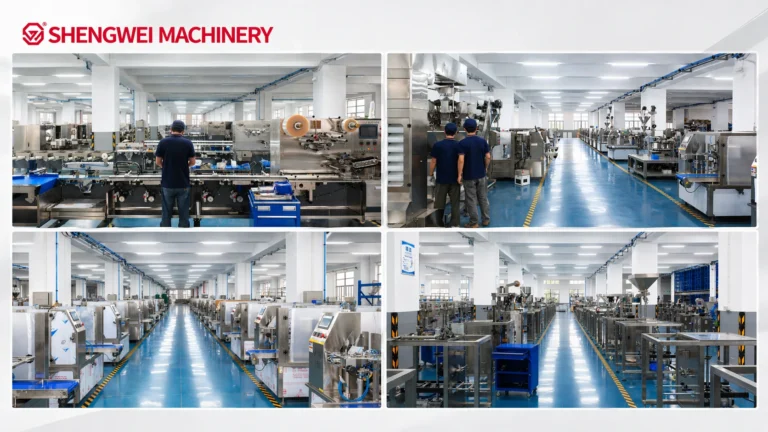
Short version, because the detail belongs on the page built for it. Our 4-person QC team runs every machine through a structured Factory Acceptance Test before crating. No machine leaves without passing — period. The acceptance run is a test run across two working days on your bag sizes and formats, with speed, seal quality, weight accuracy and rejection rate all logged; the QC report, test video and photos are sent to you for approval before crating; and the machine is packed in a fumigation-free wooden crate for export.
After delivery, two things are worth knowing in their specific form rather than as a slogan. If an item is missing from the shipment, we send it. And remote video support via WhatsApp is always free — it is not limited to the warranty period, and it is the channel most problems are actually solved through, because a live view of your machine beats a paragraph of description. The warranty itself covers electrical and mechanical components for two years, excluding wear parts like sealing jaws and heating elements.
The full quality-control sequence — incoming inspection, in-process checks, the machine FAT and final sign-off — plus the workshops, the production lines and the component brands we build with, are documented on the Factory & Quality Center page. If you would rather talk to a person than read another page, our contact page reaches the engineering and sales team directly.
Frequently Asked Questions
These are the questions buyers ask before they wire money. One coffee roaster's version of it, posted publicly, was simply: "Has anyone had any luck with Bag Filling Machines or Grinders from Alibaba?" — followed by the reply that "Alibaba is for veterans of importing from China... Take your time and ask lots of questions." The answers below are the questions we think are worth asking.
What is a factory acceptance test (FAT) protocol?
A FAT protocol is the written document that defines how the machine will be tested at the builder's works before shipment: what is measured, on which materials and formats, for how long, what result counts as a pass, and who signs. It is a contractual document rather than a regulatory one — no freely available international standard dictates its contents for packaging machinery — so its usefulness depends entirely on how specifically the buyer wrote it. A protocol made of adjectives cannot be adjudicated by anyone; one made of numbers with stated conditions can.
What is a factory acceptance test (FAT) checklist?
It is the line-by-line list used during the test to confirm the machine meets what was specified. A buyer-side checklist covers four groups: the criteria agreed before the order, the test setup (your product, your film, your formats), the readings taken during the run, and the documents and packing checked before crating. A checklist someone else wrote is a starting point, not a substitute for your own criteria. The buyer-side checklist on this page, in the checklist section above, is laid out stage by stage so you can take it into the call.
What happens during a factory acceptance test?
The finished machine is run at the factory against the agreed criteria and the results are recorded. At ShengWei that means a test run across two working days on your bag sizes and formats, with speed, seal quality, weight accuracy and rejection rate all logged, followed by a QC report, test video and photos sent to you for approval before crating. A well-run test also demonstrates fault behaviour — film break, no-product alarm, feed jam, emergency stop and restart — because that is what an operator meets on a night shift.
How long should the run test be?
There is no industry standard duration, and any supplier quoting one as a standard is quoting themselves. The figures that circulate publicly come from trade guidance rather than from any regulation, and several equipment makers deliberately decline to quantify it at all. The right question is what duration and which formats are written into your contract, and what happens if the result is not met. For reference, ShengWei's own practice is a test run across two working days on your bag sizes and formats — that is our commitment, not a rule for the industry.
What should I send the factory for a trial run, and how much?
Send the real product and the real film, in every bag format you intend to run. The quantity depends on the machine: our six-column four-side-seal machine asks for a 500 ml liquid or 500 g powder or granule sample plus both upper and lower film samples; our premade-bag liquid machine asks for 2 to 5 kg of liquid, or 1 litre for thin liquids, plus a sample pouch; our collar-type liquid machine asks for roughly 5 to 10 litres plus your target bag size specification. Confirm the figure for the model you are quoting rather than assuming one number covers all machines, and mark the parcel as a non-commercial sample with a composition statement.
If the factory already runs a FAT, do I still need a third-party inspection?
Not always. An independent inspection is most worth its cost when the order is large relative to your business, when the machine is heavily customised, when you have no history with the supplier, or when your criteria are detailed enough for a stranger to execute. It adds less when you are buying a standard model from a supplier you have used before and you are already receiving raw test records plus a live call on your own product. Note that most standard inspection products witness testing rather than perform it, and that an inspection report is evidence that specified checks were done on a date, not a guarantee of machine performance.
Can I ask to watch the test run over video instead of flying out?
Yes, and many buyers do — but ask for the right things. A continuous move from the machine's rating plate to the machine running, the operating screen and counter readable, filled bags weighed on camera, and at least one uninterrupted sequence including a changeover are worth more than an edited highlight film. Prefer a live call for the acceptance decision, since you can direct the camera and ask for a setting to be changed while you watch, and keep a recording for your file. Be aware that remote acceptance tends to push some performance checks to your own site, so write down which checks you are retaining.
What documents should I get before the machine is crated?
Eight, and ShengWei supplies all of them: electrical drawings, PLC parameter backup, operation manual, spare parts package, CE declaration, QC report, test video and packing photos. Digital copies are sent whether or not you ask. English manuals are standard and other languages are available, so confirm your language at order stage. Check the drawings against the panel as built, the spare-parts list against the crate, and ask that the program version in use be noted in the acceptance record so you can verify it again after delivery.
I found machines on Alibaba in my budget — how do I check the quality before paying?
Do it in the order the money moves. Before you pay a deposit, write acceptance criteria as numbers with conditions into the proforma invoice. Before the build, send your own product and film. Before the balance, insist on the raw test log rather than a pass statement, a live call where you direct the camera, and photographs of the crate before it closes — and consider an independent inspector if the order is significant relative to your business. Ask for a reference in your own country and call them. Every one of those steps is available to a buyer who never leaves home, and together they replace trust with evidence.
If the payment terms are 30% deposit and 70% before shipment, what leverage do I actually have?
Your leverage is the acceptance test, and it exists only in the window before the balance is released. Trade terms such as FOB do not govern payment timing, title or conformity, and banks under a letter of credit deal with documents rather than performance — which means the payment schedule is a blank space you and the supplier fill in by agreement. Use it: tie each milestone to a documented event rather than a calendar date, name the inspection certificate as a required document if you use an L/C, and make sure the criteria you wrote are specific enough that "met" is not a matter of opinion.
Send Us Your Acceptance Criteria — We'll Quote Against Them
Tell us the product, the film structure, the bag formats and sizes you need to run, your target output, and the fill tolerance and reject rate you want written into the contract. We will come back with the machine that fits, the acceptance criteria we can commit to in the proforma invoice, what to ship for a trial run on that model, and how the test and sign-off package will work for your order. If you would rather start by watching a machine run, ask for a video call walkthrough.
info@shengweimachine.com · +86 181 2511 2025 · or contact our engineering team directly

International Sales Manager · ShengWei Machine