
Quality
CE Certified
Source
Factory Direct · Guangdong
Customization
OEM · Voltage · Language
After-Sales
2-Year Warranty · Lifetime Remote Support
Start with how the dose is measured
For a free-flowing solid, the first thing to settle is not the bag and not the output figure — it is the metering device. That one choice decides which machines are even candidates, how much of the machine price is measuring hardware rather than film handling, and how much of your operator's day goes into checking packs. ShengWei builds three metering mechanisms for solids that pour: a weigher that settles the charge on a scale, a volumetric cup that repeats a volume, and a pendular head that swings a fixed volume across. Each card below opens that machine's own page, where the specifications, the component list, the photos and the video live.
Weighed dosing — the grams are settled before the bag sees the product
Weighing earns its cost when the pieces are not identical to each other. Nuts, dried fruit, trail mix, frozen pieces, pet food and small hardware vary in shape, size and density, so a fixed volume of them is not a fixed weight from one pack to the next. A weigher removes that variation before the product reaches the bag: each head or channel holds a part-charge on its own load cell, the controller adds up the combination that lands closest to the declared weight, and only that combination is released. Three machines carry a weigher, and the real difference between them is how much weighing hardware the job actually needs.
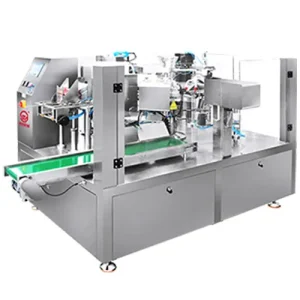
SW-D200 / D250 / D320
Granule Packing
The route to take when the printed pouch is already bought in and no two handfuls of the product weigh the same. A combination weigher settles the charge first; the machine only has to open the bag your bag supplier made, fill it and close it. Sticky material can be run on a linear weigher instead.
SW-420A / 620A / 820A
Multi-Head Combination Weigher
Same weighing logic, except the pack is now made on the line: the weigher releases its settled charge into a tube that was a roll of film a moment earlier. This is where buyers land once bought-in bags have become the expensive half of the pack and a bucket elevator can keep the weigher fed all shift.
SW-320C
4-Head Linear Weigher
For buyers who want genuine weighing without a full combination platform. Vibration-fed channels each carry their own load cell, and the controller releases the set that lands nearest the target — enough for even-sized pieces, in a floor area a full weigher platform would not fit. A common starting machine for contract packers.
Volumetric cup dosing — the same space, filled the same way, every cycle
A cup does not weigh anything; it repeats a volume. That is the quieter and cheaper answer whenever your material settles into the same space the same way every time — sugar, salt, rice, beans, seeds, spice blends, pet treats, small hardware. The cup fills by gravity under the hopper, a brush levels off whatever sits proud, and the cup tips into the forming tube. There are no load cells to look after, and the dose is changed by swapping cup inserts rather than by re-teaching a scale. What you give up is the ability to hold a declared weight when the bulk density of your material drifts between batches.
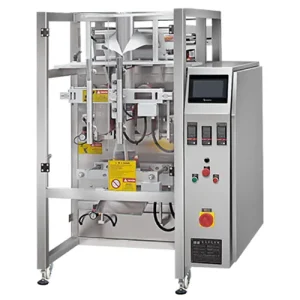
SW-320D / 420D
Turntable Measure Cup
No load cells at all. Stainless cups ride a rotating turntable, fill under the hopper, get levelled, and empty straight down into the tube. The right call when your material behaves the same way batch after batch and the pack is sold by size, and the one to price first when the metering budget is the thing under pressure.
SW-2030A
Granule Back Seal
The cup principle in a single-lane cabinet: a ring of cups under the hopper fills, travels round and tips into the bag mouth. Buyers arrive here when the sachet is small, the material pours on its own, and nothing more elaborate than a cup is needed to repeat the dose. Cup inserts are swapped when the recipe changes.
Pendular dosing — a swinging head for small pieces a cup would bruise
Between the two sits a third motion. Instead of dropping product through a cup, an oscillating head swings a fixed volume from the hopper across to the filling chute on every cycle. It suits small granules that are irregular or easy to damage — a cup rim is exactly where chipping and cracking happen — and it also scales sideways, which is how one of the machines below meters ten narrow channels in the same motion instead of one bag at a time. Choose it when the piece is small and delicate, or when the order is counted in sachets rather than in bags.
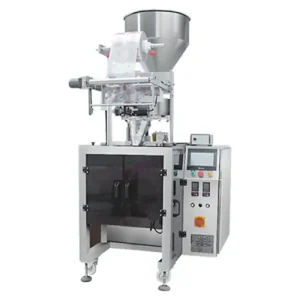
SW-2030D
Pendular Small Granule
Some pieces are irregular or easily nicked, and the rim of a turntable cup is where that damage shows up. A swinging head carries the charge across instead, which is why candy, melon seeds, peanuts and seasoning granules end up on this one. It also switches sachet format without changing machine.
SW-B10
Ten Column Back Seal
Ten narrow channels shaped out of one film roll, all served by the same rocker-arm motion in a single cycle. Ask about this one when the order is counted in stick sachets rather than in bags and the material is fine, dry and free-running — anything that clumps or hangs up will show as lane-to-lane variation.
If your material is not a free-flowing solid
Powder changes almost everything downstream of the hopper — the metering device, the fill path, the seal area and what has to be measured before anyone can quote a tolerance — so it is not handled on this page. If what you are packing is a flour, a milk powder, a spice blend, a protein mix or a fine chemical, start with Powder Packaging Solutions: How to Match a Line to Your Powder. Several machines listed above will also run fine, dry, free-running powders, and their own pages say so where it applies; the behaviour of your particular powder, not the machine list, is what decides the line. If your material is not a solid at all, say so with the enquiry and we will point you at the right platform.
This page routes; it does not rank the mechanisms
What you have above is what each mechanism does and which machine carries it. It deliberately stops short of declaring a winner. If the open question is which method holds a declared weight best, what each one costs you in product over a shift, and when a cup is genuinely good enough, that comparison has its own page: Multi-Head Weigher vs Auger Filler vs Volumetric Cup: The Dosing Accuracy & Give-Away Guide. If you are earlier than that and still working out what to compare at all — what to ask a supplier, what to test before committing — start with How to Choose the Right Packaging Machine: A 7-Step Decision Framework for 2026 and come back here with a shortlist.
How the bag is made is a separate question
Metering is one axis; how the bag comes into being is another, and the two cross. Pouches that arrive ready-made from your own bag supplier are filled by the machines on Premade Bag Packing Machine. Bags formed from a roll of film over a forming collar sit under Collar Type Packing Machine. Small sachets and stick packs formed and filled on a vertical platform sit under Full Automatic Vertical Packing Machine. The same metering device can appear on more than one of those, which is why this page is organised the other way round. For every ShengWei machine in one list, including the ones that do not meter a free-flowing solid at all, go up a level to Bag and Pouch Packing Machines.
Frequently Asked Questions
My product is free-flowing. Do I actually need a weigher?
What is the difference between a combination weigher and a linear weigher?
Can one machine run more than one granule?
What do you need from me before you can say which mechanism fits?
Send the product, not just the pack size.
Tell us what the material is, how it pours, the fill weight you have to hit and your daily output. Our engineers usually reply within one business day with a sized quote, a layout drawing and a sample-test plan. Standard lead time is 15–30 working days ex-works.
info@shengweimachine.com · +86 181 2511 2025 · Contact ShengWei