
Vertical Packing Machine Specifications: How to Read Speed, Bag Size, Film Width and Fill Weight
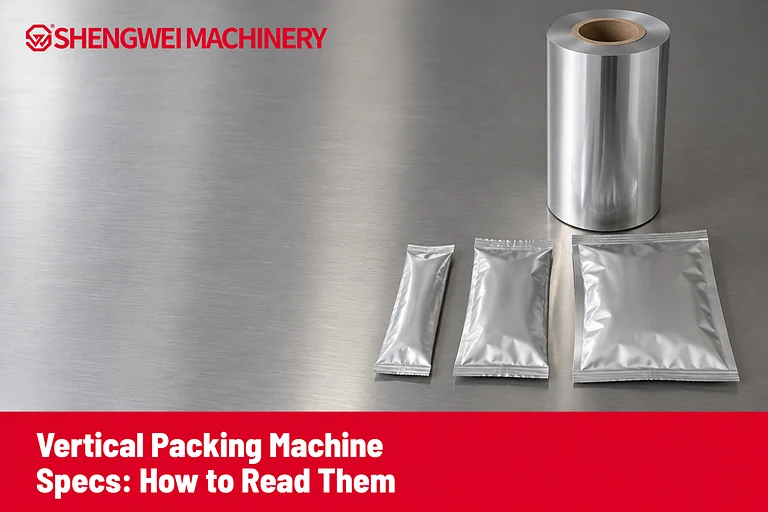
If you send me two quotes for a vertical form fill seal (VFFS) machine, I first ask which spec sheet lines can be compared as written. Some numbers are limits of the machine itself, and others depend on your product and film. That is why I wouldn’t start with the two top speeds.
The examples come from our single-lane collar type packing machine range, mainly the SW-320C. These machines form bags from a film roll, fill them by weight or volume, then seal and cut them. For multi-lane machines and other vertical machine types, see our vertical packing machines overview.
- Comparing quotes you already have? Start with the line-by-line table below, then use the comparison checklist.
- Writing your first inquiry? Go to the details to send us.
What Does Each Line on a Vertical Packing Machine Spec Sheet Tell You?
Packaging machine specifications are easier to compare once you know what kind of number each line holds. The table reads the spec sheet of our SW-320C collar type 4-head linear weigher packing machine row by row. Row names and values come from that page. The Components and Construction rows are left out, and the Control System row is shortened. If another supplier names a row differently, match it to the closest row here before you compare.
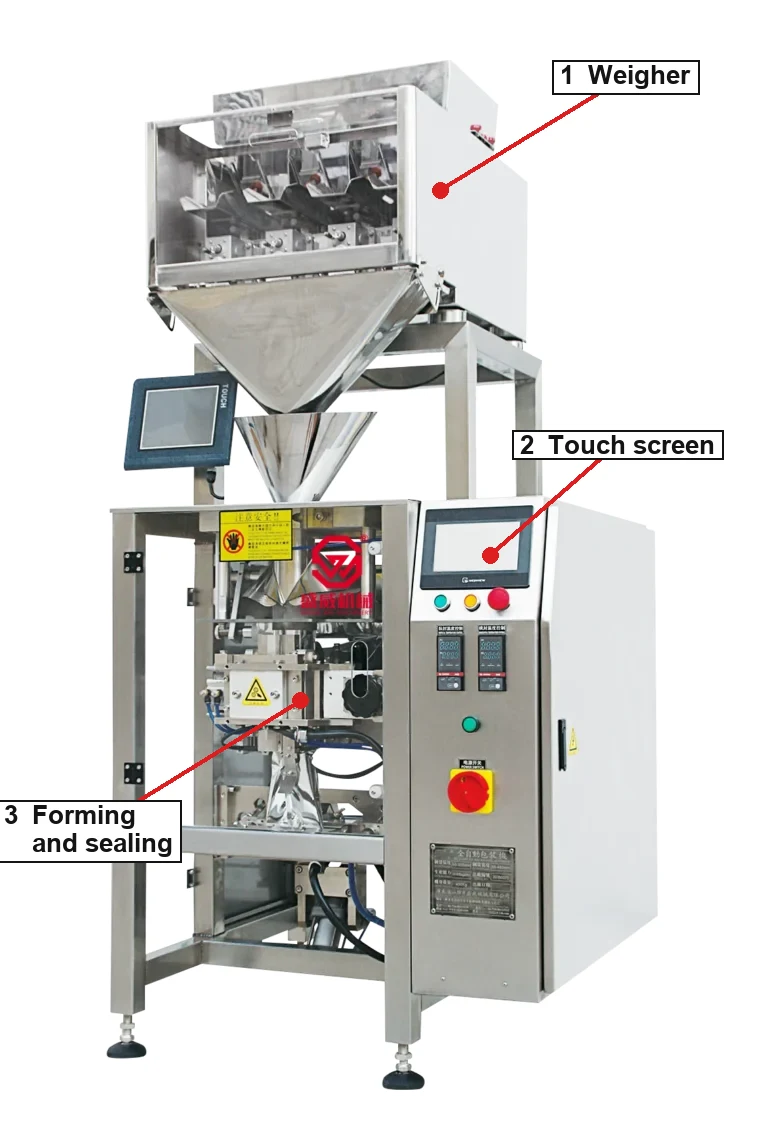
The SW-320C spec sheet, read row by row. The comparison column is our reading guide, not a standard classification.
| Line | SW-320C value | What it tells you | Compare across quotes? | More |
|---|---|---|---|---|
| Packing Speed | 15–70 bags/min (rated) | A rated range; 70 is the top of it, not a running speed | Only on the same product, fill weight, bag and film | Speed |
| Dosing | 4-head linear weigher (weighed dosing) | How each dose is measured: by weight here, by volume on cup, auger and pump machines | Directly, as a method | Fill weight |
| Fill Weight Range | 10–100 g | The weight per bag the machine covers; how steadily your dose runs depends on your product | Only on the same product and dosing | Fill weight |
| Bag Format | Back-seal pillow bag from roll film | The bag style; the SW-320C makes back-seal pillow bags only | Directly | Bag and film |
| Bag Length | 80–200 mm | A hardware range for the finished bag | Directly, once both suppliers state how bag length is measured | Bag and film |
| Bag Width | 45–150 mm | A hardware range; each width needs its own bag former | Directly | Bag and film |
| Roll Film Width | ≤320 mm | The widest film roll the machine takes, not a bag width | Directly | Bag and film |
| Bag Former | Forming collar; one bag former for each bag width | How many formers your bag widths need | Directly: count the formers each quote includes | Bag and film |
| Sealing Type | Vertical back seam + horizontal cross seal | Which seals the machine makes | Directly | Seal points to agree |
| Film Pulling | Film-pulling belts driven by a servo motor | How the film is drawn forward | Directly | Film handling items |
| Control System | PLC + HMI touch screen | The control hardware; key components are listed by brand on our quotation | Directly, by the brands listed on each quote | Scope checklist |
| Total Power | 3.5 kW | Installed power | Only for the same configuration | Power and air |
| Voltage | 220V, 50/60 Hz | The supply the machine is built for | Match it to your plant, not to the other quote | Power and air |
| Air Consumption | 0.6–1.2 m³/min | One range across our collar type models, not a figure for your configuration | Only for the same configuration, with the conditions stated | Power and air |
| Machine Weight | ~500 kg | The machine with its weigher | Only for the same configuration | Power and air |
| Dimensions (L×W×H) | 1,300 × 1,000 × 2,700 mm | Footprint and height, with the weigher | Only for the same configuration | Power and air |
These are the machine’s ranges. We’d confirm the final bag size with a sample run on your own product and film. Line up both quotes against these rows first, and note any row a quote leaves out. The comparison checklist shows what to ask for.
Will the Machine Run at the Top of Its Rated Speed on Your Product?
Speed is the first row on the sheet, so we start with it, although it comes fourth in the selection order below. How many bags a minute will the machine make on your product? The Packing Speed row answers with a rated range, not a running speed. The SW-320C is rated from 15 to 70 bags per minute, and 70 is the top of that range.
Where your product runs depends on its density, its piece size and your target fill weight. Bag size and film matter too. Smaller bags pack faster, heavier fills need more dose time, and thicker laminates need longer seal dwell.
Film thickness matters because of the seal. A BOPP film maker’s seal temperature guide explains that thicker films may need more heat or dwell time. In a thicker film, heat needs more time to reach the seal interface. The guide adds that the sealant formulation is often more important than thickness alone. A flexible-packaging maker’s compatibility guide also warns that “a seal that works at low speed may fail when dwell time becomes shorter.” So plan your line around the speed measured on your own product and film.
VDMA’s overview of DIN 8743:2014 ties nominal performance to the materials in the same way. It states that “the specified processing materials determine the associated nominal performance of the machine systems.” The overview itself does not claim to be complete, or sufficient as a reference for key figures in contracts.
How rated speed changes across our collar type machines
A rated range is given for each model. Within one series, it falls as the frame gets larger.
Rated speeds on our single-lane collar type machines, as published on each machine page. The figures are not converted or multiplied.
| Machine | Dosing | Roll film width | Rated speed | What it tells you |
|---|---|---|---|---|
| SW-320C | 4-head linear weigher, by weight | ≤320 mm | 15–70 bags/min | The model read row by row above |
| SW-320D | Measure cups, by volume | ≤320 mm | 30–100 bags/min | The same bag range as the SW-320C, rated higher, if your product can be dosed by volume |
| SW-420D | Measure cups, by volume | ≤420 mm | 30–70 bags/min | A larger frame than the SW-320D, with a lower top figure |
| SW-420A to SW-820A | Multihead weigher, by weight | ≤420 mm (SW-420A) to ≤820 mm (SW-820A) | 30–70 bags/min (SW-420A) down to 20–50 bags/min (SW-820A) | The range falls model by model, so check the exact model on each quote |
| SW-420E to SW-820E | Auger filler, by volume | ≤420 mm (SW-420E) to ≤820 mm (SW-820E) | 15–70 bags/min (SW-420E) down to 10–40 bags/min (SW-820E) | The same pattern as the multihead series |
| SW-420F | Liquid pump | ≤420 mm | 15–70 bags/min | The same rated range as the SW-420E |
What a rated range does not tell you
A rated range won’t tell you your daily output. Our machine selection guide shows how to size output against OEE rather than the nameplate speed.
Multi-lane machines are on our vertical packing machines page. Their published speeds are already whole-machine output, so they should not be multiplied by the number of lanes. If another supplier quotes per lane or per cycle, our sachet and stick pack guide shows how to put the figures on the same basis.
A rated range also says nothing about how steadily the machine runs. The same VDMA overview lists at least three key figures for describing how a machine system operates: technical quality performance, technical efficiency and technical availability. Our factory acceptance test guide treats speed and efficiency as two separate contract metrics. A machine can hit a nominal rate while losing hours to stoppages. So the guide asks for speed to be verified as a sustained rate on each format.
If your target is near the top of the range
Plan production on the top figure, and you’re assuming a speed your product may not reach. If your target sits near the top of a rated range, look at a model rated higher or run a sample test first. On our range, a target above 70 bags per minute on 10–100 g points to the SW-320D measure cup machine. It is rated 30–100 bags per minute, if your product can be dosed by volume.
Will Your Bag Size and Film Fit the Machine?
Your bag size has to fit two hardware ranges, bag length and bag width. On the SW-320C they are 80–200 mm and 45–150 mm. The roll width line, Roll Film Width ≤320 mm, is the widest film roll the machine takes, not a bag width. On the SW-320C, film up to 320 mm wide makes bags 80–200 mm long and 45–150 mm wide.
How many bag formers will you need?
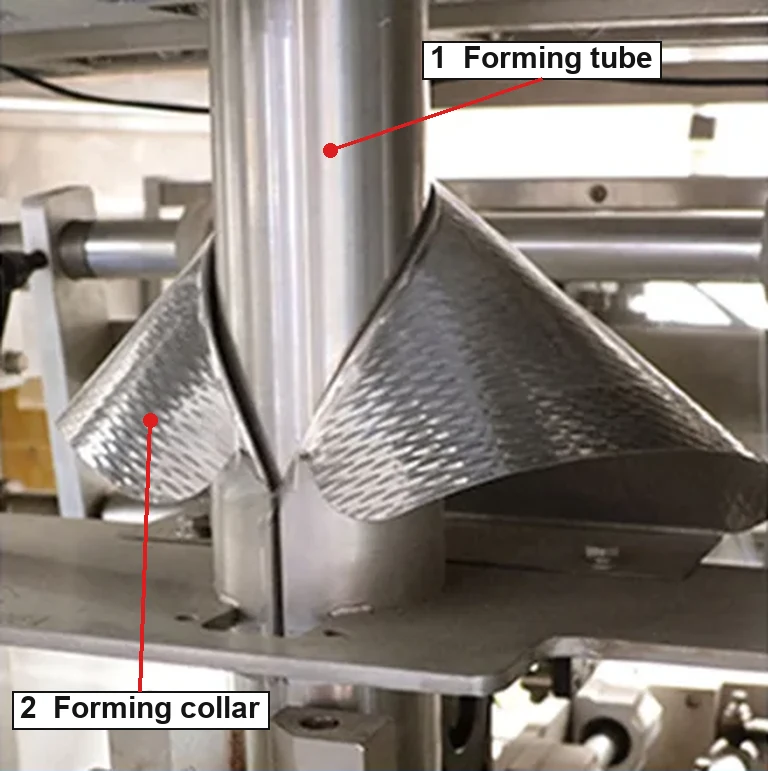
Each bag width uses its own bag former. On our collar type machines, the flat film wraps around a forming collar that folds it into a continuous tube. Changing bag width means changing the bag forming collar and re-threading the film. Bag length is adjusted through the HMI, and actual changeover time depends on the bag format and machine setup.
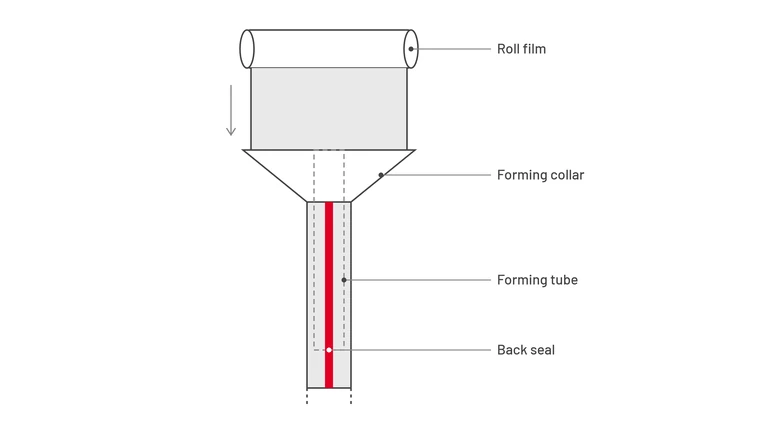
So a 45–150 mm width range does not mean the machine arrives with a former for every width in it. Count the bag widths you run, and I’d check that the quote lists how many formers are included.
Which bags and films does the machine take?
The Bag Format line tells you which bag type the machine makes. The SW-320C makes back-seal pillow bags only. Across our collar type machines, standard output is a back-seal pillow bag. With optional tooling, they can also produce connected strip packs and gusseted bags. We confirm on request whether a gusseted bag device can be fitted to the SW-320C.
On film material, our collar type machines are compatible within the structures and samples we have validated. For a new film structure, send us a sample for a sealing test to confirm it.
How wide should the film be?
A flexible-packaging maker’s VFFS compatibility guide states that “there is no universal web-width formula, eye-mark position, sealing temperature or test-roll quantity for every VFFS machine.” Those values, it adds, “must be confirmed for the actual forming set, seal jaws, sensor, product and operating speed.” The same guide explains that web width depends on the forming collar, package circumference, gusset and longitudinal-seal allowance. So finished bag width alone is not a safe universal calculation.
The guide advises against locking artwork from a generic formula. Instead, ask the machine supplier for its web layout, or use an approved sample of your existing film. Then have your packaging and equipment teams confirm the same dimensions. On our side, each forming set is matched to a film width, so list the film width for each bag format. Our film tracking guide lists the other film items to put in a VFFS specification. How film width is worked out for a back-seal pillow bag will be covered in a separate article.
Bag length needs the same care on printed film. The same guide notes that artwork height and finished bag length are not always the same value. The registration mark helps the machine control package length and cutting position. If the film is printed, fix the bag length before you order it. A flexible-packaging maker explains that the print repeat sets the printing cylinder circumference, so a wrong repeat length means new printing tooling rather than an adjustment.
Our spec sheet does not list the film roll’s outside diameter, core size, weight or winding direction. The comparison checklist includes them.
Three misreadings to avoid
On this part of the sheet, watch for three misreadings. One is taking the maximum film width for a bag width. Another is assuming one former covers every width in the range. The third is ordering printed film from a generic formula. To avoid them, list every bag width × length you plan to run, and match each one to a former and a film width. Don’t stop at the two ends of the range.
Does the Fill Weight Range Cover Every Dose You Plan to Run, and How Accurate Is It?
How many grams per bag can the machine fill? The Fill Weight Range line gives the range, 10–100 g on the SW-320C. This line is separate from the bag ranges, so a bag that fits the machine does not mean your dose fits this range. Whether your dose runs steadily inside it depends on your product and on how the dose is measured.
Will every dose run steadily?
On the SW-320C, a 4-head linear weigher weighs each dose instead of measuring its volume. The SW-420A uses a 10-head multihead weigher, and our linear weigher vs multihead weigher guide compares the two. Measure cups, augers and pumps dose by volume instead. They are faster and simpler than weigher-based systems, but their accuracy depends on product density.
Bulk density directly affects how much material fits in a given volume, as a powder processing explainer notes. So if your product’s density varies, it is a mix, or its pieces differ in shape, a fixed volume would not give a steady weight.
List every fill weight you plan to run, not only the main one, and check each against the range. A fill weight change means adjusting the target weight, or on a measure cup machine, swapping the cups.
What does the accuracy line promise?
Our SW-420A multihead weigher machine is specified at ±1 g (≤100 g) · ±1% (>100 g), depending on the product. The SW-320C page gives no accuracy figure. Instead, we ask for your target fill weight and acceptable weight variation. Then we agree with you how fill weight and output will be checked using your product and film.
The legal metrology recommendation for automatic filling scales also ties accuracy to conditions. OIML R 61-1:2017 says accuracy classes for automatic gravimetric filling instruments “shall be specified for intended usage”. That means the product weighed, the type of installation and operating environment, the mass of the fills and the rated operating conditions. At initial verification, an instrument must meet the accuracy class its manufacturer specified. That is judged by the maximum permissible deviation of each fill from the average of all fills in a test. R 61 governs the accuracy classes of automatic gravimetric filling instruments; it is not a factory acceptance procedure for a packing machine.
The ±1 g on our SW-420A sheet states no sample size or test method. If your product’s density varies and a quote is for volumetric dosing, the quoted accuracy may not hold on your product. So I’d compare accuracy figures only when both suppliers give them for the same product, with the sample size and how they were calculated. How accuracy turns into overfill cost, or give-away, is covered in our weigher, auger and cup comparison.
How does machine accuracy relate to the net quantity on your bags?
They are separate questions. OIML R 87:2016 covers the quantity of product in prepackages. It sets requirements for the packs, with sampling plans for the legal metrology officials who check them. It also notes that those sampling plans are not recommended for use in the packer’s own quantity control.
As our factory acceptance test guide puts it, R 87 is about prepackages, not machines. Compliance attaches to the packs you sell, not to the equipment. So a ±1 g line on a spec sheet is a machine figure; it does not set a legal pass mark for your packs. Check what your destination market’s legal metrology system requires.
What Do the Power, Voltage and Air Consumption Lines Tell You?
These lines tell you what your plant has to supply. Total Power on the SW-320C, 3.5 kW, is its installed power. Before you compare it with the figure on another quote, check that both cover the same equipment, such as the weigher or an elevator. The voltage line has to match your plant. The SW-320C sheet reads 220V, 50/60 Hz, and the SW-420A series sheet reads 380V / 220V · 50/60 Hz (customizable).
Neither sheet states the phase, which has to match your plant as well.
Air Consumption, 0.6–1.2 m³/min, is the same range on every one of our collar type machines, from the SW-320C to the SW-820A. It does not tell the models apart, and it is not an exact figure for the configuration you are quoted. For that, step 5 of our machine selection guide says to take the figures from the supplier’s GA drawing and utility sheet for your exact configuration. It also says to add headroom, and notes that undersized plant air shows up immediately as instability, misfeeds and poor sealing.
Air flow figures also need their conditions. Writing about compressor delivery, Atlas Copco’s guide to compressor measurements explains that air volume changes with inlet temperature and pressure. That is why, it says, flow statements should always include the conditions at which they apply. The advice is about compressors, not packing machines, but it is a reason to ask what conditions an air consumption figure was stated at.
For machine size, the Dimensions line on the SW-320C, 1,300 × 1,000 × 2,700 mm, includes the weigher. So does the machine weight of about 500 kg. Check what each supplier’s figures include before you compare footprints. Getting power, air and ceiling height ready at your plant before the machine arrives will be covered in a separate article.
How Do You Choose a Vertical Packing Machine from Its Spec Sheet?
To choose a vertical packing machine from spec sheets, rule machines out in this order. The order is our way of reading a sheet, not a standard procedure.
- Product and dosing. Our collar type range has five dosing configurations, and the right one depends on your product. If the dosing method does not suit your product, the machine is the wrong one, whatever its other lines say.
- Every fill weight. Each dose you plan to run sits inside the Fill Weight Range.
- Every bag size. Each bag width × length sits inside the bag ranges, and you know how many formers your widths need.
- Target speed. Your target sits below the top of the rated range. If it is near the top, see the options above.
- Plant supply and space. Your plant can provide the power and air, and has room for the footprint and height.
Accuracy is not one of the five steps, because an accuracy figure on a sheet is product- and test-specific. It has to be checked on your product.
Don’t start from speed. Our guide on how to choose a packaging machine explains why. Starting from a target speed before confirming film type, dosing behavior or actual changeover need can point you to the wrong machine. A machine that fits all five steps is a candidate for a sample test on your product; the final choice comes after the test. To see your own product run first, you can send a sample and a roll of your film to our factory in Shantou, and we send you the video of the run.
For model-by-model matching, use the dosing guide on our collar type machine page. Narrow the list to one or two machines with the first three steps, then compare speed and price. If seals are the main risk for your product, agree the seal points before you order, as our seal problems guide explains.
How Do You Put Two Quotes on the Same Basis Before You Compare Them?
Two quotes are only comparable when both suppliers answer the same questions. The more complete your RFQ, the more comparable the quotes you’ll get. The checklist below collects the points from the sections above in one place.
What to ask both suppliers to state before you compare two vertical packing machine quotes.
| Line | Ask both suppliers to state | Why it matters | See |
|---|---|---|---|
| Product and fill weights | The same product for both quotes, and every fill weight you plan to run | Speed, fill weight and accuracy all change with the product, and nominal performance follows the materials it was specified with | Fill weight |
| Bag sizes and formers | Every bag width × length, how bag length is measured, and how many bag formers are included | Each bag width needs its own former, so a size range alone does not show what is in the price | Bag and film |
| Film and roll | Film material, thickness, reel width and color mark, plus the roll’s outside diameter, core size, weight and winding direction | A film maker’s guide lists these roll items for a film specification. A flexible-packaging maker warns that a roll right in material and print can still be unusable. It may not fit the unwind station, or it may exceed the machine’s handling limit. | Bag and film |
| Speed | The sustained rate on your product, bag and film, how long it was measured, and the efficiency figure alongside it | A rate achieved on one easy format is not the rate you bought. One flexible-packaging maker advises comparing validated output for your bag and product, not an unloaded headline speed. | Speed |
| Accuracy | Accuracy on your product, with the sample size and how it was calculated | Exact ± figures are product- and test-specific | Fill weight |
| Scope of supply | The weigher or other dosing unit, the number of bag formers, and each option, listed one by one | On our quotes, options are confirmed for your product and listed in the quotation | What moves a quote up or down |
| Utilities | Installed power, voltage, frequency and phase, and air consumption with the conditions it applies to, plus what the dimensions and weight include, all for the quoted configuration | Series figures do not describe your configuration, and flow figures need their conditions | Power and air |
| Tests and acceptance | A sample test and the factory acceptance test (FAT) on your own product and film, the run duration and formats in the contract, and the raw records | “FAT passed” is not evidence; the log is. Each criterion needs a number, a condition and a signature. | FAT guide |
Send the same checklist to every supplier you are comparing. If you run more than one bag width, also ask what a width change involves on each quoted machine and how long it takes. Then you can compare the figures that come back line by line.
How long should the acceptance run be?
The VDMA overview of DIN 8743:2014 gives a reference value for the acceptance period. Depending on the machine system, it should not fall short of 2 h and not exceed 8 h. As noted above, the overview does not claim to be sufficient as a reference for key figures in contracts. So write the run duration and formats you need into the contract.
Our own standard acceptance run takes two working days on your bag sizes and formats. We log speed, seal quality, weight accuracy and rejection rate. That is our practice, not an industry rule.
How should fill accuracy be checked at the FAT?
Agree the target fill weight and acceptable weight variation, the sample size and how accuracy will be calculated. Check fill accuracy using your own product and film, and ask for the raw test records. Our factory acceptance test guide borrows the structure of R 87 as a reference, but this is our own derivation, not an R 87 factory acceptance procedure. R 87 does not mention factory acceptance testing; its sampling plans are for legal metrology officials and are not recommended for the packer’s own quantity control.
Frequently Asked Questions
Is the roll film width on a spec sheet the same as the bag width?
No. On our collar type sheets, Roll Film Width is the widest film roll the machine takes, not the width of a finished bag. On the SW-320C, film up to 320 mm wide makes bags 80–200 mm long and 45–150 mm wide. Each forming set is matched to a film width, so list the film width for each bag format and confirm it with the machine supplier.
What specifications should you compare on a vertical packing machine quote?
Compare bag length and width ranges and maximum film width after confirming how bag length is measured, and compare the number of bag formers included in each quote. Compare speed, fill weight and accuracy only when both suppliers state the same product, fill weight, bag size and film. Compare power and air consumption for the same configuration; match voltage, frequency and phase to your plant.
What does bags per minute mean on a VFFS spec sheet?
It is a rated range, and the top figure is the upper limit, not a running speed. Our SW-320C is rated from 15 to 70 bags per minute, and 70 is the top of that range. Where your product runs depends on its density, piece size and fill weight, and on the bag size and film thickness. On our multi-lane machines, the published figure is already whole-machine output and is not multiplied by the number of lanes.
Can one forming collar make different bag widths?
No, not on our collar type machines. Each bag width uses its own bag former, or forming collar. Changing the width means changing the collar and re-threading the film, while bag length is adjusted on the HMI. So count your bag widths to know how many formers to order.
Is the filling accuracy on a spec sheet guaranteed for my product?
Not until it is checked on your product. Accuracy figures depend on the dosing method and the product. Our SW-420A series, for example, is specified at ±1 g (≤100 g) · ±1% (>100 g), depending on the product. Give the supplier your target fill weight and acceptable weight variation, and agree how fill weight will be checked using your product and film.
Comparing Quotes? Send Us These Details
If you are writing your first inquiry, or want our quote on the same basis as the others, send us these details.
Please Send
- Product name and photos, and whether it is a single product or a mix
- Piece size, and whether the pieces are sticky, fragile or uneven in size
- Every fill weight you plan to run, with the acceptable weight variation
- Every bag width × length, in mm
- Target output in bags per minute, and shifts per day
- Film material, thickness and reel width, and whether the film is printed with a color mark
- Options you need, such as gusseted bags, nitrogen flushing, date printing or an output conveyor
- How product reaches the machine in your plant today
- Voltage, frequency and phase at your factory, and the compressed air available
- Whether you want the FAT run with your own product and film
We send a quotation within one working day of receiving your details. It lists the bag formers and options you need, with the options confirmed for your product. You can also ask for the full datasheet of the model we propose.
Related Guides and Machine Pages
- Collar Type Packing Machines
- SW-320C Collar Type 4-Head Linear Weigher Packing Machine
- SW-320D / SW-420D Collar Type Measure Cups Packing Machine
- SW-420A Series Multihead Weigher Packing Machine
- Vertical Packing Machines
- How to Choose the Right Packaging Machine
- Packaging Machine Factory Acceptance Test Guide
- Multi-Head Weigher vs Auger Filler vs Volumetric Cup
- VFFS Film Tracking Troubleshooting: Film Drift, Missed Eye Marks and Inconsistent Bag Length
- Sachet vs Stick Pack vs Packet
- VFFS and Flow Wrapper Seal Problems
- Linear Weigher vs Multihead Weigher
- More from the blog
References and Sources
- CloudFilm: Heat Sealable BOPP Film Seal Temperature Guide: a BOPP film maker on why thicker films may need more heat or dwell time, why the sealant formulation often matters more than thickness, and which roll items belong in a film specification
- Runlong Pack: VFFS Rollstock Film Compatibility Guide: a roll-film supplier on seals at shorter dwell times, web width and the lack of a universal formula, bag length on printed film, and rolls that do not fit the unwind station; a supplier’s guide, not an industry standard
- VDMA: Das Kennzahlensystem der DIN 8743 (2014): English and German slides summarizing DIN 8743:2014, used for nominal performance, the three technical key figures and the reference value for the acceptance period; an overview, not the standard text, and by its own account not sufficient as a reference for key figures in contracts
- Sayru: Printed Roll Film: a printed roll film maker on why a wrong repeat length means new printing tooling rather than an adjustment
- PowderTechnology.info: Bulk Density in Powder Processing, Why It Matters: how bulk density affects how much material fits in a given volume; general background, not specific to packing machines
- OIML R 61-1:2017, Automatic Gravimetric Filling Instruments, Part 1: current edition; how accuracy classes are specified for intended usage and how the deviation of each fill is judged at initial verification. It covers the weighing instrument, not factory acceptance of a packing machine
- OIML R 87:2016, Quantity of Product in Prepackages: current edition; used for its scope, which covers requirements for prepackages and sampling plans for legal metrology officials, plans it does not recommend for the packer’s own quantity control. It applies to packs, not machines
- Atlas Copco: Understanding Air Compressor Measurements: why air flow statements should include the conditions they apply to; written about compressor delivery, not packing machine air consumption
- Runlong Pack: Potato Chip Packaging Line Guide: a roll-film supplier’s advice to compare validated output for your bag and product rather than an unloaded headline speed; written for snack lines
Public-data note: ShengWei machine pages and the reference pages above were checked on 5 November 2026. Machine figures are the published ranges for our single-lane collar type machines. Speeds are rated ranges, not speeds measured at a customer’s plant. This article does not report any customer’s bag dimensions, output or machine configuration.
Send Your Product and Bag Details
Send the details in the checklist above. We’ll match your product to a collar type machine and send a quotation within one working day, listing the bag formers and options you need.
Email info@shengweimachine.com · or contact our engineering team

International Sales Manager · ShengWei Machine