
Sachet vs Stick Pack vs Packet: Differences and How to Choose
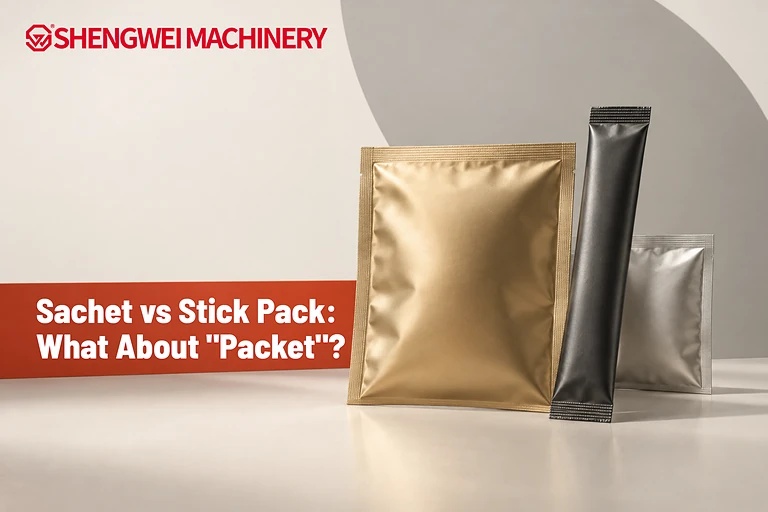
If you ask me which format to choose, my first question is how your customer will use it. Will they pour powder into a bottle, squeeze out a sauce, or need room on the pack for instructions? From there, we can work through the seal layout, finished size, filling system and output you need. Those details give us a useful basis for comparing machines.
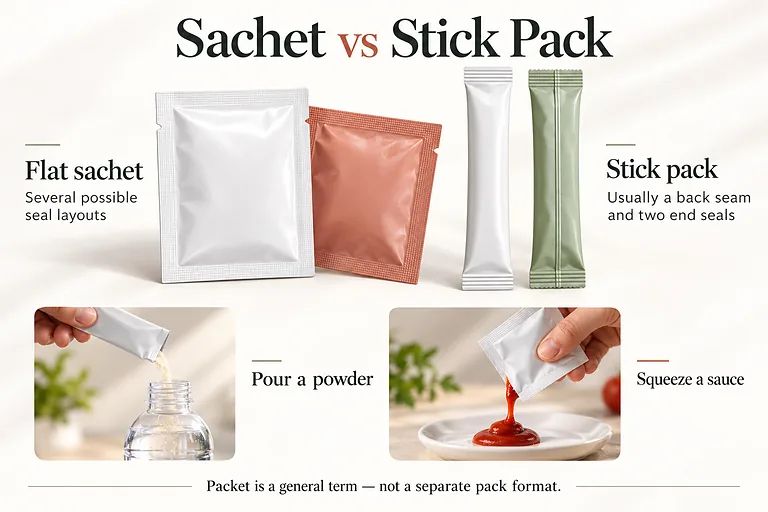
Sachets, Stick Packs and Packets at a Glance
Here’s a quick comparison of the three terms and what to check before discussing machine options. Use it as a starting point; your pack’s dimensions and seams then narrow down the options.
| Term | What it usually describes | Common uses | What I’d check first |
|---|---|---|---|
| Flat sachet | A small, flat pack, commonly with three or four sealed edges. | Sauces, seasoning, powders and personal-care samples. | Whether it has a folded edge or four sealed edges, and enough room for the product and label. |
| Stick pack | A long, narrow pack, usually with a back seam and two end seals. | Coffee, sugar, drink mixes and suitable liquid or jelly portions. | Whether the opening suits how the product will be poured or squeezed out, and which filling system it needs. |
| Packet | A general name for a small pack, with no fixed shape or seal layout. | Often used for single portions, including sachets and sticks. | A front and back photo, or a drawing showing the dimensions and seams. |
The overlap is why I wouldn’t choose a machine from the name alone. Let’s start with “sachet” and what we still need to know when that’s the only description on a quote.
Why “Sachet” Alone Does Not Tell You Which Machine
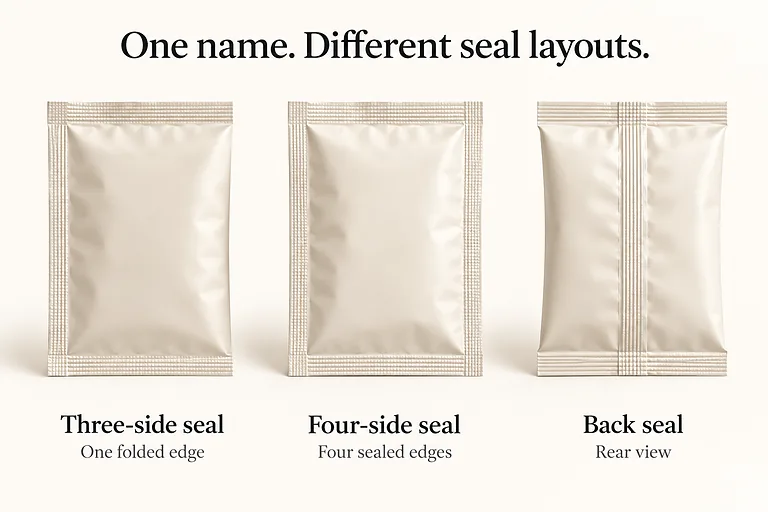
A sachet usually holds a small portion of a product. The Cambridge Dictionary explains what it holds, but doesn’t specify how it’s sealed. You’ll see suppliers use “sachet” for three-side-seal, four-side-seal and some back-seal packs.
“Packet” is just as broad. For a small, single-use pack, the Cambridge Dictionary gives “packet” as the US term and “sachet” as the UK term. So “ketchup packet” tells me what’s inside, but I still need to see how the pack is sealed.
When I compare two “sachet machine” quotes, I first check that they’re for the same finished pack. They may use different seal layouts, fillers or numbers of lanes. A few photos showing the front, back and edges help me see what each supplier is quoting.
Sachet vs Stick Pack: Shape and Seal Pattern
Flat sachets: three-side seal or four-side seal
A three-side-seal sachet has one folded edge and three sealed edges. A four-side-seal sachet is sealed along all four edges. On a sample, that smooth folded edge is the quickest way to tell them apart. The shape alone won’t tell me, because both can be square.
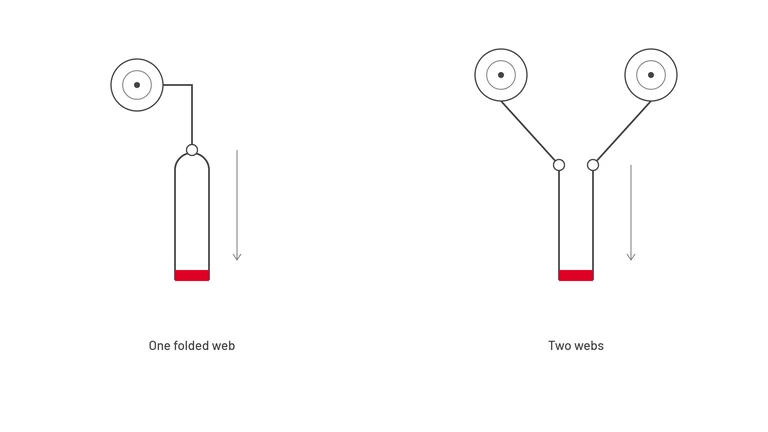
How the film runs through the machine matters, too. A three-side-seal sachet can be made from one folded web of film, while a four-side-seal sachet can be made from two separate webs. But I wouldn’t judge the cost just by how many film reels the machine uses.
Stick packs: narrow shape, usually a back seam
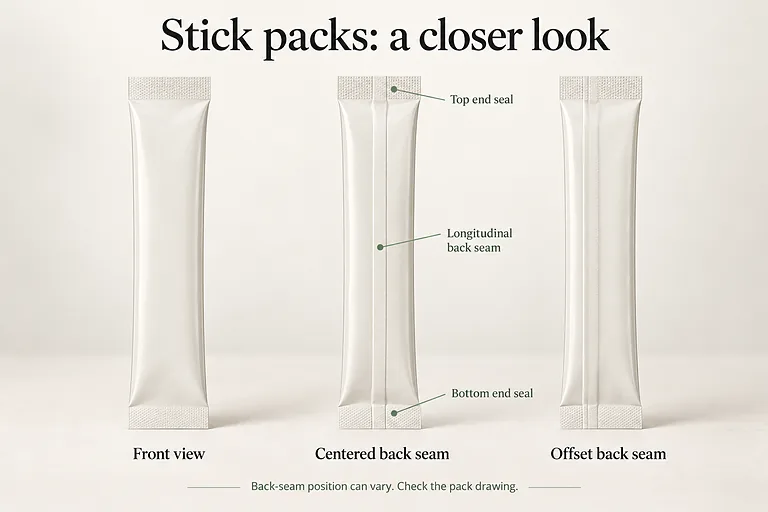
A typical stick pack is a narrow tube with a seam down the back and seals at both ends. Some suppliers also call long, narrow four-side-seal sachets “sticks”, so I’d ask for a drawing to check exactly what they mean.
If I see “three-side sealed” on a stick-pack quote, I check which three seals the supplier is counting. They may mean the back seam and two end seals. That’s different from a flat sachet with one folded edge and three sealed edges.
Back-seal, fin-seal and pillow pouch describe different features of a pack. Back-seal tells you where the seam sits; fin-seal tells you how the film surfaces join; pillow pouch tells you the bag’s shape. For individually wrapped solid products, see our horizontal pillow packing machines. If you’re packing powder or liquid portions, you’ll need a machine with a suitable dosing system.
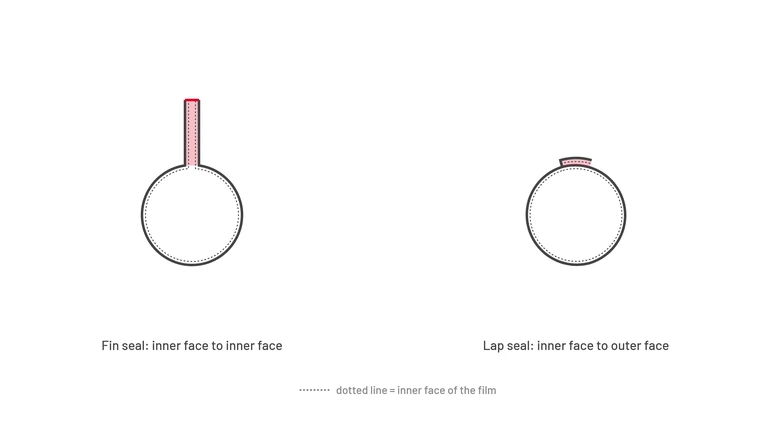
With a fin seal, the film’s inner surfaces seal together. With a lap seal, an inner surface seals to an outer surface, so both surfaces need to be suitable for sealing. Packaging World explains these options in its VFFS guide. Before choosing the film, I’d confirm that it works with the machine’s seam type.
The easiest way to see the difference is to look at the pack itself. The image below shows the front view, two common back-seam positions, and the top and bottom end seals.
The seal layout is easier to follow once you see a machine running. Watch the SW-2830A running in the video below.
There is no single standard stick-pack size
Size depends on the dose, product volume, how the product fills, and how much room is needed for sealing. For example, 10 grams of a light powder may take up more space than 10 grams of dense granules. Liquids also need enough space at the top to keep the product away from the seal area.
Send us the finished width and length. It’s best to confirm the size with a filled sample. For powders, the bulk density is also helpful if you have it. Using the same bag size as another product may leave too much empty space, or not enough room for a clean seal.
For reference, our ten-lane SW-B10 supports back-seal stick packs 10–30 mm wide and 50–150 mm long. This is the machine’s working range; the final pack size should still be based on the actual filled sample.
Which Format Fits Your Product Best?
Start with how your customer will open and empty the pack. For a drink powder, the question is whether it pours cleanly into the intended bottle. For a sauce, it is how easily it squeezes out and how much stays inside. The table below gives you a starting point for comparing those needs.
| Your product or priority | Start by comparing | Check on a filled sample |
|---|---|---|
| Coffee, sugar or drink powder | A narrow stick and a flat sachet for the same dose. | Pouring control, opening width and powder caught at the opening. |
| Ketchup, honey or a personal-care sample | A flat sachet; a liquid stick if the filler suits the product. | Flow at filling temperature, nozzle cut-off and residue after squeezing. |
| Jelly or a drink consumed from the pack | A suitable liquid stick configuration. | Product flow during filling and how the opening works in use. |
| More room for instructions or artwork | A flat sachet with enough usable panel space. | Legibility after allowing for seals, the opening feature and coding. |
| Several products or sizes in short runs | Machines with suitable format parts and cleaning access. | Change parts, cleaning effort and time to resume acceptable production. |
It’s a good idea to print the artwork at actual size and check it on a filled sample. Make sure the instructions are easy to read. Opening the pack should not remove important information, such as the batch code. Do you need a tear notch, a specific cut edge or an easy-tear feature? If so, we should confirm that the machine and film can handle it before the artwork is finalised.
For more details on different seal styles, see our 3-side-seal, 4-side-seal and back-seal pages. If the pack needs to stand on a shelf or be resealable, our pouch types overview can help you compare other options.
Which Costs Less: a Sachet or a Stick Pack?
If you ask me which format costs less, I’d compare two pack designs for the same product and dose. A narrow stick may use less film, but I’d want the figures for both designs before quoting a saving.
In practice, the useful figure is film consumption per 1,000 acceptable finished packs, from each supplier and with the same protection requirements. That comparison should include seal allowances, trim and production waste. If the film is priced by weight, look at both the price per kilogram and how much is used.
Then set the operating costs below against your production schedule.
- Format parts: formers, filling tubes and other parts needed for each agreed size.
- Changeovers and cleaning: time between products or sizes, including the restart.
- Labour and downstream work: feeding, inspection, counting and secondary packing.
- Rejects and lost product: off-weight packs, contaminated seals and start-up waste.
During a trial, I recommend counting acceptable filled and sealed packs over an agreed period that includes normal interruptions. This is a more useful basis for production cost than maximum cycle speed alone.
Which Machine Type Makes Each Format?
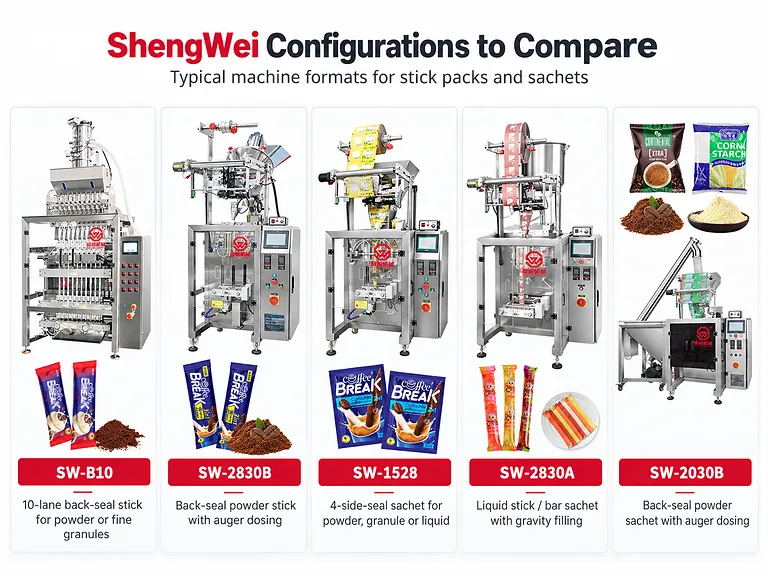
The ShengWei machines I list below are all vertical form-fill-seal machines. Match the seal layout first, then evaluate the filler, size range and lane count together.
Start with the product and dosing system
Free-flowing granules usually work well with volumetric cups. Fine powders often need an auger, depending on how easily the powder flows and how much dust it creates. For liquids and sauces, we may use a pump or piston filling system, depending on the viscosity and filling conditions. The SW-2830A is the exception in our range: it feeds free-flowing liquids by self-flow (gravity). When comparing sachet filling machine quotes, it’s worth checking which dosing system is actually included.
I also wouldn’t assume a powder machine can handle sauce just by changing a setting. We still need to check the dosing system, product-contact parts and cleaning requirements for each product. If your powder is oily, sticky or tends to absorb moisture, it’s better to run the trial with the actual product. Then we can see how it flows and whether any product gets into the seal area.
ShengWei configurations to compare
The ranges below are taken from our product pages and are mainly for reference when comparing configurations. Actual speed still depends on the product, pack size and machine setup, so not every application will run at the maximum listed speed.
| Model | Format and published width × length | Product and filling route |
|---|---|---|
| SW-B10 | Ten-lane back-seal stick, 10–30 × 50–150 mm | Dry, free-flowing powder or fine granules; pendular dosing. |
| SW-2830B | Back-seal powder stick, 20–100 × 45–150 mm | Suitable powders or fine granules; listed auger configuration. |
| SW-1528 | Flat four-side-seal sachet, 25–140 × 50–150 mm | Powder, granule or liquid configurations; select the dosing module for the product. |
| SW-2830A | Liquid stick or bar sachet, 40–150 × 50–200 mm | Free-flowing liquids and suitable semi-liquids; self-flow (gravity) feeding. |
| SW-2030B | Back-seal powder sachet, 25–140 × 50–200 mm | Powder packaging with auger dosing. |
For a three-side-seal sachet, you can compare the single-lane SW-1328 with a multi-lane option like the six-lane SW-A6. If you’re looking at a four-side-seal format, the six-lane SW-C6 is also worth comparing with the single-lane option above.
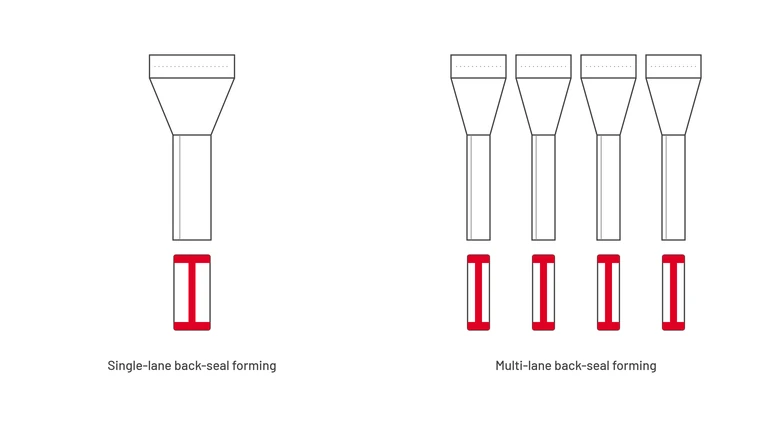
Single-lane or multi-lane?
A multi-lane machine forms and fills several packs side by side. It makes sense when you have steady demand for compatible small formats. In practice we usually recommend a single-lane machine first, and a multi-lane machine only when one small format will run at steady volume. For wider packs or frequent changes, compare the available size ranges, tooling and changeover work. A multi-lane machine can also change formats with the right parts, so base the choice on what your production schedule requires.
The SW-A6 and SW-C6 list a maximum of 200–300 sachets/min for the whole machine. The SW-B10 lists up to 300 bags/min from a single machine. These figures are already whole-machine output, so they should not be multiplied by the number of lanes.
If another supplier quotes packs per minute per lane, check how many lanes can actually run at your pack size before comparing the total output. If the speed is given in cycles per minute, we also need to know how many packs each lane makes per cycle. For one pack per lane per cycle, the theoretical output is cycles per minute × active lanes, before rejects and normal stoppages. I’d then compare that figure with the expected running output for your actual product and film.
For back-seal packs, different widths usually need different formers. Our published Mexico protein powder sachet case study is a useful reference for what to include in a multi-size quotation. The project involved two sachet sizes, about 3 × 10 cm and 5 × 12 cm, and a second former was included with the machine. We sent the buyer factory test-run videos on 7 October 2026. The case study does not include production output measured at the customer’s plant.
The video below shows the ten-lane SW-B10 back-seal stick machine running.
What Should You Check Before Ordering?
Ask what each seal test actually measures
Before a trial, I’d separate three questions. Does the seal hold? Does the pack leak? Can the customer open it as intended? One test won’t answer all three. We can discuss the checks your product needs and agree the acceptance criteria before testing.
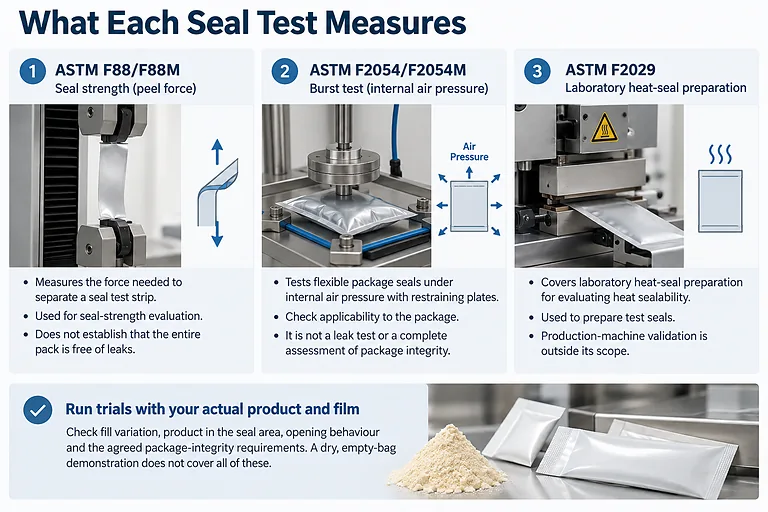
ASTM F88/F88M measures the force needed to separate a seal test strip. It supports seal-strength evaluation; it does not establish that the entire pack is free of leaks.
ASTM F2054/F2054M covers burst testing of flexible package seals under internal air pressure, using restraining plates. Check that the method suits your package. It is not a leak test or a complete assessment of package integrity.
ASTM F2029 concerns laboratory heat-seal preparation for evaluating heat sealability. Production-machine validation is outside its scope.
Run trials with the product and film you actually plan to use. Check fill variation, product in the seal area, opening behaviour and the agreed package-integrity requirements. A dry, empty-bag demonstration does not cover all of these.
Ask for barrier data for the actual film
For moisture-sensitive powders, ask for the film’s water vapour transmission rate (WVTR). If the product is sensitive to oxygen, check the oxygen transmission rate (OTR) as well. A good test report should show the film structure, thickness, test method and test conditions. That includes temperature and humidity where needed. When comparing results, make sure the tests were done under the same conditions.
ASTM F1249 is commonly used to measure water vapour transmission through plastic film and sheeting. ASTM D3985 covers oxygen transmission through plastic film and sheeting. These standards explain how the barrier is measured. They don’t set one pass/fail limit that works for every sachet.
Barrier data is only one part of the picture. Seal quality, filling conditions and storage conditions can also affect shelf life. It’s better to first work out what level of protection your product needs, then check whether the finished pack can meet it.
Confirm food-contact documentation
I’d ask the film supplier for documentation covering the supplied structure and its intended use. The FDA guidance on food contact materials explains that regulatory status depends on the components used and their authorised uses.
In the US, 21 CFR Part 177 contains provisions for food-contact polymers. 21 CFR 177.1520 covers certain olefin polymers, including the applicable conditions and limitations. A polymer name or a citation to this part alone is not enough to confirm that the complete film structure is compliant.
For EU plastic food-contact materials within its scope, Regulation (EU) No 10/2011, as amended, includes declaration-of-compliance requirements at marketing stages other than retail. The documentation should match the intended food and contact conditions.
We also confirm who supplies the trial film, and whether the film, coding equipment and agreed format parts are included in the machine quotation. For printed film, we check the registration mark (eye mark) size and position, so each pack can be cut correctly with the artwork.
Frequently Asked Questions
What is a sachet pack?
A sachet pack is a small sealed single-portion pack made from flexible film. It is usually flat and has three or four sealed edges. You’ll often see it used for sauces, powders, seasoning and personal-care samples. In sachet packaging, the term mainly describes the pack size and how it is used, rather than one fixed seal layout.
What is a stick pack machine?
A conventional back-seal stick pack machine forms narrow packs from rollstock film. It handles dosing, longitudinal sealing and end sealing in the same process. Some machines run one lane, while others run several lanes side by side. In our range above, the SW-B10 and SW-2830B are dry-product configurations, while the SW-2830A uses a liquid-filling configuration.
Are sachets and packets the same thing?
They can both refer to a small single-portion pack. “Packet” is a broader everyday term and does not tell you how the pack is sealed. For a machine enquiry, it’s better to include the seal layout or send a sample photo.
Can stick packs hold liquids?
Yes, as long as the filling configuration matches the product. The SW-2830A example above uses self-flow (gravity) feeding for free-flowing liquids and suitable semi-liquids. For a thicker sauce, check the viscosity at filling temperature and the proposed dosing system. For a liquid stick pack, also confirm how the filler stops the flow before the end seal is made.
Can one machine make both flat sachets and sticks?
Only if the proposed platform is designed to support both constructions. Changing the bag length or replacing a former does not automatically change the sealing layout. Ask which formats the machine supports and what parts are needed for each one.
Do stick packs always use less film?
No. You still need to compare the finished dimensions, seal allowances, film structure and waste for the same dose and protection requirements. A practical way to check the difference is to compare film consumption per 1,000 acceptable packs.
Which gives a longer shelf life?
The format name alone does not tell you that. Shelf life depends on the product, film, seals, filling process and storage conditions used.
Why do two “sachet machine” quotes differ so much?
They may be quoting different seal layouts, lane counts, fillers or included equipment. Before comparing prices, make sure both quotes are based on the same product, dose, finished pack, output basis and acceptance criteria.
What is a VFFS packaging machine?
A vertical form-fill-seal machine makes packs from rollstock film, fills the product and seals the pack in a vertical process. The forming and sealing setup determines which bag formats the machine can produce.
Not Sure Which Format or Machine You Need?
If you’re not sure whether your pack is a sachet, stick pack or another format, send us a few basic details. We can help you narrow it down.
Please Send
- A front and back photo of the pack
- The product you want to fill
- Target dose or fill weight
- Finished pack width and length
- Required production output, if you already have a target
If possible, also tell us whether the product is a powder, granule, liquid or sauce, and whether you already have the packaging film.
From there, we can check the seal layout, suitable filling system, pack size and machine configuration. Then we’ll let you know which ShengWei models are worth comparing.
Related Guides and Factory Information
- Visit the Factory Page
- Open the Pouch Types Guide
- Bag Sealing Methods Compared
- Premade Bag vs VFFS
- How to Choose a Packaging Machine
- More from the blog
References and Sources
- Cambridge Dictionary: sachet: everyday meaning of the word
- Cambridge Dictionary: packet: everyday meaning and regional usage
- Packaging World: Vertical Form Fill Seal 101: further industry reading on VFFS and seal terminology
- ASTM F88/F88M: seal-strength testing; 2023 edition
- ASTM F2054/F2054M: restrained-plate burst testing; 2013 standard reapproved in 2024
- ASTM F2029: laboratory heat-seal preparation; 2016 standard reapproved in 2021
- ASTM F1249: water vapour transmission; 2025 edition
- ASTM D3985: oxygen transmission; 2024 edition
- FDA: Determining the Regulatory Status of Components of a Food Contact Material: checking components and intended uses
- 21 CFR Part 177: US food-contact polymer provisions
- 21 CFR 177.1520: olefin polymers and applicable conditions
- Regulation (EU) No 10/2011: EU plastic food-contact material requirements; consult the applicable amended text
Public-data note: ShengWei product pages and the reference pages above were checked on 27 October 2026. ASTM links lead to public standard summaries; full test procedures may require access to the standards. Apart from the published case study linked above, this article does not report any customer's pack dimensions, output or machine configuration. ShengWei output figures are maximum outputs for the whole machine; actual output depends on the pack, fill weight, film and dosing system.
Send Your Pack Details
Send the details listed above. We will reply with the seal layout, filling system and ShengWei models worth comparing.
Email info@shengweimachine.com · or contact our engineering team

International Sales Manager · ShengWei Machine
Technical review: WeiHuang Wu, Chief Engineer