
Auger Filler Accuracy Problems: Why Fill Weights Vary and Where to Look First
Two rows of the table below end at the auger count. The others start in the scale, the powder, the feed or the dosing parts, where a new count can hide the cause for a while. If you are choosing a new machine, see what to agree before you order.
| What you see | Likely pattern | Check first | Who fixes it | Read more |
|---|---|---|---|---|
| Every bag is heavy, or every bag is light, by about the same amount | The average has moved | The scale’s zero and tare; the auger count and the settings on the screen; whether the powder lot changed | Operator: reset the count for the current powder. Powder supplier, if lot-to-lot bulk density or moisture changed | Weighing; New lot |
| Weights scatter around the target from bag to bag | The spread has grown | Hopper level and refills; bridging or flooding; the agitator; build-up on the screw or tube; the screen settings for this product | Operator: hopper level and refill routine. Maintenance: agitator, cleaning for build-up, or a new screw or tube for wear. Powder supplier only if it began with a new lot | Hopper level; Bridging; Screw and tube |
| Weights creep lighter as the hopper runs down and recover after a top-up, or creep heavier during the run | Drift with the hopper level. Heavier bags probably mean the flights are filling more densely | Refill timing; the feeding conveyor and hopper level; whether vibration from a flow aid compacts the powder | Operator: frequent top-ups. Machine supplier: a feeding conveyor | Hopper level; Flow aids |
| A jump after a refill, a pause or a restart | A step at an event on the line | Weights either side of the refill or restart; how you refill the hopper | Operator, then machine supplier: the refill and restart routine | Refills |
| The change starts with a new powder lot or in humid weather | The powder’s bulk density has changed | Compare the old and new lots | Operator, then powder supplier | New lot |
| Light bags while the screw runs empty, or a few bags far heavier than the rest | Bridging, or powder flooding past the screw or still flowing after it stops | The agitator; how aerated the powder is; the hopper; the screw | Machine supplier: hopper, feeder and flow aids for the powder. Maintenance, if the agitator does not turn. Powder supplier, if flow behaviour changed between lots | Bridging and flooding |
| A new product or fill weight | The screw may not suit the new powder | A sample or the bulk density of the new powder | Machine supplier, before the change: a new count, and a matched screw if the current one does not suit | Screw and tube |
| The bench scale and the checkweigher disagree | The measurement | A test weight on both scales; the same tare | Whoever looks after the scales; scale service if a test weight reads wrong | Weighing |
| A slow drift you want the checkweigher to correct | Depends on the checkweigher | Whether it only rejects packs or feeds a correction back to the filler | Machine supplier: a checkweigher wired to the filler. Fix bridging, flooding and level swings first. Feedback cannot fix those. One that only rejects packs does not correct the dose | Feedback |
| Bags look short but weigh right, or powder sits in the seal | Not a dosing fault | Bag length or film; the seal | Not the filler | Bag length; Powder in the seal |
What Do the Weights of Consecutive Bags Tell You?
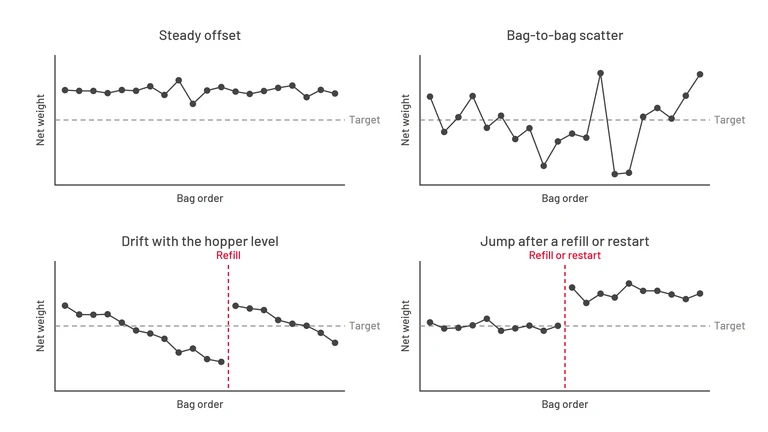
A moved average and a wider spread have different causes and fixes. Adjusting for the wrong one can hide the real cause. Telling them apart starts at the scale.
Weigh a run of consecutive bags
Weigh the bags in the order they come off the machine, each on the same checked scale. Record the net weight and the time. Mark every refill, stop and restart, as in the record across refills and restarts in our powder guide. Note the hopper level too, if you can see it. Weigh enough bags to see a pattern, and run through at least one refill. A set number of bags that ends before the next refill can miss the change you are looking for. Don’t pick bags. When inspectors check a lot, they select samples at random. A randomly selected sample is needed for statistical validity and reliable data. Here, you are asking a different question: how the weight moves over time.
Once you start changing things, change one at a time and write each change down in order. Set aside a few problem bags and a sample of the same powder lot.
Read the average and the spread
Compare the average with your target, and the bags with one another. A filler can repeat closely from bag to bag and still sit consistently off target. Then match how the weights move over time to the figure below.
Reset the count only when the average has moved
If the average has moved and the spread looks normal, rule out the scale first. Then reset the auger count for the powder you are running now. On our collar-type auger powder packing machine, the SW-420E, a servo motor drives the auger. The Siemens PLC controls the rotation count. You adjust fill weight by changing that count on the Siemens HMI touch screen. The new setting takes effect on the next bag cycle without stopping production. The screen also controls auger speed, bag length, sealing temperature and production count.
If the weights scatter, leave the count alone. When the scatter comes from the feed or the powder, a new count only moves the whole run up or down, and the scatter stays. Compensating for single bags can also cause overshoot. It changes the process before anyone has carefully studied the possible causes of its variation. W. Edwards Deming devised his funnel experiment to describe the adverse effects of such changes.
Where this guide stops
This guide assumes a volumetric auger filler dosing powder, with no alarms on the screen. Liquids and pastes are outside it. Fillers that fill by weight largely design out density drift. A net-weigh auger with a load cell and a multihead weigher are two examples. Infeed distribution, settling time and discharge behaviour still matter there. They and cup fillers fail in their own ways, set out in our failure modes by dosing method. A multi-component powder can pass every weight check and still be out of specification. Correct gross weight is not correct blend. The net-content rules of your market decide whether your packs are legal.
Call maintenance or the machine supplier if the screen shows an alarm or the screw does not turn as set. Do the same for a bent screw, a damaged tube or an agitator that stands still. No setting will hold until someone repairs the part. Stop the machine before you reach into the hopper, to the screw or onto the dosing tube. Lock it out under its own lockout procedure.
Are You Weighing the Bags the Same Way Every Time?
A scale that reads wrong, or a tare taken differently from one check to the next, can look like a filler problem. Check the weighing before you touch the machine.
- Weigh net, the same way every time. Net weight is the gross weight minus the bag. US inspectors follow NIST Handbook 133. When the sample holds 12 or more packages, they subtract each package’s own tare weight from its gross weight. For troubleshooting, pick one tare method and keep to it.
- Check the scale before the run. Check its zero, then weigh a known test weight. Inspectors’ own test equipment must be calibrated or standardized before initial use.
- Use a scale fine enough for the job. Its reading steps should be much smaller than the differences you are trying to see.
- Check both scales when they disagree. Put the same test weight on the bench scale and the in-line checkweigher, and compare how each one takes the tare. Also rule out machine vibration reaching the checkweigher. I treat a disagreement as a weighing problem until a test weight says otherwise. An in-line checkweigher used for quality control is not automatically legal for trade.
Write the method down, which scale, which tare and which bags, and use it for every comparison so the numbers line up.
Why Does the Same Setting Give a Different Weight on a New Lot or a Humid Day?
At the same auger count, each turn moves the same volume of powder. Its weight follows the bulk density. Compaction, particle size and moisture all shift that density. So as the density shifts, the weight drifts with nothing changed on the screen. That is why weight variation on an auger filler can start in the powder. The same cause can make fill weights inconsistent from one run or lot to the next. Yet each run looks steady on its own.
So put the two lots side by side. Check the lot numbers, and whether the change began with a new lot, a new shift or a change in the weather. Measure the bulk density of both the same way, loose or tapped. One public cylinder method is USP <616>: pour about 100 g into a 250 mL graduated cylinder for the loose value, then tap it a set number of times for the tapped value. For a hygroscopic powder such as milk powder, note how long the bag stood open and how humid the room was.
If every bag has moved the same way and the scale checks out, reset the count for the current powder. The dose is a volume, as our Mexico protein powder case study notes. Measure each powder’s density before setting the turn count. Take lot-to-lot differences to your powder supplier. Then write the powder’s state into your specification and incoming checks. Note when it was milled and how long it has been stored. Also note how far its moisture moves between a sealed bag and an opened one. Keep how it reaches the hopper consistent on the line. Check each new lot’s density before the full run.
If the density has not changed and the weight still moves, the lots are probably not the cause. The hopper level, the way the powder flows and the screw are next.
Why Do Weights Change as the Hopper Empties or After a Refill?
Line the weight record up with the hopper level and refill times, and follow one stretch of the shift.
Right after a top-up. The depth of powder above the screw sets how densely the flights, the turns of the screw blade, fill. With more powder above, each turn can pack more in, so weights can run heavier right after a top-up. A vibrator on the hopper can compact the powder and do the same.
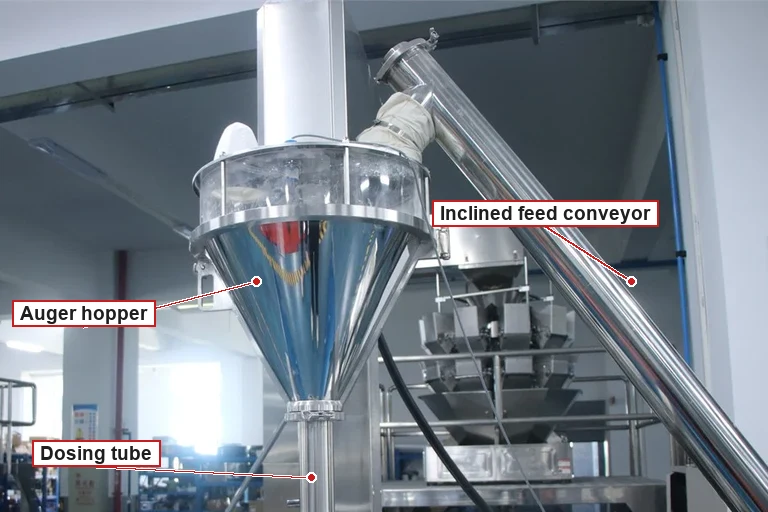
As the hopper runs down. The head pressure falls with the level, the flights fill less densely and the weight drifts down. Note whether the level stays in a narrow band or swings between nearly full and nearly empty. If a feeding conveyor refills the hopper, check that it tops up on time.
At the refill. Each top-up changes the depth above the screw again, and the fill changes with it. This is the weight drift after a refill. If weights hold while the level is low but lose control after a refill, suspect flooding instead. The next section covers it.
After a pause or restart. Weigh the first bags after a stop apart from the steady run; if only those are off, look at the restart routine.
A steady level is the fix. An inclined screw conveyor from a ground-level hopper can hold the filler hopper at a constant level. On a new machine, I’d consider a feeding conveyor. Without one, top up often. The machine in our Hungary milk powder case study has no feeding conveyor, so the hopper is topped up by hand. There, frequent top-ups keep the dose closer to its setting than a low hopper and a big refill. Make the refill routine part of the job: who tops up, when, and to what level.
Powder That Bridges, Ratholes or Floods Past the Screw
Some weight problems start before the powder reaches the screw.
- The level sensor reports product while the screw runs empty. The powder has probably bridged. Cohesive powder can bridge over the hopper throat or channel into a rathole. Either way the screw starves, giving light bags and scattered weights. Flow that pulses after a tap, or a slug that drops when the arch collapses, points to a bridge too.
- A few bags far heavier than the rest, or powder still running after the screw stops. These suggest very free-flowing or aerated powder is flooding past the screw. That causes large overfills. Another name for flooding is flushing.
- An agitator that stands still while the auger runs. An agitator in the hopper breaks up bridges over the screw. Check that it turns, and that it was chosen for this powder.
Flow aids need care. Vibrators, air pads and agitators are application-specific aids. None of them is a universal fix. Vibration can compact the powder, aeration can trigger flooding, and agitation changes density.
Chronic bridging is a design problem, and the feeder itself can create a bridge. Hopper and feeder should be designed around your powder’s flow behaviour. Check that your machine supplier chose the hopper, feeder and agitator for your powder. If a supplier offers a drip cut-off against flooding, ask for proof. It should be proven by trial on your powder, not asserted from the design.
The Auger Screw, the Tube and the Drive
Whether the screw still suits the powder
Start here if the problem began with a new product or target weight. A screw’s pitch and diameter are chosen for a powder’s particle size and a target fill weight. Another powder may need a different auger set-up. Clearance and speed matter too. In one published study, researchers looked at a single face powder on one auger filler. Casing clearance, screw pitch and filling speed all affected fill weight variation. They ran experiments on that machine to verify how those three factors changed weight variation. Their best settings belong to that powder and that machine.
Build-up and wear
With the machine stopped and locked out, look at the screw and the dosing tube for build-up, caked powder and wear. Plan time for it. Cleaning an auger filler is a heavy strip-down. The hopper lid, the screw and the agitator come out for a wet wash. Cohesive powder also packs into the tight drive clearances.
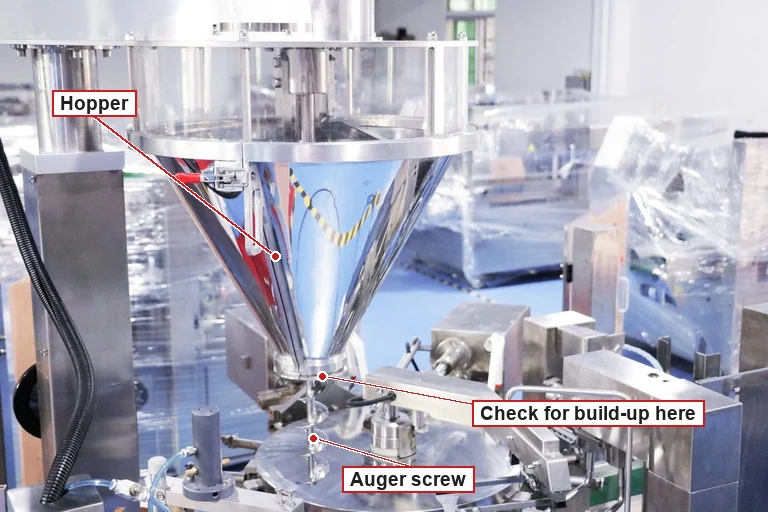
Build-up can also make the screw work harder. In a laboratory study of detergent powders, torque rose as build-up increased. The study used a semi-automatic auger filler. Build-up also tended to fall as the researchers increased the clearance. The abstract does not report the effect on fill weight, so read it as a reason to inspect, not a rule for your powder.
On many machines the auger screw counts as a wear part. If the problem grew as the screw aged, it may need cleaning or replacing. The machine supplier sets the limits (see the handover list).
What the drive controls
A servo holds the number of turns, but it cannot control how much powder each turn takes in. Bridging, a falling head level, unstable agitation and refill disturbance still move the dose. That holds even with a faultless servo. Tightening servo accuracy does not cure flooding either. Flooding is powder and air moving together, and position control does not reach that.
Who Fixes What
For each problem, the table at the top names who fixes it. That may be the operator, maintenance, the machine supplier or the powder supplier. Few fixes happen on the screen; your HMI manual lists what yours allows. A setting change that only holds for a while means the cause probably sits with someone else.
The checkweigher row depends on your checkweigher’s role. Above all, does it have feedback? One with feedback tracks the moving average of pack weights. It feeds a correction back to the filler. On an auger, it trims the screw revolutions. On uniform, free-flowing powder, that can cancel slow density drift. For bag-to-bag scatter, a correction based on the average is unlikely to narrow it, so fix the feed first.
What to Pass On
When the weights still won’t hold steady, call whoever the table names for your row, and bring your records.
Records to Bring
- Net weights of consecutive bags, in the order they came off, with the time of each
- Marks for every refill, stop and restart, and the hopper level where you could see it
- The target weight and a photo of the HMI settings, with what you changed and in what order
- The powder’s lot number, its bulk density if you have it, and a sample from the problem lot
- The scale you used and the result of the test-weight check
- The machine model, and whether a checkweigher on the line only rejects packs or feeds a correction back to the filler
- The screw specification and when the screw was last replaced (check your wear-parts list)
- When the problem appears: with a new lot, after a refill, at a shift change or in humid weather
Ask your machine supplier whether the screw still suits your powder and fill weight. Find out what wear limits apply to the screw and tube, too. Check with your powder supplier that each lot stays within spec for bulk density and moisture.
What Should You Agree on Your Next Auger Machine Before You Order?
Agree these five items before you order a collar-type auger powder packing machine. The same goes for a whole powder packing machine line. The five items apply whoever builds the auger filler machine. I wouldn’t compare quotes on a single accuracy figure.
- A trial on your powder. How your powder flows and its bulk density decide the auger screw size and the settings, so send a sample. On the SW-420E, we match the screw to your powder during the quotation phase. Its pitch and diameter follow the powder particle size and target fill weight. We also run a filling and sealing test on your powder at our Shantou factory before you commit to an order. We record a video of the result and share it with recommended machine settings.
- How you feed the hopper. A feeding conveyor or hand top-ups; see hopper level for what each does to the weights.
- What “accurate” means. Ask which product, fill weight and line speed produced any accuracy figure. Also ask whether your own powder will reproduce it in the acceptance test. Treat vendor figures as best-case numbers from lab conditions. Then judge the machine against the net-content rules of your market. Take the United States as an example. There, NIST Handbook 133 says the average net quantity of a lot must in general at least equal the label. Unreasonable shortages are not generally permitted, even when other packages in the lot are overfilled. So a wider spread means aiming further above the label and paying for the extra powder as give-away. These rules inspect packages and do not accept machines. There is also no public standard for judging a packaging machine’s fill accuracy at a factory acceptance test. Agree the method in writing. Our acceptance test guide suggests a few questions. How many bags were sampled, and were they taken at random or selected? Ask for the average, the number of packs outside tolerance and the single worst bag as well.
- A test that includes refills. Include the refill transition, where production failures cluster. Add a stop and restart, which needs its own check. A demo on prepared sample powder won’t show you a whole shift. On the SW-420E, our factory acceptance test means verifying auger dosing accuracy on your actual powder. It checks screw pitch performance and hopper flow stability across your bag sizes. See what has to be measured before anyone quotes a tolerance.
- The checkweigher’s job. Ask whether it will only reject packs outside the limits, or feed a correction back to the filler. The checkweigher notes above show what each kind can and cannot fix. On the SW-420E we can integrate a checkweigher for 100% weight verification with automatic rejection.
Write these five items into your enquiry and your acceptance criteria.
Frequently Asked Questions
How accurate should an auger filler be?
Don’t look for a single figure. Ask how close the average sits to target and how far bags differ, on your own powder and fill weight. Judge both against the net-content rules where you sell. Powder filling machine accuracy quoted without those conditions is a best case.
Can I fix fill weight variation by recalibrating the auger?
Only part of it. Recalibrating the auger count shifts every bag by the same amount. That corrects a moved average, as after a new powder lot, once the scale checks out and the spread is normal. When bag-to-bag scatter comes from the feed or the powder, recalibrating the count leaves it in place. Correcting after single bags can also overshoot, so trace the scatter to its source first.
Does a servo-driven auger fix accuracy problems?
It steadies the number of turns. What each turn picks up still depends on the hopper level, the agitation, the refills and the powder. Bridging and flooding move the weight as before.
How do I stop powder bridging in an auger hopper?
Start with the agitator: if it has stopped, it cannot break the bridge. Vibrators and air pads suit some powders and compact or aerate others. Bridging that keeps coming back points to the hopper and feeder design. Take that to the machine supplier.
- Powder Packaging Solutions
- SW-420E Collar-Type Auger Powder Packing Machine
- SW-L200 Powder Premade Pouch Packing Machine
- Multi-Head Weigher vs Auger Filler vs Volumetric Cup
- Packaging Machine Factory Acceptance Test Guide
- Hungary Milk Powder VFFS Case Study
- UK Powder Zipper Pouch Case Study
- Mexico Protein Powder Sachet Case Study
- Ireland Powder Blend Zipper Pouch Case Study
- VFFS Film Tracking Troubleshooting
- VFFS and Flow Wrapper Seal Problems
References and Sources
- The W. Edwards Deming Institute: The Funnel Experiment: why a process should not be changed before the possible causes of its variation have been studied
- NIST Handbook 133, Chapter 2: Test Procedures for Packages Labeled by Weight, Gravimetric Testing: subtracting each package’s own tare weight from its gross weight when the sample holds 12 or more packages; 2026 edition
- NIST Handbook 133, Checking the Net Contents of Packaged Goods, Chapter 1: the average requirement, unreasonable shortages, random sampling and the calibration of inspectors’ test equipment; 2026 edition, a US inspection procedure for packages and not a machine acceptance standard
- Singphu, Theerathammakorn and Teekasap (2020), Filling improvement of the face powder with auger filler machine to reduce the variability of the filling weight, Journal of Thonburi University (Science and Technology), Vol. 4 No. 1, pages 15 to 24: the factors behind fill weight variation for one face powder on one machine; linked to the authors’ upload on ResearchGate, with the full issue on the university’s site
- Hewitt, Smith and Ingram: Build-up of powders in auger fillers, EngD project abstract, University of Birmingham: build-up, torque and clearance in a laboratory study of detergent powders; an abstract only, with no publication year given (original PDF no longer online)
- USP General Chapter <616> Bulk Density of Powders, harmonized text: the graduated cylinder method for loose and tapped bulk density
Public-data note: ShengWei product pages, case studies and the reference pages above were checked on 4 and 5 November 2026. ShengWei machine details here come from our published product pages; they describe the machines as specified, not results measured at a customer’s plant. Apart from the published case studies linked above, this article does not report any customer’s fill weights, output or machine configuration. The two research sources cited each describe a single study on specific powders, and their results are not general settings.
Have the Screw Matched to Your Powder
Send us your powder details, a sample or its bulk density. Add your target fill weights, the bag type and width, the output you need, and whether a conveyor or hand top-ups will feed the hopper. We match the screw to your product before we reply with a machine recommendation and a quote. If you run a ShengWei auger machine, send us the handover list instead.
Email info@shengweimachine.com · or contact our engineering team

International Sales Manager · ShengWei Machine