
Quality
CE Certified
Source
Factory Direct · Guangdong
Customization
OEM · Voltage · Language
After-Sales
2-Year Warranty · Lifetime Remote Support
Start with how your product flows
For a liquid, settle the flow first, because the flow decides the pump. The SW-Y200 / Y250 / Y320 is the rotary filler for pre-formed pouches. Its dosing configuration is selected according to the liquid and filling requirement, and the standard configuration handles viscous products such as honey, syrup and jam. The SW-420F makes its bag from film, and its pump type is selected for your product. On the SW-420F, a thick sauce or a paste moves to a piston pump. The SW-2830A uses no pump: the liquid runs in from a hopper under its own flow. After that, what separates the three is how the pouch comes into being. The SW-Y200 series opens and fills pouches that arrive pre-formed. The SW-420F makes its bag from a roll of film while it fills. The SW-2830A forms long narrow bags from roll film around the liquid flowing in from its hopper. Each card opens that machine's own page, where the specifications, the filling options, the photos and the video live.
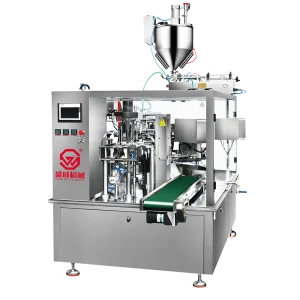
SW-Y200 / Y250 / Y320
Liquid & Paste Packing
Pre-formed pouches are opened, filled and sealed on a rotary carousel, for a product list that can stretch from vinegar or detergent to mayonnaise and tomato paste. Anti-drip nozzles fill each dose, and the dosing configuration is selected according to the liquid and filling requirement.
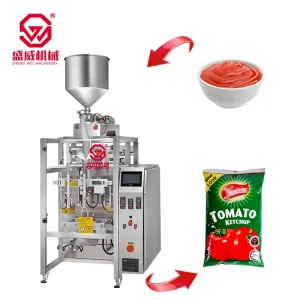
SW-420F
Liquid & Paste Pump
The bag starts as a roll of film, which costs less per bag than a bought-in pouch, and is formed and filled in one continuous motion, with the pump type selected for your product. Suited to one steady recipe such as soy sauce, vinegar or cooking oil; thick sauce gets a peristaltic or piston pump and a hopper agitator, and the very thickest pastes are discussed with us before quoting.
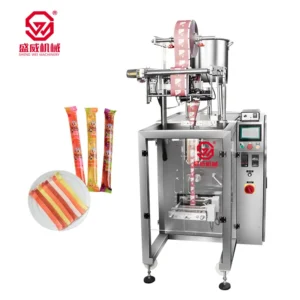
SW-2830A
Self-Flow Liquid Filler
No pump here: the liquid runs down from a hopper under its own flow, with the feed adjustable, into long narrow bags formed from roll film — the format for jelly, drinks and ice pops.
Three machines, three ways of getting the pouch
The three belong to three different families, because each one comes by its pouch in a different way. The rotary filler that opens pre-formed pouches sits in the Premade Bag Packing Machine family. The machine that shapes its bag from a roll of film and fills it on the way down sits in the Collar Type Packing Machine family. The machine that lets liquid run from a hopper into a tube of roll film and seals it into long narrow bags sits in the Full Automatic Vertical Packing Machine family. For every ShengWei model in one list, grouped by family, go up a level to Packing Machines.
Sauce and paste filling: where the piston pump comes in
A thick sauce or a paste is where the dosing set-up matters most. On the rotary filler for pre-formed pouches, the dosing configuration is selected according to the liquid and filling requirement, and the standard configuration handles viscous products such as honey, syrup and jam. On the machine that makes its bag from film, thick sauce goes to a peristaltic or piston pump, and a hopper agitator keeps it from settling or bridging during production. The third machine has no pump: it suits free-flowing liquids that run from its hopper, not thick pastes. For the very thickest pastes, send the product or its approximate viscosity first, so that the dosing set-up is confirmed on your material before the machine is quoted.
Soy Sauce, Cooking Oil, Sauces and Honey: Where to Look First
The pump decides the machine, not the product name. For four common liquids and pastes, where to look first and what to settle before a quote. Other vertical machines also run these products.
| Product | Typical pack | Machines to open first | Settle this first |
|---|---|---|---|
| Soy sauce, vinegar, cooking oil | Bags formed from roll film | SW-420F, pump type selected for your product | One steady recipe suits the film-formed machine. |
| Mayonnaise, tomato paste, thick sauce | Ready-made pouches | SW-Y200 / Y250 / Y320, dosing configuration selected for the product; thick sauce can also go to the SW-420F with a peristaltic or piston pump and a hopper agitator | For the thickest pastes, send the product or its approximate viscosity first. |
| Single-serve sauce sachets (ketchup, dressing) | 3-side or 4-side seal sachets | SW-A6, SW-C6 (six lanes, piston pump); SW-1528 (single lane) | These cover a limited range of sauces; confirm yours on a sample. |
| Honey, syrup, jam | Ready-made pouches; honey stick packs | Pouches: SW-Y200 series, whose standard configuration handles honey, syrup and jam. Stick packs: SW-C6 or SW-1528 with a piston pump, and a heated option for honey on the SW-C6, see 4 side seal pouch packing machines | Say at enquiry that the product is honey so the heated option is considered. |
If your pack or your product is not covered here
Some liquid packs are made on other machines. If the pouch has a spout and leaves the line with a screw cap on, filling and capping both happen on the Spout Pouch Filling and Capping Machine. A limited range of sauces can also be dosed into a forming tube by a piston pump on other machines under Full Automatic Vertical Packing Machine. If the product is not a liquid at all, powder has its own starting point in Powder Packaging Solutions: How to Match a Line to Your Powder, and a free-flowing granule is matched to a weigher, a cup or a pendulum head in Granule Packing Machines.
Still working out the dosing method or the seal?
This page points you to a machine; the method behind the choice lives elsewhere. If the open question is how to match a dosing method to the way your product behaves, from a thin liquid to a viscous paste, the step-by-step method is in How to Choose the Right Packaging Machine. If the worry is the seal, it is a fair one for liquids: product that lands on the seal surface can leave a fine leak channel even when the seal pulls strong, and the failure modes and the tests that catch each one are set out in Bag Sealing Methods Compared: Heat Seal, Impulse, Band & Ultrasonic.
Case studies
Argentina Case Study: From Hand Filling to an SW-Y200 Premade Pouch Machine for 200 ml Liquid Detergent
An Argentine start-up moved from hand filling to an SW-Y200 8-station premade pouch machine for 200 ml liquid detergent doypacks: quotes, pump, PI terms, status.
Read the case study →Frequently Asked Questions
Which of the three machines should I look at first?
Can one machine fill both a thin liquid and a thick paste?
Where are the specifications for each machine?
What do you need from me before you can recommend a machine?
Send the liquid, not just the pouch size.
Tell us what the product is, how thick it is, the fill volume per pouch and your daily output — or ship a sample so the pump can be checked on the real thing. Our engineers usually reply within one business day with a sized quote, a layout drawing and a sample-test plan. Standard lead time is 15–30 working days ex-works.
info@shengweimachine.com · +86 181 2511 2025 · Contact ShengWei