
Saudi Arabia Case Study: Two Doypack Lines for Retort Ready Meals
Quick Facts
| Country | Saudi Arabia |
| Product | Retort ready-to-eat rice with meat cubes, vegetables and sauce |
| Fill per pouch | About 250 g of rice plus 75 g of sauce, as stated by the buyer |
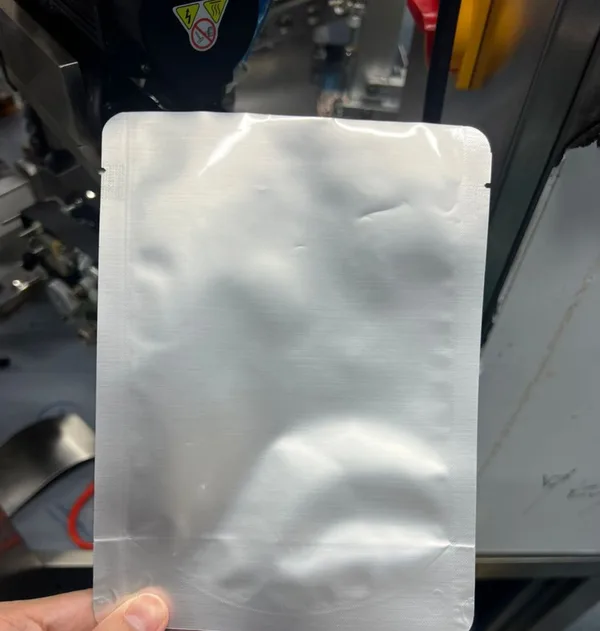
| Pouch | Premade doypack, some with a zipper and some without; width 100–250 mm, length 100–350 mm, as stated by the buyer |
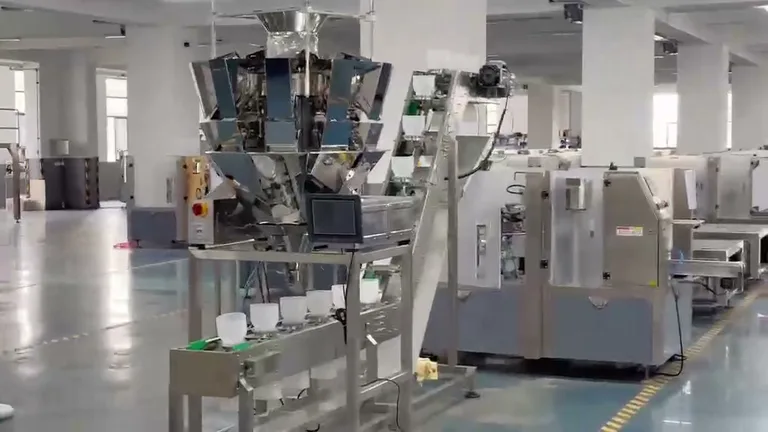
| Machines | Two lines, each with an 8-station SW-D250 premade pouch machine, a bowl conveyor, a 10-head weigher with platform and feeding conveyor, and a sauce filling pump |
| Power requested | 380 V, three-phase, 60 Hz |
| Lead time | 20–30 days after the deposit, as stated on the proforma invoice |
| Terms | EXW; 30% deposit, 70% balance before shipment |
| Status | Machines ready on 13 October 2026 |
The Customer
The buyer is a company in Saudi Arabia that is starting a new food factory for retort ready meals. It also runs its own pouch-making operation. We do not name the company here. The chat records used for this article begin on 31 August 2026.
What They Needed to Pack
The product was retort ready-to-eat rice with meat cubes, vegetables and a sauce. The buyer gave the fill as 250 g of rice plus 75 g of sauce per pouch. The pouches were premade doypacks, some with a zipper and some without, and the buyer said that most had a zipper. The buyer stated a width of 100–250 mm and a length of 100–350 mm. It also asked for 380 V, three-phase, 60 Hz power.
On 31 August 2026 the buyer said it would start with manual filling because of budget. It would add automatic filling later. It still wanted a sauce filler to put the sauce into the pouch before sealing. The next day it asked about a multihead weigher for the solids: rice, meat cubes and vegetables. It wrote that it did not want the weigher to fill directly into the pouch.
The sauce was the open point. On 31 August 2026 we asked to see the actual sauce before the order. On 1 September 2026 we told the buyer that a sauce carrying solid pieces can stick in a pump filler. The buyer replied that the sauce would depend on the meal and that it could soften the sauce with a blender.
What We Proposed and Why
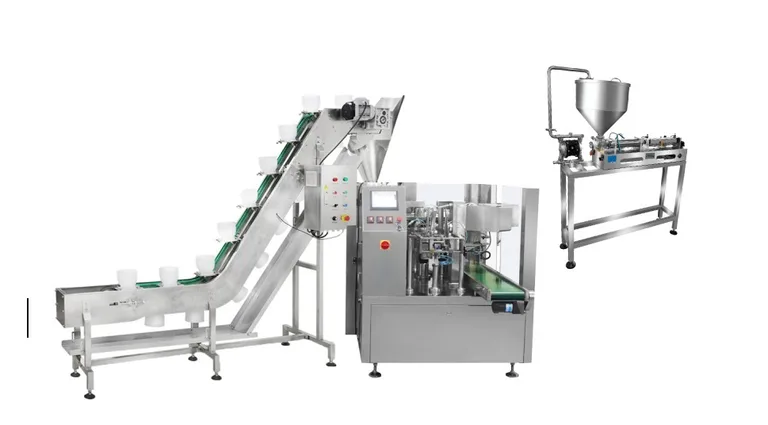
We proposed two lines of the same configuration. Each line has:
- An 8-station SW-D250 premade pouch packing machine
- A bowl conveyor between the weigher and the pouch machine
- A 10-head weigher with a platform and a feeding conveyor
- A sauce filling pump
Our first quotation was based on a smaller model for 80–200 mm pouches. After the buyer stated 100–250 mm, we moved up to the SW-D250.
The weigher discharges into the bowls of the conveyor. The bowls carry the product up to the pouch machine. That matched the buyer's wish not to fill from the weigher directly into the pouch. We quoted a 14-head and a 10-head weigher, and the buyer ordered the 10-head. The buyer asked whether the 14-head would be faster. Our answer in the project was that the line would not be much faster: the pouch machine waits for all the product to drop into the pouch before it moves to the next step, so a faster weigher alone does not raise the line output by much. This was our answer at the time, not a measured comparison.
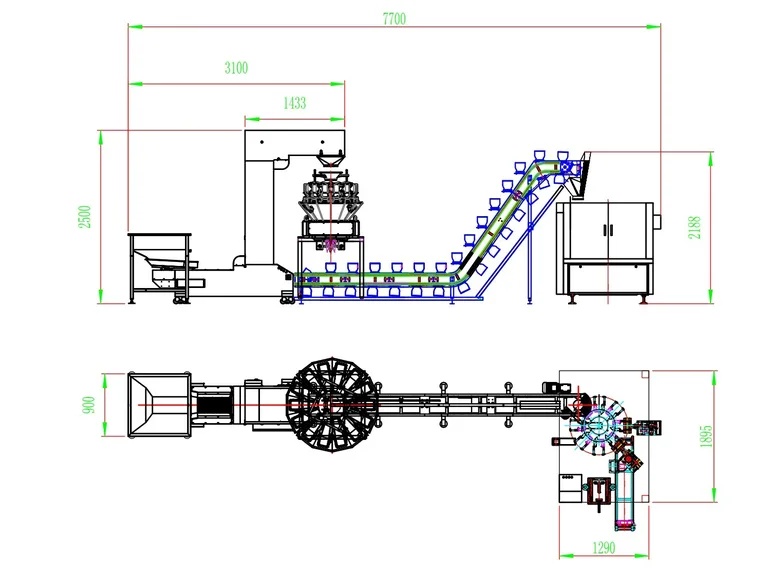
On 3 September 2026 we sent a layout drawing of the line and asked the buyer to confirm it would fit its workshop. The layout drawing shows an overall line footprint of about 7,700 mm by 1,895 mm. The buyer answered: "Drawing no problem."
How the SW-D250 Handles Retort Rice Meals and Sauce
Rice with meat cubes and vegetables arrives in pieces of uneven size, so no single weigh hopper lands exactly on the target. A combination weigher does not try to. Each head holds a partial portion, and the controller compares the possible combinations of heads (2n − 1 for n heads). It then releases the set whose total comes closest to the target weight.
The sauce is the harder of the two products. Every seed, flake or cube in a sauce has to pass the whole pump route: the valve, the cylinder inlet, the hose, each bend and the nozzle bore. Piston-type fillers are generally suited to thick sauces and pastes, while gear pumps are better kept for smooth liquids without particles. Whether a particular sauce passes cleanly depends on the size of its pieces against those openings, and only a trial with the real sauce settles it.
A retort pouch is a laminate, and it is the inner sealing layer that forms the seal. Sterilisation then loads that seal with heat, pressure and moisture, and a weak seal often shows itself only after the pouch has cooled. Whether a seal survives the retort therefore depends on the pouch material, and it has to be proven by running sealed pouches through the retort cycle. It is not a property of the sealing station alone.
How the Project Ran
On 1 September 2026 the buyer asked to see videos before ordering. We sent videos of the sauce filling and of a weigher, bowl conveyor and pouch machine set. We had no video of rice with meat and vegetables, and on 2 September 2026 we sent one of rice only. We also asked the buyer for sample pouches. It said it could not send samples, so we obtained retort pouches ourselves.
| 31 August 2026 | Chat records begin; quotation sent |
| 1 September 2026 | Videos sent; proforma invoice issued; buyer sends the deposit transfer receipt |
| 2 September 2026 | Deposit confirmed; production starts; rice-only video sent |
| 3 September 2026 | Layout drawing sent; buyer answers that the drawing is no problem |
| 13 October 2026 | Machines ready |
On the day of the order the buyer wrote to us: "We still need a lot of packing machines."
Production ran from 2 September 2026 to 13 October 2026, 41 calendar days. Our salesperson wrote on 13 October 2026 that two national holidays had fallen in the period.
Commercial Terms
| Scope | Two lines of the configuration above |
| Price basis | EXW; the buyer uses its own forwarder in China |
| Payment | 30% deposit by bank transfer; 70% balance before shipment |
| Lead time | 20–30 days after the deposit, as stated on the proforma invoice |
| Warranty | Two years on manufacturing defects. In-warranty replacement parts sent free of charge (wear parts excluded). Lifetime remote support |
Status
At the time of writing the machines are awaiting shipment. The buyer wrote that shipping would be discussed once the machines were ready. This article reports no delivery date, no running speed, no sauce filling result and no feedback from the buyer's factory.
What We Would Check First on a Similar Project
For a ready meal in premade pouches, I would settle four things before the order. First, the sauce: whether it carries solid pieces, because a sauce with solid pieces can stick in a pump filler. Second, the solids: whether the rice, meat and vegetables can be randomly mixed. In this project we advised that, if they could be randomly mixed, one weigher would be enough. Third, the pouch: the width and length range, and which pouches have a zipper. Fourth, the power supply: the voltage and frequency at the buyer's factory.
I would ask for the actual sauce before the order and run the filler on it at the factory. No sauce test is recorded for this order. If you would like to know how we run that test, our factory acceptance test guide sets it out. If you are still choosing between a weigher and another filler, our multihead weigher vs auger filler guide covers that decision.
Frequently Asked Questions
How long did production take?
Production started on 2 September 2026, when the deposit was confirmed. The machines were ready on 13 October 2026, 41 calendar days later. The proforma invoice stated 20–30 days after the deposit. Our salesperson wrote that two national holidays had fallen in the period.
What pouch sizes did the buyer specify?
The buyer stated pouches 100–250 mm wide and 100–350 mm long, some with a zipper and some without.
Why is there a bowl conveyor between the weigher and the pouch machine?
The buyer wrote that it did not want the weigher to fill directly into the pouch. The weigher discharges into the bowls of the conveyor. The bowls carry the product up to the pouch machine.
What did the buyer see before and after ordering?
The buyer saw reference demonstration videos, not the ordered machines. On 1 September 2026 we sent videos of the sauce filling and of a weigher, bowl conveyor and pouch machine set. We had no video of rice with meat and vegetables, and on 2 September 2026 we sent one of rice only. The records used for this article show no trial run of this order.
Send Us Your Product, Pouch Size and Power Supply
Tell us the product and the sauce, the fill weight per pouch, the pouch size range and the power supply at your factory. We will come back with the line that fits, the weigher and filler, the lead time and the payment terms for your order.
info@shengweimachine.com · or contact our engineering team directly

International Sales Manager · ShengWei Machine
Technical review: WeiHuang Wu, Chief Engineer