Auto Tidying Feed Flow Wrap Machine
SW-300B
Complete bar and block product packaging line with automatic sorting belt, six-servo tidying mechanism, and high-speed pillow pouch wrapping — integrated into one 9-metre stainless steel production line. The SW-300B replaces manual product sorting and line feeding with a motorised belt conveyor system that aligns bar-shaped items into single-file rows using servo-driven guide lanes, then feeds each piece into the wrapping zone at up to 1,200 bags per minute. Built for chocolate bars, shaqima snack bars, chicken stock cubes, nougat bars, and any regular bar or block product that needs fully automatic line feeding.

Quality
CE Certified
Source
Factory Direct · Guangdong
Customization
OEM · Voltage · Language
After-Sales
2-Year Warranty · Lifetime Remote Support
SW-300B: Full-Line Tidying Feeding & Pillow Wrapping System
The SW-300B is not a single wrapper — it is a complete automatic tidying feeding packaging line that combines product sorting, single-file alignment, high-speed pillow pouch wrapping, and finished bag discharge into one integrated 9-metre stainless steel platform. Bulk bar-shaped products — chocolate bars, shaqima, chicken stock cubes, nougat bars — are loaded into the hopper, automatically tidied into single-file rows by six Panasonic servo-driven belt sections, and delivered to the wrapping zone without manual intervention.
What sets this line apart is the distributed servo architecture: six independent Panasonic servo motors each control a belt section, allowing per-lane speed tuning for different product geometries. A fiber sensor at the handoff point detects product presence before sealing — if no product is detected, the line pauses automatically, bringing the empty-bag rate to near zero. Combined with Siemens PLC touch-screen control, photoelectric colour-mark registration, and recipe memory, the SW-300B is designed for factories that need sustained high-speed output with minimal operator involvement.
Packing Speed
1,200 bags / min max
Film Width
≤320 mm
Machine Weight
~3,500 kg
| Parameter | SW-300B |
|---|---|
| Machine Type | Automatic tidying feeding packaging line |
| Suitable Product Size (L×W×H) | 20–150 mm × 10–60 mm × 5–30 mm |
| Film Width | ≤320 mm |
| Film Roll Diameter | ≤φ320 mm |
| Packing Speed | 50–1,200 bags/min |
| Feeding System | Six-servo linear tidying belt with guide rails and lane separators |
| Control System | Siemens PLC + 10-inch colour touch screen · multi-language · recipe memory |
| Servo Motors | 6× Panasonic servo motors (tidying belt drive) |
| Empty-Bag Detection | Fiber sensor — line stops automatically if product is absent |
| Eye Mark Tracking | Photoelectric colour-mark sensor |
| Date Coding | Optional date coder |
| Construction | SUS304 stainless steel |
| Power | 9.5 kW |
| Voltage | 380V 50Hz (customisable) |
| Machine Dimensions (L×W×H) | 9,000 × 1,200 × 1,700 mm |
| Machine Weight | ~3,500 kg |
Note: actual packing speed depends on product shape, film material, and bag size. Custom tidying belt geometry available for non-standard product shapes — send your product sample for a confirmed compatibility assessment.
What the SW-300B Packages
The SW-300B tidying feeding line is designed for bar-shaped, block, and rectangular products that need to be sorted into single-file rows before wrapping. If your product has a consistent length and can be fed in a linear lane, this line handles it at high speed.
Chocolate & Candy Bars
Individual-portion chocolate bars, wafer sticks, moulded candy bars
- Feeding Mode
- Tidying belt separates bulk product into single file and feeds each bar into the wrapping zone
- Film
- OPP laminate / aluminium foil laminate
- Key Advantage
- Six-servo belt maintains precise spacing even at high throughput
- Buyer Type
- Chocolate factories and confectionery exporters
Shaqima & Snack Bars
Sorghum bars, cereal bars, puffed-rice bars, shaqima blocks
- Feeding Mode
- Linear tidying lane aligns rectangular bars directionally before wrapping
- Film
- OPP / CPP / PET laminate
- Key Advantage
- Consistent rectangular geometry is a perfect fit for linear lane alignment
- Buyer Type
- Snack and cereal bar manufacturers
Chicken Stock Cubes & Seasoning Blocks
Bouillon cubes, seasoning blocks, compressed-powder products
- Feeding Mode
- Belt sorting + fiber sensor detects every cube before sealing
- Film
- Aluminium foil laminate / printed OPP
- Key Advantage
- Fiber sensor eliminates empty pouches — critical for food ingredient packaging
- Buyer Type
- Seasoning and food ingredient factories
Mixed Bar Format Products
Any regular bar, stick, or block within the size range
- Feeding Mode
- Adjustable guide rails and lane separators configured to sample dimensions
- Typical Speed
- Case-by-case after sample test
- Film
- Confirmed by sample trial
- Key Advantage
- Recipe memory allows fast product changeover between SKUs
- Buyer Type
- Contract packaging plants and multi-product factories
For single-piece candy wrapping at a lower investment level, consider the SW-1000A candy turnplate wrapper. For round or disc-shaped products that need radial sorting, the SW-300A turntable feeding line is the better match.
Output Bag Type: Pillow Pouch from Rollstock Film
The SW-300B produces pillow pouches directly from rollstock film. Film is pulled from the mounted roll, formed around the product, sealed longitudinally along the back, then cut and sealed transversely at each end. The result is a compact, airtight single-piece pack — the standard format across the pillow pouch packing machine category.

Chocolate bar in pillow pouch

Shaqima snack bar in pillow pouch

Pillow Pouch (Standard Output)

Fin Seal / Back Seal Structure
Film materials: OPP, CPP, PET, laminated rollstock film, aluminium foil rollstock film, waxed paper, and single or double-layer heat-seal materials. The photoelectric color-mark sensor tracks printed registration marks on film for accurate seal alignment on every bag. Send your film sample and product for a seal quality test before ordering.
How the SW-300B Tidying Feeding Line Works — 4 Stages
The SW-300B completes the full packaging cycle automatically — from bulk product input to sealed bag output — without manual intervention at any step. The sequence below shows how product moves through each stage of the line.
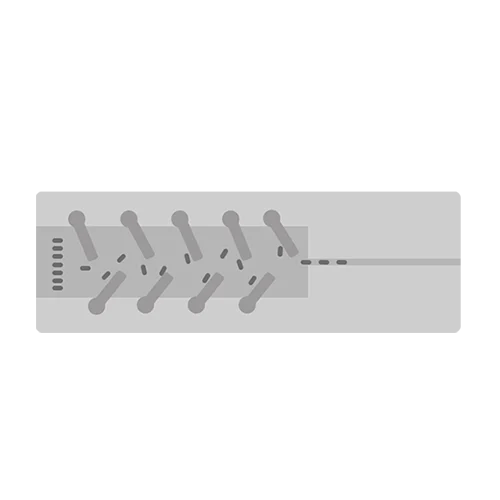
1. Servo Feeding

2. Roll Film Wrapping
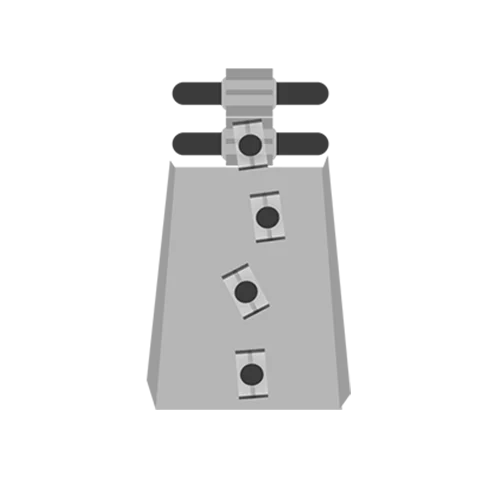
3. Cutter Sealing

4. Finished Product
01
Bulk Loading & Servo Belt Feeding
Bulk product is loaded into the hopper above the tidying belt. The motorised belt conveyor, driven by six Panasonic servo motors, carries individual items forward while guide rails and adjustable lane separators align them into a single-file row. Unlike a turntable, the linear belt is optimised for bar-shaped and block products that need directional alignment rather than radial separation. The fiber sensor at the belt entry monitors product presence continuously — if the belt runs empty, the line pauses automatically to prevent empty bags from reaching the sealer.
02
Film Feed, Forming & Longitudinal Sealing
Rollstock film is pulled from the film roll, guided through the tensioning rollers, and formed around each product by the forming collar. The longitudinal back seal is applied to close the film tube around the product. The photoelectric color-mark sensor reads registration marks on printed film to keep brand artwork and seal lines in the correct position on every bag. Film tension, forming speed, and seal temperature are set through the touch screen and stored in the recipe memory. The Siemens PLC manages the synchronisation between the tidying belt speed and the wrapping section speed — these two speeds are set as a ratio in the recipe, so changing product size or target speed is a single parameter adjustment.
03
Cross Sealing, Cutting & Date Coding
The transverse seal bars close the ends of each bag and the cutting knife separates it from the film tube. The seal jaw timing is managed by the servo drive, maintaining consistent seal width and bag length accuracy up to 1,200 bags per minute. An optional date coder can stamp production date codes on each bag before discharge.
04
Bag Discharge & Line Integration
Finished pillow pouches exit onto the discharge conveyor for collection or downstream integration with metal detectors, checkweighers, or cartoning systems. The SW-300B is designed to run as a standalone production line or integrate into a broader factory layout. For factories already running ShengWei wrapping equipment, the control logic and operator interface follow the same conventions across the pillow pouch packing machine range.
Gallery & Video
Five Core Systems That Make This a Complete Packaging Line
At 9 metres and 3,500 kg, the SW-300B is a production-grade packaging line, not a standalone wrapper. These five subsystems define how the line handles product from bulk hopper to sealed bag output. For factories that need a turntable rotary feeding approach instead of linear tidying, see the SW-300A turntable feeding line.
① Six-Servo Tidying Belt System
Six Panasonic servo motors drive the tidying belt independently, allowing individual lane speed control. Guide rails and adjustable separators align bulk product into a single file. The servo-per-lane design means each section of the belt can be tuned for different product sizes without changing mechanical parts.
② Fiber Sensor Empty-Bag Prevention
A fiber sensor monitors product presence at the handoff point between the tidying belt and the infeed conveyor. If no product is detected — gap in supply, jammed item, or hopper running low — the line pauses automatically before the empty film section reaches the sealer. This brings empty-bag rate to near zero.
③ Siemens PLC + Touch Screen Control
The Siemens PLC with 10-inch colour touch screen stores product recipes. Speed, temperature, film feed, belt ratio, and bag pitch are all set from this single panel. Multi-language display and a structured recipe system mean line operators can handle product changeover without engineering support.
④ Photoelectric Color-Mark Registration
The photoelectric sensor reads registration marks on printed film in real time, keeping brand artwork positioned correctly on every bag. At 1,200 bags per minute this registration precision is critical — the servo drive and color-mark loop work together to compensate for any film stretch or slip.
⑤ Optional Date Coder & Discharge Conveyor
The optional date coding unit prints production date, batch, or expiry information on each bag before discharge. The output conveyor delivers sealed bags for collection, counting, or downstream integration with metal detectors, checkweighers, or cartoning lines.

Verified Detail Photos from the Actual SW-300B
Close-up photos of the actual SW-300B showing the touch screen control panel, color-mark sensor, fiber sensor sealing zone, Panasonic servo motor array, film forming section, and end sealer output. These are real machine images taken in our factory — not generic stock graphics.
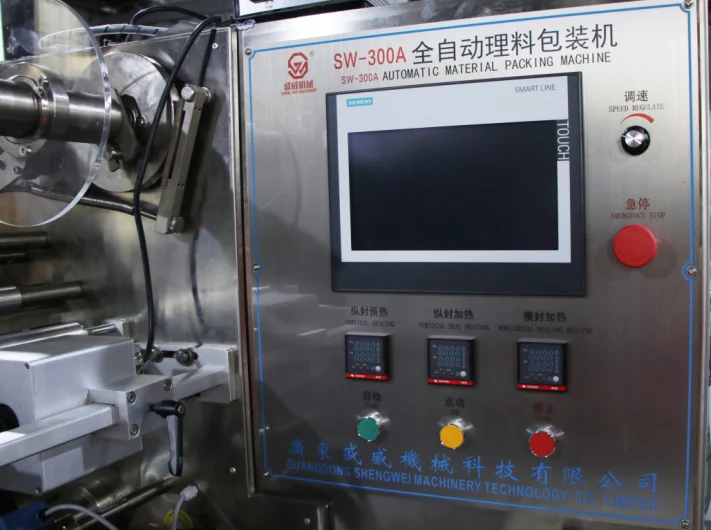
Siemens Touch Screen Control Panel
Siemens PLC paired with a 10-inch colour touch screen. Stores product recipes, supports multi-language display, and manages belt speed, seal temperature, film feed, and bag pitch from a single operator interface.
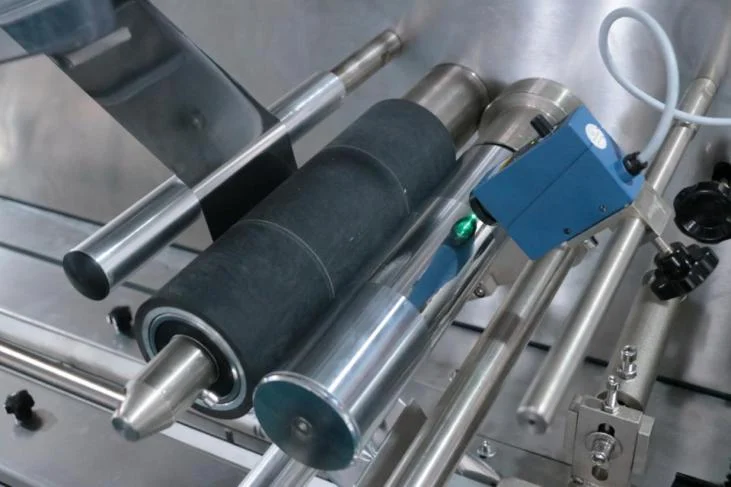
Photoelectric Color-Mark Sensor
Reads registration marks on printed film to keep brand artwork aligned with the seal position on every bag. Works in real time at full line speed, compensating for film stretch or slip through the servo feedback loop.
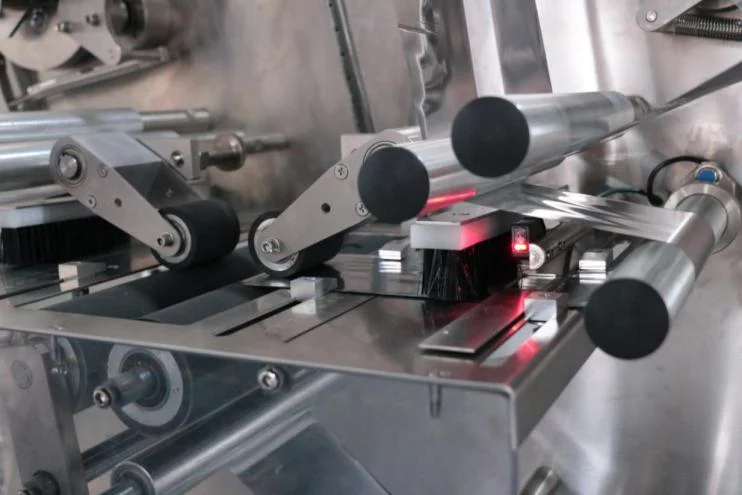
Sealing Zone & Fiber Sensor
The fiber sensor detects product presence before the cross seal station. If no product is present, the line pauses to prevent an empty pouch from being sealed and passing to the downstream line. This system brings the empty-bag rate to near zero — a critical requirement for stock cube and food ingredient producers.
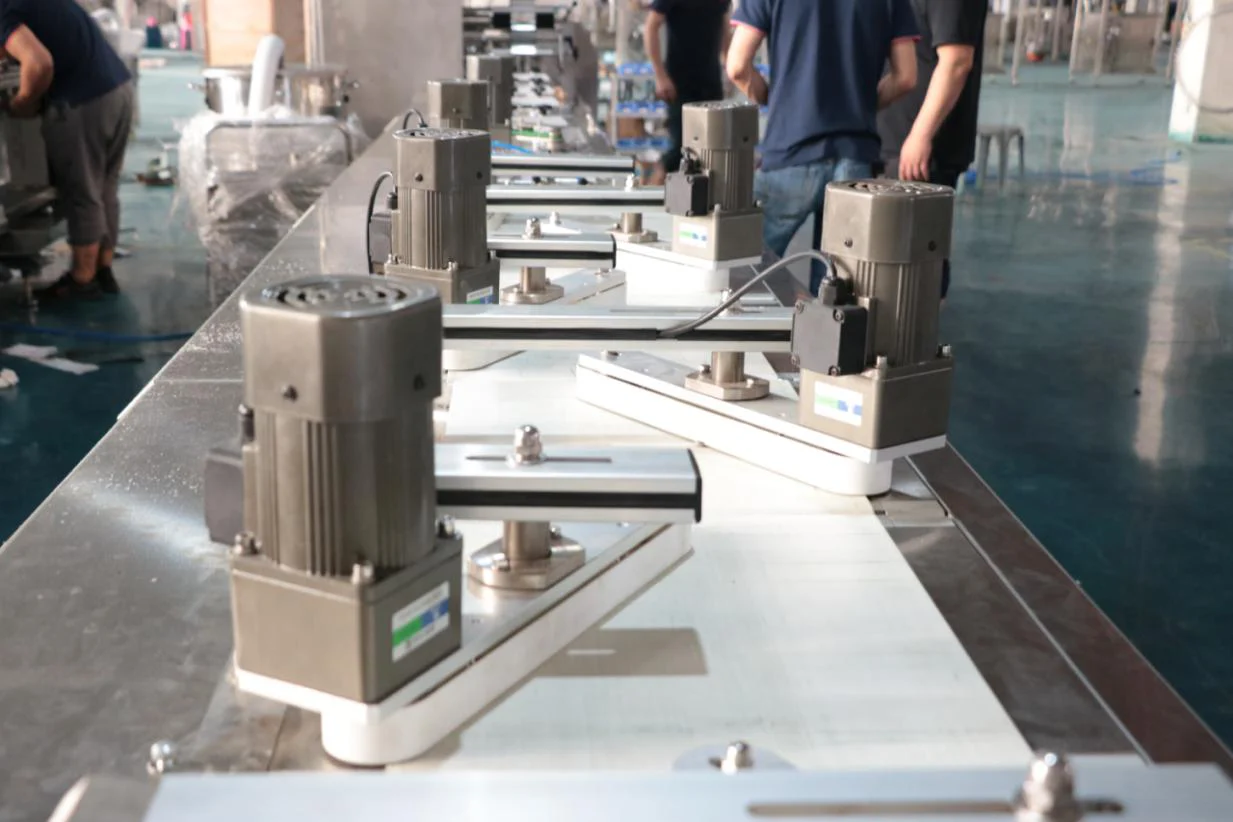
6× Panasonic Servo Motors
Six Panasonic servo motors drive the tidying belt independently. Each motor controls a belt section, allowing individual speed tuning per lane. This distributed servo architecture is what enables the SW-300B to achieve 1,200 bags per minute with stable, low-noise operation across the full belt length.
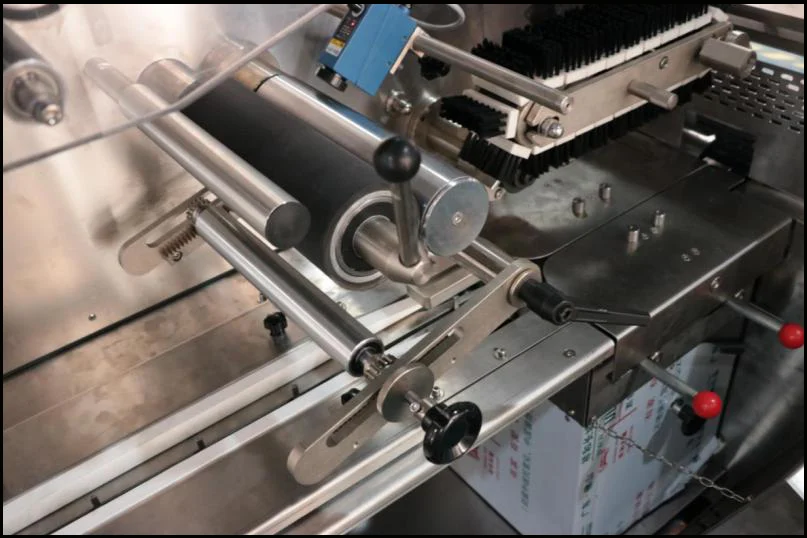
Film Forming & Tensioning Section
Precision film guide rollers maintain consistent tension as rollstock film is pulled from the roll, guided through the forming path, and wrapped around each product. Correct tension is critical at high speeds — loose film causes misregistration, over-tightened film causes tears.
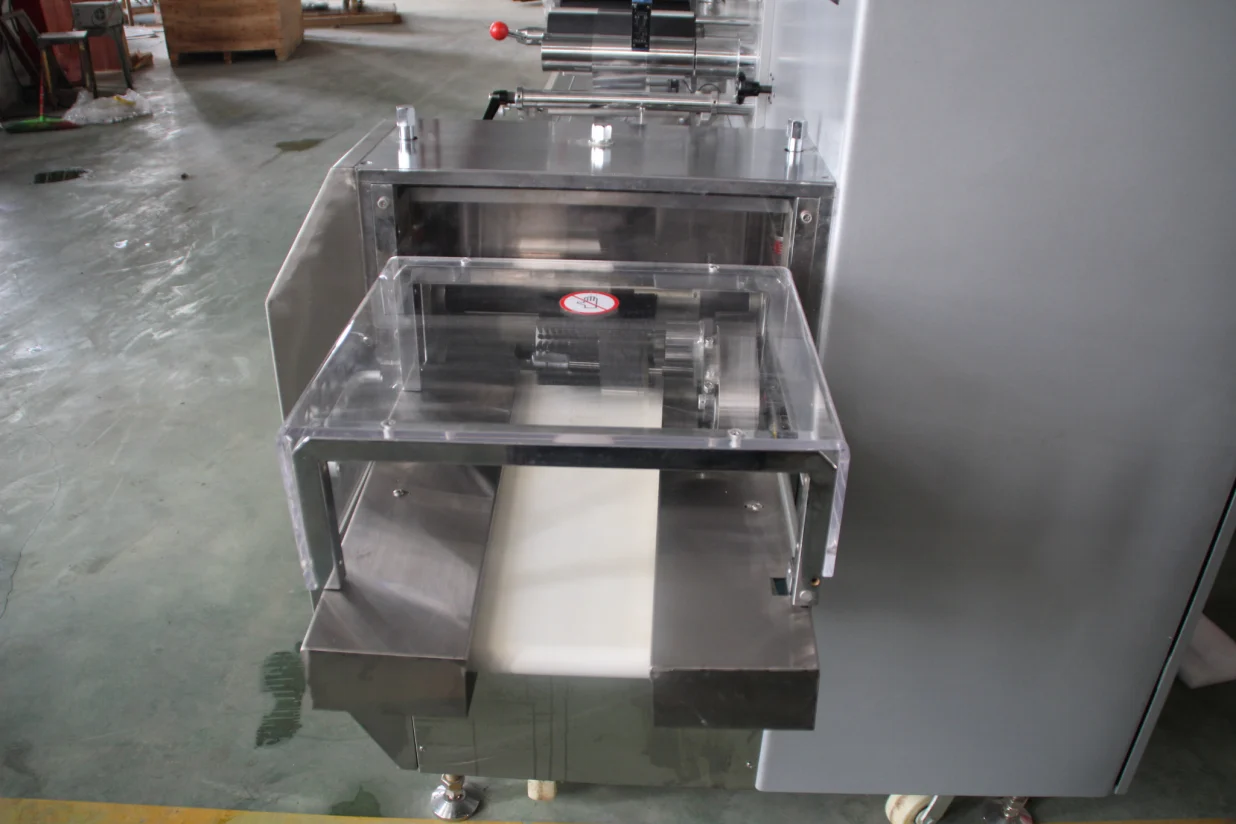
End Sealer & Bag Discharge
The cross seal station applies transverse seals to both ends of the pillow pouch and the cutting knife separates finished bags from the film tube. A transparent safety cover allows operators to observe the sealing action without stopping the line. Finished bags exit on the discharge conveyor.
SW-300B vs SW-300A — Tidying Line or Turntable Line?
Both are complete packaging lines (not standalone wrappers), but they use different product-feeding logic. The SW-300B uses a linear tidying belt optimised for bar-shaped and rectangular products. The SW-300A uses a rotary turntable optimised for round, disc, or compact products. The wrapping sections are similar — the key difference is how bulk product gets organised before entering the wrapper.
Choose SW-300B When:
- Products are bar-shaped, rectangular, or block format — chocolate bars, shaqima, stock cubes, biscuit sticks
- You need up to 1,200 bags/min — higher throughput than the turntable line
- Your line footprint allows for a 9-metre installation (~3,500 kg)
Consider SW-300A Instead When:
- Products are round, disc-shaped, or compact — candy drops, compressed towels, nougat cubes
- You prefer a turntable rotary feeder for radial product separation
- 50–800 bags/min meets your production target and a 6-metre footprint is preferred
When a Full Packaging Line Is Not What You Need
The SW-300B is for factories that need integrated tidying feeding, wrapping, and discharge in one line. If you already have a feeding system and just need a standalone wrapper, the SW-350A multifunctional wrapper or SW-350B film-beneath model may be a better fit at a lower investment. For liquid products, use a collar type liquid packing machine (SW-420F). For powder with auger dosing, use a collar type auger powder packing machine (SW-420E/620E). For granules with multihead weighing, use a collar type multihead weigher packing machine (SW-420A/620A). For premade stand-up pouches or zip-lock bags, see the premade bag packing machine family.
Why Choose ShengWei Machine for Tidying Feeding Line Projects
Complete Line Engineering, Not Just a Wrapper
ShengWei designs and manufactures complete packaging lines — from tidying belt to discharge — in one Guangdong factory. That matters on a line project like the SW-300B because the sorting belt, infeed conveyor, wrapper, and controls all need to work together. Buying feeding and wrapping from different suppliers creates integration risk. ShengWei builds and tests the entire 9-metre line as one system before shipping.
Custom Tidying Belt for Your Product
The tidying belt geometry — lane width, guide rail spacing, separator pitch, and brush type — is configured to your actual product sample before manufacturing. Send us a product sample and we provide a running test video before the line leaves the factory. This front-end engineering is what makes the automatic feeding reliable on the factory floor.
Factory-Direct Export with Remote Support
Direct factory communication through WhatsApp and video call for pre-sales engineering, commissioning support, and troubleshooting. For a production line that weighs 3,500 kg and runs at 1,200 bags/min, the quality of technical support during installation directly affects how fast the line reaches full production.
Stainless Steel 304 Construction
The entire line is built from SUS304 stainless steel. This is particularly important for chicken stock cube, seasoning, and food ingredient packaging where cleaning procedures and contamination prevention are part of daily operation. The line also carries CE certification for export compliance.
Tested Before Shipment — How We Prove the SW-300B
Two-Day Run Test on Your Product
Every SW-300B goes through a structured Factory Acceptance Test before it ships: a test run across two working days, with speed, seal quality, and rejection rate all logged — plus weight or fill accuracy when a dosing unit is fitted. For a pillow line that means tuning servo synchronisation and cutter phasing to your product dimensions (20–150 mm long, 10–60 mm wide, 5–30 mm high), checking fin- and end-seal quality on your film, verifying the tidying-and-feeding belts on your product at speed, and running acceptance at the speed and conditions agreed in the order (product, film, target weight, configuration). The catalog maximum for this model is 1,200 bags/min and is not an acceptance figure for every product. Free sample test run on your own product and film — we send you the test video, usually within 2 working days of receiving your samples.
Approve Before We Crate
Before crating, our QC team sends you the FAT report, a test video of your machine running, and photos for approval. If your order requires it, we coordinate SGS, Bureau Veritas, or TÜV pre-shipment inspection and provide full access to the machine and test records. See how the 4-person QC team works at our Factory & Quality Center.
Frequently Asked Questions
What types of products is the SW-300B designed for?
How does the tidying feeding system work differently from a turntable feeder?
What is the maximum packing speed of the SW-300B?
How does the fiber sensor prevent empty bags?
Why does the SW-300B use six servo motors instead of one?
What film materials can the SW-300B handle?
Can the SW-300B handle multiple product types or SKUs?
What are the main electrical component brands used in the SW-300B?
Can I send product samples for a test run?
What is the installation requirement for the SW-300B?
Expert Guides
Packaging Line vs Standalone Wrapper
Understand when a complete feeding + wrapping line like the SW-300B makes sense versus buying a standalone pillow pouch packing machine with separate manual or third-party feeding equipment.
View All Pillow Machines →SW-300A: Turntable Feeding Alternative
A direct comparison with the turntable rotary feeding approach — how product shape determines which feeding mechanism is the right choice for your factory.
Compare SW-300A →Seal Strength vs Seal Integrity
Why a strong-looking fin or end seal can still leak, which seal-integrity test finds what, and how the four sealing methods compare.
Read the Sealing Guide →How to Choose the Right Packaging Machine
A step-by-step buyer's path — product type, bag format, dosing, speed, and budget walked through in order.
Read the Choosing Guide →Other Automatic Feeding Machines
Different feeding systems and machine formats for packaged food products.
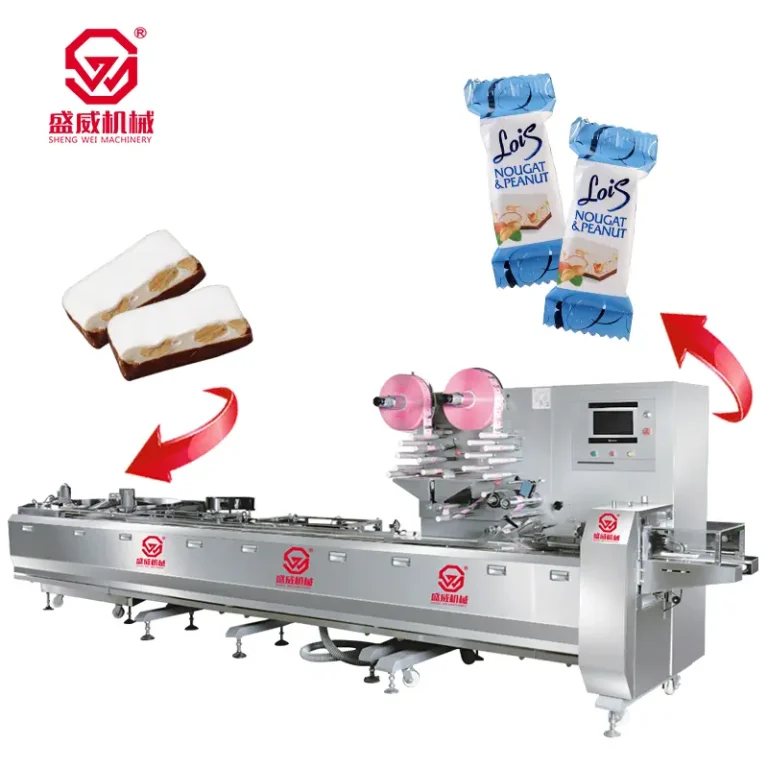
Turntable Feeding Packaging Line
Turntable feeding packaging line with rotary sorting. Different feeding method for same bar product types.
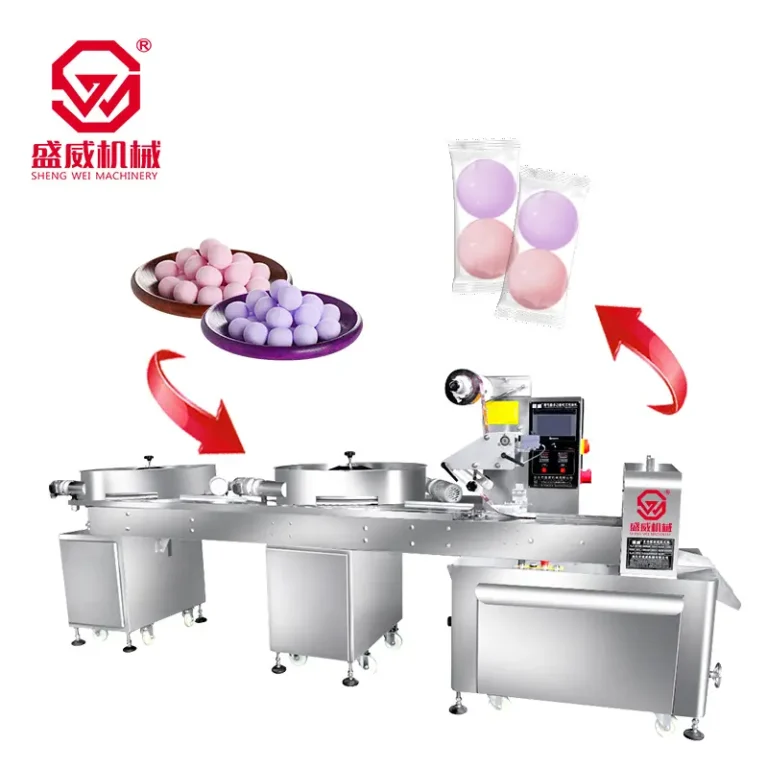
Double Material Feeding Pillow Machine
Double material feeding pillow machine. Handles two different products simultaneously on one packaging line.
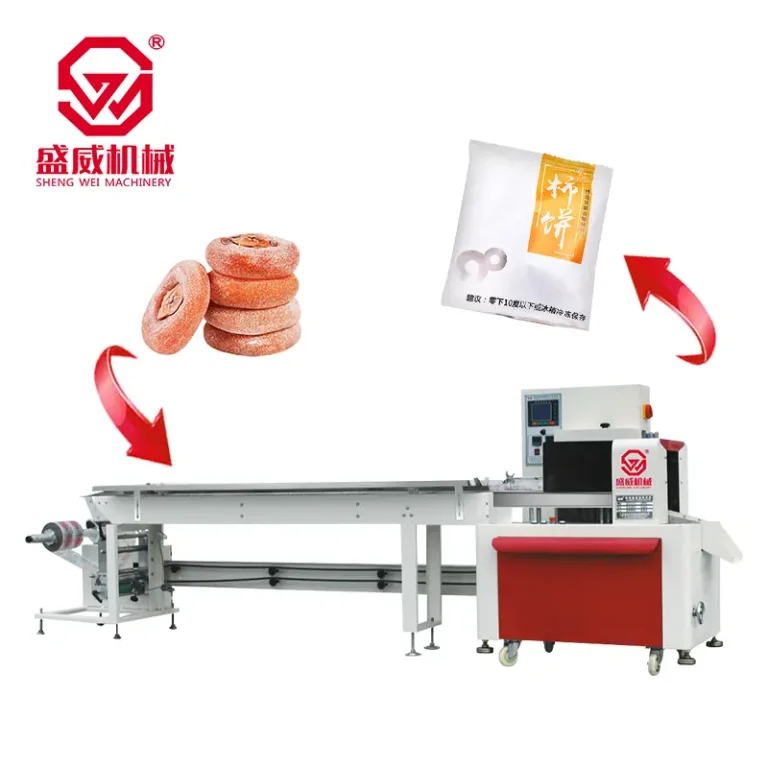
Film Back Feeding Pillow Machine
Film-back-feeding wrapper for fragile biscuits, cakes, and trayed products. Standalone wrapper at a lower investment than the SW-300B line.
Ready to Automate Your Bar Product Packaging?
Send us your product sample and target daily output. We will confirm compatibility, run a test on our SW-300B line, and send you a video before you commit to an order.
info@shengweimachine.com · +86 181 2511 2025

Usually replies within one business day · Helps packaging buyers across 80+ countries