
Linear Weigher vs Multihead Weigher: Which Fits Your Product, Bag Weight and Budget?
Perhaps you have two quotes: one for a 4-head linear weigher machine and one for a complete 10-head multihead weigher line. When you ask me which to choose, my first question is what your product looks like. Are the pieces even in size, or a mix of shapes? Does each bag hold 10–100 g or 100–1,000 g? From there, the choice becomes something you can test. How close does each weigher land to your target on your product, and what do the extra grams cost you?
What Is the Difference Between a Linear Weigher and a Multihead Weigher?
The table compares the two weighers point by point, with our SW-320C and SW-420A as the examples. Read how a dose is made up first, then the product, bag weight and floor space rows.
| Point | Linear weigher | Multihead weigher | What to check first |
|---|---|---|---|
| How a dose is made up | Product runs along feed lanes to the weighing heads, and each dose is weighed rather than measured by volume. | Each weigh bucket holds part of the target. The controller releases a combination of buckets whose total is close to the target. | How each quote names the weigher type. Head count alone does not tell you whether a weigher combines loads. |
| Heads on our machines | SW-320C: four weighing heads, fed by four feed lanes. | SW-420A: 10 weighing buckets, fed from a radial dispersion plate through vibration feeder troughs. | Compare head counts only between weighers that work the same way. On a combination weigher, more heads give more combinations to choose from. |
| Product it suits | Dry, free-flowing granules and small pieces. It suits product that is already even in size. | Dry, free-flowing granules. Our SW-420A page lists it for irregular or mixed-shape pieces, where uniform piece weight cannot be assumed. | Whether your pieces are even, or irregular and mixed. Dry and free-flowing is a starting condition for both. |
| Comparing bag weights | Measure it on your product at your smallest bag weight: how far each bag lands from the target, and the spread. | It chooses among part-loads in several buckets for a total close to the target. Measure it the same way. | The spread of single-bag weights on the same product. The smaller the spread, the closer the target can sit to the label weight. |
| Speed | SW-320C: rated 15–70 bags/min for the whole machine. | SW-420A: rated 30–70 bags/min for the whole machine. | These are whole-machine ratings, not head count times a per-head rate. Plan on the sustained speed measured on your product and film. |
| Footprint, height and infeed | SW-320C: 1,300 × 1,000 mm, 2,700 mm high, about 500 kg with the weigher. The weigher sits above the forming and sealing section. | SW-420A system: 4,700 × 2,000 mm, 3,800 mm high, about 1,300 kg. A Z-type bucket elevator lifts product from ground level. | Your floor area and ceiling height, and how product reaches the machine today. |
| What the complete machine includes | A vertical form-fill-seal machine with the 4-head linear weigher above its forming and sealing section. | Z-type bucket elevator, 10-head combination weigher, vertical form-fill-seal machine and output conveyor. A working platform with staircase gives access to the weigher; ask whether your quote includes it. | Every item in each quote, listed line by line, before you compare prices. |
| Our machine | SW-320C, for 10–100 g per bag. | SW-420A, for 100–1,000 g per bag. | Your bag weights. The two machines cover different bands. |
How each weigher makes up a dose is the main difference between them. Check the other rows against your own line.
How Does a Linear Weigher Fill Each Bag?
OIML R 61-1 covers automatic gravimetric filling instruments. It describes them as automatic feeding devices working with weighing modules, plus the control and discharge devices that deliver each fill. A load cell measures force and outputs it as an electrical signal.
On our SW-320C, product sits in four feed lanes on top of the weigher, and four weighing heads sit above the discharge funnel. Film runs over the forming collar into a tube, and the back seam is sealed lengthwise. The weigher then drops each weighed dose into the tube, and a cross seal closes the bag. It weighs each dose instead of measuring its volume.
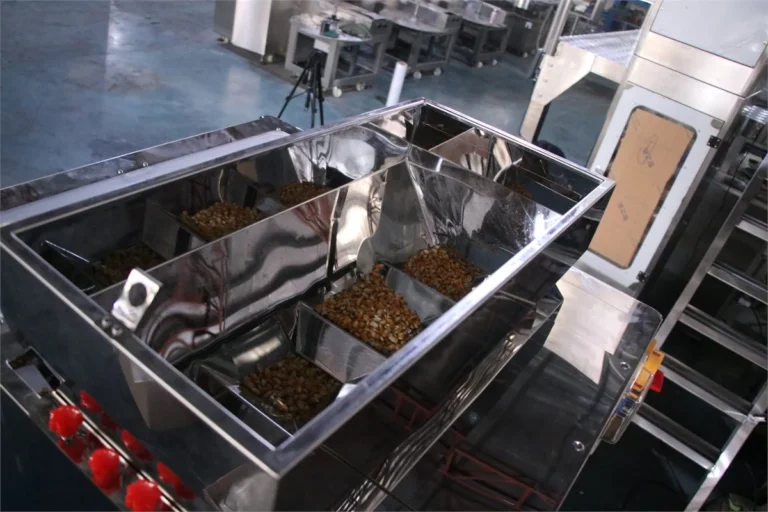
How closely it holds your weights is something to test on your own product. An accuracy figure only holds for the product, fill weight and line speed it was measured on. So send a sample, and ask for it to run at the smallest and the largest bag weight you plan to pack.
How Does a Multihead Weigher Work?
A multihead weigher, also called a combination weigher, spreads the product over several weigh buckets (weigh hoppers). On our SW-420A, a Z-type bucket elevator lifts product from ground level to the weigher platform. Vibration feeder troughs then carry it from a radial dispersion plate to 10 weighing buckets.
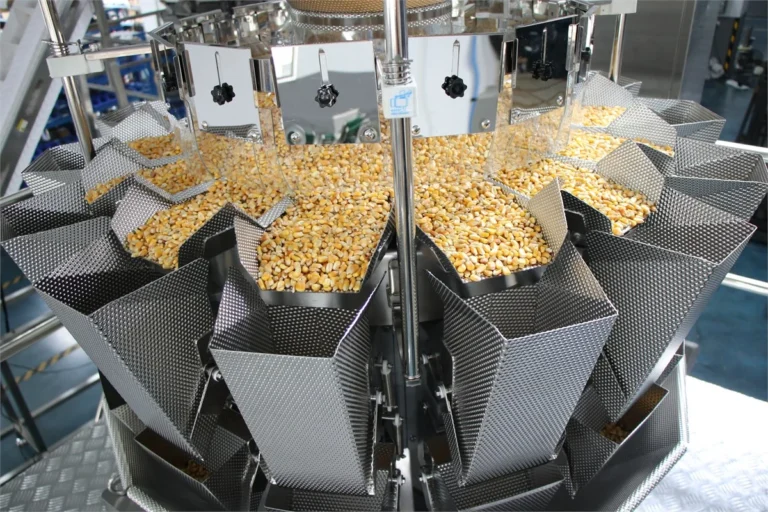
Each bucket holds only part of the target. Its setpoint is the amount it should hold on average each cycle, and the setpoints need not be identical. Each cycle, the controller opens a combination of buckets whose total is close to the target. On the SW-420A, the selected buckets then release together into the forming tube. OIML R 61-1 describes this kind of instrument as one that “computes an appropriate combination of the loads and combines them into one fill”.
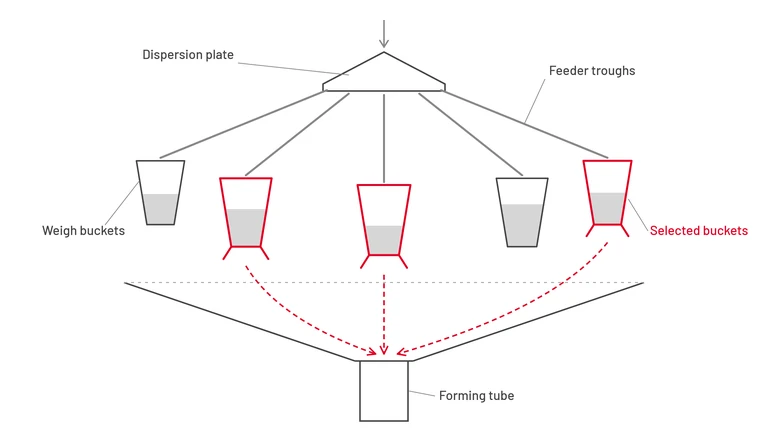
Why does splitting the dose help? With part-loads in 10 buckets, the controller has many combinations to choose from. As the head-count section of our dosing guide explains, the saving comes from having more sums to pick from. The guide also shows how the number of combinations grows with head count, and why extra heads eventually add less.
So when you compare multihead weighers, compare how close each lands to the target on your product and bag weight. Head count is only one input to that.
Does a Multihead Weigher Pack More Bags per Minute?
On our two machines, the top of the rated range is the same: 70 bags per minute. The 4-head SW-320C is rated 15–70 bags per minute. The 10-head SW-420A is rated 30–70 bags per minute, depending on product and fill weight. Both are ratings for the whole machine; neither is a per-head figure multiplied by the number of heads.
Where your product runs inside that range depends on the product and the fill weight. For the SW-320C, we list the product’s density, its piece size and your target fill weight. So plan your line around the speed measured on your own product and film. When you test, check speed as a sustained rate on each bag size, and don’t go by a short peak on the easiest one.
When Is a Linear Weigher Enough?
One condition applies to both weighers. Our SW-320C page lists dry, free-flowing granules and small pieces, and our SW-420A page lists dry, free-flowing granules. So dry and free-flowing is where both start; it doesn’t favour one over the other.
Where a linear weigher fits
- Weighing instead of measuring. Compared with measure cups, weighing suits product whose density varies, mixed product, and pieces that differ in shape. A fixed volume of these would not give a steady weight. A multihead weigher weighs too, so this point favours weighing in general.
- Even pieces. Compared with a multihead weigher, a linear weigher suits product that is already even in size.
- Small bags. Compared with our SW-420A, the SW-320C takes bags of 10–100 g, no wider than 150 mm.
- Tight floor space or height. The SW-320C, with its weigher above the forming and sealing section, takes 1,300 × 1,000 mm and stands 2,700 mm high. The SW-420A system, with its 10-head weigher on a platform fed by a Z-type bucket elevator, takes 4,700 × 2,000 mm and stands 3,800 mm high.
Where to test a linear weigher first
- Irregular or mixed pieces. Compared with a multihead weigher: our SW-420A page lists irregular or mixed-shape granules for it, such as trail mix, where uniform piece weight cannot be assumed.
- The smallest bag you plan to pack. Test at that weight before you rely on it.
- Sticky or oily product. The SW-320C is listed for dry, free-flowing product, so send a sample first.
- Packs sold by piece count. The SW-320C fills by weight, small hardware included. If each pack must hold an exact count, say so in your enquiry.
For reference, products we have run on the SW-320C include seeds, nuts, small candy, small hardware, sugar, salt and spice blends. Seeds and candy also appear on our SW-420A page, among irregular or mixed-shape granules. So the product name alone does not decide which weigher fits. For sticky and fragile product, see the product-physics section of our dosing guide.
If your product fits the first list, a linear weigher is worth a sample test on your own product.
When Do You Need a Multihead Weigher?
Where a multihead weigher fits
- Irregular or mixed pieces. Our SW-420A page lists irregular or mixed-shape granules, where uniform piece weight cannot be assumed: chips, mixed nuts, candy, pet food, trail mix and seeds. The weigher chooses among part-loads in several buckets.
- Costly product or high volumes. Each extra gram adds up, and give-away counts at full product value once the product is made.
- Packs sold by labelled weight. The tighter the spread, the closer the target can sit to the label, as explained below.
- Heavier bags. On our range, the SW-420A covers fills of 100–1,000 g in bags 80–200 mm wide.
Where to test a multihead weigher first
- Floor space and height. Our SW-420A system takes 4,700 × 2,000 mm, stands 3,800 mm high and weighs about 1,300 kg.
- Infeed and access. A Z-type bucket elevator lifts product from ground level. A working platform with staircase gives access to the weigher for cleaning and maintenance.
- Parts on the weigher. The SW-420A has a radial dispersion plate, vibration feeder troughs and 10 weighing buckets. The SW-320C has four feed lanes and four weighing heads.
- Feed stability. Ask how the feeders keep every bucket filling evenly.
- Mixes, static and fragile pieces. These need a trial on your own product, as explained below.
Why the label weight pushes the target up
Packs sold by weight are judged on averages. In the US, the average net quantity in a lot must at least equal the declared quantity. OIML R 87 and the EU’s Directive 76/211/EEC set the same average rule. R 87 also allows no more than 2.5% of packs to fall short by more than the tolerable deficiency, and none by more than twice it.
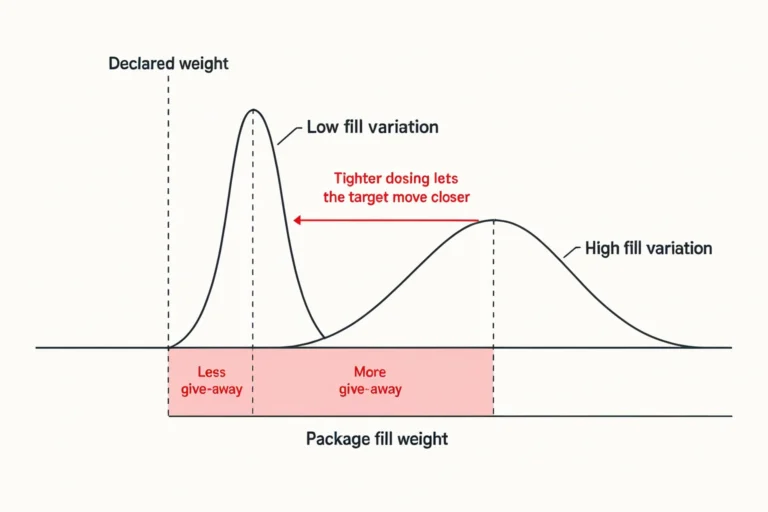
So a filler with a wide spread has to aim above the label. UK trading standards guidance says that when process variability exceeds 0.5 TNE, the tolerable negative error, the target quantity must exceed the declared quantity. Reducing variation lets the target move closer to the declared weight, and that is where a tighter weigher saves product. Our dosing guide works through the give-away economics. These rules judge the packs you sell, not the machine, so check the rules of your own market for the exact limits.
Mixes, static and fragile product
Research on stored grain bulks finds that mixture components differing in size, shape or density tend to segregate during handling. That research covers grain only. Even so, it is a reason to check the mix in each bag at your trial. Packaging lines also have several sources of static, including form-fill-seal steps, and static can make plastic film hang up at feed points. Those sources describe film and form-fill-seal steps; neither is about weigh buckets.
On the weigher itself, our dosing guide notes that dry or oily product can build a static charge and cling to the pans. It also counts uneven feed among the quietest causes of weight drift, which is why feed stability belongs in your questions to the supplier. Include fragile product in the same trial.
When the extra grams are cheap
For a cheap, stable product, work out the difference in yearly give-away cost between the two options before you decide. Compare any saving with the quoted price difference, the larger footprint, the extra height and the bucket elevator of a line like our SW-420A.
How Should You Compare the Cost of a Linear and a Multihead Weigher?
I won’t give prices here, or say which weigher costs less. That depends on what each quote includes. What you can do is put both quotes on the same basis.
Put a value on the give-away first
Give-away is the product you pack above the label weight. You may also see it called giveaway or overfill. A UK good-practice guide on waste minimisation lists giveaway as a form of waste. It also values losses after the product is made at full product value, rather than at raw-material cost. For each option, take the average grams above the label per acceptable bag, using the same product and labelled bag weight. Multiply by the value of your finished product per gram to get the cost per bag. Multiply by 1,000 for the cost per 1,000 acceptable bags, and by your annual bag count for a yearly figure.
Give-away exists because the average of a lot must at least equal the label. That’s why a filler with a wider spread has to aim higher, under the rules set out in the previous section. Set the difference between the two yearly figures against the price difference between the two quotes, and against the floor space, height, infeed and cleaning each line needs. Our dosing guide shows the arithmetic in its give-away and total-cost sections.
Put the cost items side by side
| Cost item | Linear weigher (SW-320C) | Multihead weigher (SW-420A) | How to compare |
|---|---|---|---|
| Weigher | 4-head linear weigher | 10-head combination weigher | Quote both on the same product and the same target weights. |
| Infeed and access | Tell us how product reaches the machine today. | Z-type bucket elevator from ground level; working platform with staircase for cleaning and maintenance access | Check that each quote lists every part of the line. |
| Floor space and height | 1,300 × 1,000 mm, 2,700 mm high, about 500 kg | 4,700 × 2,000 mm, 3,800 mm high, about 1,300 kg | Check your floor area and ceiling height before you compare prices. |
| Parts on the weigher | Four feed lanes and four weighing heads | Radial dispersion plate, vibration feeder troughs and 10 weighing buckets | Ask which parts come off for cleaning, and how long a clean takes. |
| Give-away | Measured on your product, at your bag weights | Measured the same way | Cost per 1,000 acceptable bags, at full product value |
Ask both suppliers to quote the same product and the same target weights, with the configuration written out. Include a sample test and the factory acceptance test in both. Then compare the difference in yearly give-away cost with the price difference, rather than the machine price alone.
Which ShengWei Machine Uses Each Weigher?
We build both. Our 4-head linear weigher packing machine, the SW-320C, covers 10–100 g per bag. Our multihead weigher packing machine, the SW-420A, covers 100–1,000 g. The figures below come from the two machine pages.
| Point | SW-320C | SW-420A | What to check |
|---|---|---|---|
| Weigher | 4-head linear weigher | 10-head combination weigher | How each quote names the weigher type |
| Fill weight | 10–100 g | 100–1,000 g | Which band your smallest and largest bags fall in |
| Rated speed (whole machine) | 15–70 bags/min | 30–70 bags/min | The sustained speed you need, measured on your product |
| Bag and film | Back-seal pillow bag, 80–200 mm long and 45–150 mm wide; film up to 320 mm | Back-seal pillow bag or gusset bag, 80–300 mm long and 80–200 mm wide; film up to 420 mm | Your finished bag size, confirmed with a filled sample |
| Infeed | Tell us how product reaches your line today | Z-type bucket elevator and vibration dispersion feeder | Where your product starts, and how it gets to the weigher |
| Footprint and weight | 1,300 × 1,000 × 2,700 mm (L × W × H), about 500 kg with the weigher | 4,700 × 2,000 × 3,800 mm (L × W × H), about 1,300 kg | Floor area and ceiling height |
| Products | Run on this machine: seeds, nuts, small candy, small hardware, sugar, salt and spice blends | Listed on the machine page: chips, mixed nuts, candy, pet food, trail mix and seeds | Whether your pieces are even, or irregular and mixed |
| Consider it when | Even pieces; fills of 10–100 g in bags 45–150 mm wide; output within 15–70 bags/min; tight floor space or height | Irregular or mixed pieces; fills of 100–1,000 g in bags 80–200 mm wide; room in your plant for the line | Confirm either choice with a sample test on your product |
Confirm the final bag size with a filled sample. The fill weight bands shown here belong to these two models, not to the two weigher types as a whole. For a line that must run several bag weights, first check that each quoted configuration covers the full list. For heavier fills, the SW-420A page also lists larger models. Both weighers appear in our weigher packing machine overview, next to the other ways we dose granules.
What Should You Check Before You Order a Weigher?
Before you buy a weighing machine for food packaging, make both suppliers answer on the same basis. These are the points I’d put in writing.
- Your conditions, in one list. Send the product: a sample or photos, the piece size, and whether pieces are sticky, fragile or uneven. Add every target weight with its acceptable variation, and the bags per minute and shifts you need. Then add how product reaches the machine today, and your floor space and ceiling height. The SW-420A line, for example, stands 3,800 mm high. Our SW-320C page has the full quote checklist.
- A sample test on your product. For the SW-320C, send a sample and a roll of your film to our factory in Shantou. We run them on the machine and send you the video of the run. Agree with us how fill weight and output will be checked using your product and film. Before shipment, the SW-320C goes through a factory acceptance test (FAT) that takes two working days.
- The raw record, not a summary. Ask for individual bag weights rather than an average, how many bags were sampled and how they were chosen, the rejects and the settings in use. With the individual weights, you can work out the average and the standard deviation yourself. Our FAT guide explains how to read these numbers.
- The conditions behind any accuracy figure. Ask which product, fill weight and line speed produced it, and whether it will be reproduced in the FAT on your own product. Check speed the same way, as a sustained rate on each bag size.
For a model of a careful weight record, look at how OIML R 61 tests these instruments. In R 61-2, each test fill is weighed individually, at fills near both the maximum and the minimum. The test then works out the average of all fills and each fill’s deviation from that average. These are type-evaluation and verification tests of the weighing instrument, not a factory acceptance test for a packing machine. R 61-1 governs the weigher’s accuracy class, specified for product, installation, fill mass and operating conditions; it is not a factory acceptance procedure.
So Which Should You Choose?
- If your pieces are already even and your bags are 10–100 g, start with a sample test on a linear weigher such as our SW-320C. Check that 15–70 bags per minute covers your output.
- If your pieces are irregular or mixed, or extra grams are worth real money, look at a multihead weigher. For bags of 100–1,000 g, that is our SW-420A.
- If you are starting out with one product and a tight budget, compare complete quotes for machines that cover your bag weights. A linear weigher is enough if it meets your weight-variation and sustained-output requirements. Otherwise, test a multihead weigher against those same requirements.
- If floor space or ceiling height is the limit, compare the two footprints first, using the complete-machine dimensions in the machine table above.
If neither fits
- Powder: an auger filler, as on our SW-420E series. Our dosing guide compares auger filling with weighing.
- Liquid: our SW-420F liquid machine.
- Uniform granules whose volume gives a steady weight: measure cups, as on our SW-320D. See how the SW-320C and SW-320D compare.
- Sticky or wet product: send a sample before we discuss a weigher.
Before you decide, confirm these five points
- Your product is a dry, free-flowing granule. Both our weigher machines are listed for that.
- You know which band your smallest and largest bag weights fall in: 10–100 g or 100–1,000 g.
- The sustained bags per minute you need sits inside the machine’s rated range.
- The machine fits your floor and your ceiling height: 2,700 mm or 3,800 mm high.
- The single-bag weights from your sample test are within the variation you can accept.
Frequently Asked Questions
What is a linear weigher?
A linear weigher feeds product along lanes to its weighing heads and weighs each dose instead of measuring its volume. Our SW-320C has four feed lanes on top of the weigher and four weighing heads above the discharge funnel. Compared with a multihead weigher, a linear weigher is simpler and smaller, and it suits product that is already even in size.
Is a multihead weigher more accurate than a linear weigher?
That depends on your product, so measure it rather than assume it. A multihead weigher picks a combination of part-loads whose total is close to the target. Test both at your bag weights and compare how far bags land from the target, and how much they vary. The average of a lot must at least equal the label, so a smaller spread lets you set the target closer to it.
Is a 4-head linear weigher a multihead weigher?
Not by head count alone. In OIML R 61, a selective combination weighing instrument has more than one weighing module and computes a combination of the loads to make one fill. Check how each quote describes the weigher type. On our machine pages, the SW-320C has a “4-head linear weigher” and the SW-420A a “10-head combination weigher”.
What is a multi-head weigher?
A multi-head weigher, or combination weigher, is an automatic filler that spreads product over several weigh buckets, each holding part of the target. Each cycle, its controller opens a combination of buckets so that the total in the bag is close to the target.
How much more does a multihead weigher cost than a linear weigher?
This article gives no prices, because the difference depends on what each quote includes. Compare the weigher itself, the Z-type elevator and working platform on our SW-420A line, and the floor space and height each line needs. Then work out the give-away per 1,000 acceptable bags on each line at full product value, for the same product and bag weight. Scale both figures to your yearly bag count, then set the difference between them against the price difference.
Do 10–100 g packs need a multihead weigher?
Not necessarily. It depends on the variation you can accept and what an extra gram is worth to you. On our range, 10–100 g bags go to the 4-head linear weigher on the SW-320C, and 100–1,000 g bags to the 10-head SW-420A. Test your product at your own bag weights before you decide.
Not Sure Which Weigher Fits? What to Send Us
If you’re not sure which weigher your product needs, send us these details.
Please Send
- Photos of your product, or a sample
- The piece size, and whether pieces are sticky, fragile or uneven in size
- Every target weight you plan to run, with the acceptable variation
- Bag length and width
- Target bags per minute
- How product reaches the machine in your plant today
- Your floor space and ceiling height
From there, we can suggest which weigher to test first. If the SW-320C is a candidate, we run your sample on it and send you the video before you order.
Related Guides
- Cup Filler vs Auger Filler vs Multi-Head Weigher
- The Head-Count Math: Why More Weigh Heads Cut Give-Away
- Give-Away Economics: Why Dosing Accuracy Is Money
- Product-Physics Edge Cases in Dosing
- Granule Packing Machines
- SW-320C 4-Head Linear Weigher Packing Machine
- SW-420A Multihead Weigher Packing Machine
- Reading FAT Numbers: What “Passed” Should Mean
- Visit the Factory Page
- More from the blog
References and Sources
- OIML R 61-1:2017, Automatic gravimetric filling instruments: definitions of an automatic gravimetric filling instrument (3.2.2) and of selective combination (3.2.2.1.1), and how accuracy classes are specified (4.2); the current edition
- OIML R 61-2:2017: how test fills are weighed one by one near the maximum and minimum fill, then averaged and compared; type-evaluation and verification tests, used here only as a model for a weight record
- HBM: The working principle of a compression load cell: what a load cell measures and outputs
- del Castillo, Beretta and Semeraro (2017), Optimal setup of a multihead weighing machine, European Journal of Operational Research 259(1): 384–393: how the machine opens a combination of hoppers each cycle, and how bucket setpoints work; cited from the abstract
- García-Jiménez, García-Díaz and Pulido-Rojano (2021), Mathematics 9(9): 1039: the aim of a total package weight close to the label weight; cited from the abstract
- NIST Office of Weights and Measures: Net Contents of Packaged Goods FAQs: the US average requirement and the Maximum Allowable Variation; page updated 24 August 2026
- OIML R 87:2016, Quantity of product in prepackages: the average requirement and the limits on short packs; rules for packs, not machines
- Council Directive 76/211/EEC, EUR-Lex consolidated text of 26 July 2019: the EU average requirement and the e-mark limit for prepackages; amended by Directives 78/891/EEC and 2007/45/EC and by Regulation (EU) 2019/1243
- Business Companion: Packaged goods, average quantity: UK trading standards guidance on the average system, including when the target must exceed the declared quantity; guidance rather than the regulations, reviewed July 2026
- Advantive: Optimizing product target weights of foods and beverages, by Steven Wachs: why less variation lets the target move closer to the declared weight; a software company’s blog
- Jian, Narendran and Jayas (2019), Journal of Stored Products Research 81: 11–21: segregation of grain mixtures during handling; research on stored grain, used only for the general tendency
- Smart Fog: Static elimination for manufacturing, a process-by-process guide (June 2026): sources of static on packaging lines, including form-fill-seal steps
- Keyence: Static eliminator applications, clogging issues: plastic film hanging up at feed points in packaging
- Good Practice Guide GG25, Saving money through waste minimisation: Raw Materials: giveaway as a form of waste, and valuing losses at full product value once the product is made; a UK guide, this copy hosted by Tangram
Public-data note: ShengWei machine pages and the reference pages above were checked on 4 and 5 November 2026. The machine figures are the ratings and ranges published on our machine pages, not results measured at a customer’s plant. This article gives no weighing-accuracy figures, because they depend on the product, fill weight and line speed. It does not report any customer’s bag dimensions, output or machine configuration. The net-content rules are summarised for their structure only; check the rules of the market you sell in.
Send Your Product Details
Send the details listed above, with photos or a sample of your product. We’ll tell you which weigher to test first and which ShengWei machine fits your bag weights.
Email info@shengweimachine.com · or contact our engineering team

International Sales Manager · ShengWei Machine